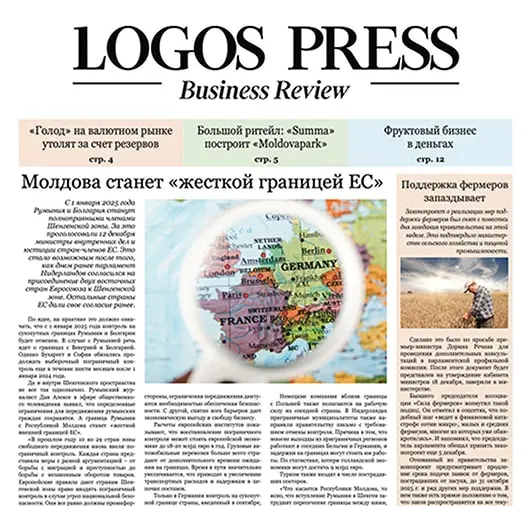
News about Agribusiness
As of the middle of this week, wholesale prices for watermelons at wholesale markets in Moldovan cities do not exceed 5–6 lei per kilogram. By contrast, at the end of last workweek, the price was 7–9 lei per kilogram.

He previously served as deputy director general of that agency. Alexandr Manciu began working at the National Agency for Food Safety (ANSA) in 2014 as a chief specialist in the Sanitary and Veterinary Inspection Department. Subsequently, his work was focused on the agency’s Animal Health and Welfare Department.

The staff of the National Agency for Food Safety (ANSA) gave a warm farewell to their former director general, Radu Musteață, who is now the head of the Ministry of Agriculture and the Food Industry (MAIA). Judging by the group selfies on Facebook, the new minister also holds warm feelings for his former colleagues and is grateful to them.

Moldova’s experience with subsurface (in-soil) irrigation—which is unique even among many EU countries—is being implemented in Uzbekistan’s agricultural sector.

“It all started with apple shipments—and that’s how it will continue. Dried fruit shipments will be added.” This was the central theme of the speech by Iurie Fala, executive director of the “Moldova Fruct” Association, at the Moldovan-Indian business forum held in Chisinau.

The American agribusiness company Archer-Daniels-Midland (ADM) has announced the appointment of Jeff Rowe, former CEO of Syngenta Group, as Chief Operating Officer. He will assume his duties on August 17 and will oversee the company’s commercial operations, manufacturing, and research and development.

The water level in the Danube within Romania has dropped to its lowest level since 1996. Due to the river’s low water levels, authorities have restricted the use of water for irrigation, and navigation has been partially suspended on certain sections of the river.

Prime Minister Vasile Tofan believes that the future Minister of Agriculture, Radu Mustață, will face the most challenging term during his tenure as prime minister.

During the last ten days of July, a clear upward trend in the purchase price of rapeseed for export emerged on the Moldovan market. While just yesterday the “working price” for rapeseed demanded by major traders was around 10 lei/kg, today it has risen to 10.1–10.2 lei/kg. There are several factors driving this growth, the most important of which are the currently limited domestic supply and high external demand. As a result, competition has intensified.

The name of the “Tofan government’s” program—“European Economy, Effective State”—clearly indicates its top priority: restructuring the economy and public administration institutions to meet the needs of European integration.

In June 2026, Moldova imported nearly 1,300 metric tons of sunflower oil worth 36.7 million lei. The main suppliers were Ukraine, Russia, and Romania. The main buyers were large companies. These figures are included in a review of sunflower oil imports into the Moldovan market by Yuri Rizi, an expert in agromarketing.

Ukraine is returning to a government structure in which the agri-food sector of the economy will be coordinated by a single specialized ministry—the Ministry of Agrarian Policy and Food. The ministry is headed by Taras Vysotsky, one of the youngest and, at the same time, most widely recognized experts in Ukraine’s agricultural sector.

Over the past workweek, the Agency for Agricultural Interventions and Payments (AIPA) authorized nearly 10 million lei in payments to farmers from the national budget fund.

In recent days, the organization has received a number of reports from farmers regarding issues such as a growing diesel fuel shortage and a widening gap between retail prices at gas stations and wholesale prices.

In July, the price of barley in Moldova ranged from 2.9 to 3 lei per kilogram. This is despite the fact that market operators note an unusually early start to the 2026/27 marketing season and a relatively low starting price for the first export shipment of Moldovan barley at the end of June—3.19 lei/kg (last year’s starting price was 3.40 lei/kg).

This spring, the government approved the Regulations on the Procedure for Developing a Project and a Planting Plan for Fruit Trees, Berry Shrubs, and Strawberries. However, these regulations are merely advisory in nature.

Ukraine’s “NIBULON” has signed a long-term contract with the Romanian company TTS (Transport Trade Services) SA, one of Europe’s largest river logistics operators, to provide international transportation services on the Danube. This was reported by the company’s press office.

After analyzing the commodity structure of Moldova’s exports and imports for January through March of this year, economist Vladimir Golovatiuc reached conclusions that were “disappointing, to say the least.”

Last month, Moldova exported 151,500 metric tons of grain crops worth 620.3 million lei. Compared to the previous month, Moldovan grain exports fell by 13.9% in volume and 11.4% in value, which is typical for the final month of the marketing season.

Russia is imposing a ban on imports of stone fruits from five Turkish companies. The restrictions apply to apricots, cherries, sweet cherries, peaches, and nectarines. The Federal Service for Veterinary and Phytosanitary Surveillance (Rosselkhoznadzor) explained the decision by citing the regular detection of quarantine pests in these products.