News about Romania
Restrictions on commercial shipping in the Sea of Azov and the Kerch Strait as early as last Friday triggered a 10-euro-per-metric-ton increase in food wheat prices on the Paris Matif (Euronext) exchange. This week began with a significant rise in prices in major European grain-exporting countries, including Romania.

During Monday’s consultations with President Nicușor Dan, the Romanian Social Democrats proposed abandoning efforts to form a new government and instead considering the option of dissolving Parliament and holding early legislative elections.

According to the National Institute of Hydrology and Water Resources Management (INHGA), over the next week, the flow rate of the Danube at the Baziash section will drop to 1,850 cubic meters per second, which is significantly below the long-term annual average for July (4,700 cubic meters per second).

This was the reaction of Dumitru Roibu, chairman of the “Alliance of Moldovans” political party, to the statements made by Romanian MEP Luis Lazarus during a plenary session of the European Parliament.

A 30-day nationwide quarantine is being imposed throughout Romania. During this period, all movement of sheep and goats within the country is suspended, with the exception of authorized transport to slaughterhouses. Grazing is also being restricted to prevent contact between herds within the same pasture. Police at all levels are stepping up enforcement.

SANITAS, the Federation of Romanian Medical Workers’ Unions, which represents 100,000 healthcare workers, has called for a two-hour warning strike on July 20 and a general strike on July 28 that will affect all healthcare facilities in the country.

Romania has approached Ukraine with a proposal to change the operating algorithm for maritime drones. Bucharest is also in talks to strengthen its air defense system following a recent drone incident.

Otokar, a Turkish manufacturer of land systems, has taken an important step toward expanding its presence in Europe by acquiring the Romanian company Automecanica S.A. This investment will establish Otokar’s first production facility in the European Union and support local production of COBRA II 4×4 tactical wheeled light armored vehicles for the Romanian Ministry of National Defense and, potentially, for the Moldovan Armed Forces.

The Council of Europe’s Committee of Experts on the Evaluation of Anti-Money Laundering Measures and the Financing of Terrorism (MONEYVAL) noted Romania’s progress in complying with international standards on combating money laundering, the financing of terrorism, and the proliferation of weapons of mass destruction. However, the country will remain under the organization’s enhanced monitoring.

Romania became the largest recipient of the latest tranche of funding from the European Union’s Modernization Fund, receiving 636.9 million euros for investments in the energy sector out of a total of 2.5 billion euros, allocated to 11 EU member states.

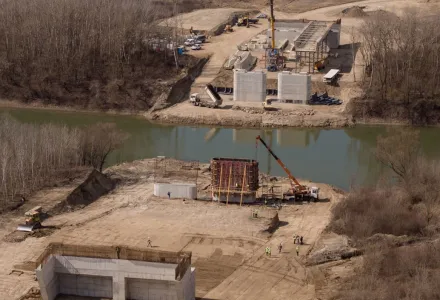
The Moldovan government has approved the signing of an agreement between Moldova and Romania on the development of strategically important transportation infrastructure.
Romania has increased its natural gas supplies to Moldova by 50% compared to last year, raising them from 2 million m³ to 3 million m³ per day.

A report by the European Environment Agency (EEA) titled “Overheated and Underprepared” states that approximately one in ten EU residents has difficulty accessing sufficient quantities of safe and clean water. The problem is most acute in Cyprus (36.5%) and Greece (31.5%). The situation is only slightly better in Bulgaria (27%), Romania (21%), and Hungary (20%).

Romanian labor inspectors will check whether employers are complying with protective measures on days with extreme temperatures, and if violations are found, they will impose the penalties provided for by law.

500 million Romanian lei (nearly 2 billion Moldovan lei) have been allocated for the electrification of the railway between Iași and the border with the Republic of Moldova. Half of the project will be financed by European funds (under the Connecting Europe Facility program), and the remainder will be covered by Romania’s national budget.

Three Romanian parties—the National Liberal Party (PNL), the “Save Romania” Union (USR), and the Democratic Union of Hungarians in Romania (UDMR)—have officially nominated MEP Siegfried Mureșan for the post of prime minister.

The Social Democratic Party of Romania (PSD), the largest political force in the country’s parliament, has nominated its leader, Sorin Grindeanu, for the position of prime minister.

A legislative initiative to unite Romania with the Republic of Moldova, introduced by lawmakers from the S.O.S. România party, was tacitly approved on Wednesday, June 24, by the Chamber of Deputies of the Romanian Parliament and sent to the Senate, which is the decision-making body in this case.

On Monday, the Romanian parliament rejected Prime Minister Adrian Vestea’s nomination, prolonging months of political instability in the country and increasing the likelihood of early elections if the government’s second candidate also fails to win the support of lawmakers.

The Romanian company Delgaz Grid, an operator of electricity and natural gas distribution networks, has secured a syndicated refinancing facility worth 3 billion Romanian lei (approximately €573 million). The funds will be used to increase the company’s financial flexibility and support its energy infrastructure modernization program.