News about innovations
Artificial intelligence could enable developing countries to achieve results equivalent to a century of development in just a decade, if they take swift action to address gaps in energy, communications, and skills, according to a World Bank report released on Tuesday.

Companies in the fashion and beauty industries are actively implementing artificial intelligence tools; however, investment in staff training has so far lagged significantly behind the pace of digital transformation. This creates a gap between the adoption of new technologies and employees’ readiness to use them effectively in practice. This is evidenced by the results of a BoF Careers survey conducted among nearly 3,000 professionals from 98 countries.

According to the Global Innovation Index 2025 report, compiled by the World Intellectual Property Organization (WIPO), the Republic of Moldova ranked 74th, placing between Kuwait and the Seychelles.

The National Center for Seed Research and Production will serve as a facility for testing European industrial hemp varieties and providing scientific support for their production to meet the needs of the industry in the Republic of Moldova. This was announced by the center’s director, Anatolie Spivachenko, during a seminar on adapting agriculture to climate change.

The Ministry of Education and Research has begun equipping 108 schools with modern equipment for teaching science, technology, and robotics. The cost of the supplies is approximately 4.8 million lei, and funding is provided through the EQIP project with support from the World Bank and the Global Partnership for Education.

xAI announced that the Grok 4.5 model, as part of the Capy research agent, helped find a counterexample to one of the well-known conjectures in graph theory—the Graffiti Conjecture 284. According to Elon Musk, the solution was found in a matter of minutes, though it has yet to be evaluated by the mathematical community.

Moldova’s experience with subsurface (in-soil) irrigation—which is unique even among many EU countries—is being implemented in Uzbekistan’s agricultural sector.

NVIDIA CEO Jensen Huang’s black leather jacket was sold at a Sotheby’s charity auction in New York for $960,000. The price was nearly 16 times the auction house’s preliminary estimate of $40,000–$60,000.

A Romanian startup has created a car that doesn’t need fuel—it runs on compressed air.

Shares of major software developers fell following reports that Starbucks is developing its own artificial intelligence-based solutions that could replace some of the products from third-party vendors.

Electric vehicle batteries last significantly longer than expected just a few years ago. New data shows that battery life is becoming one of the key factors reshaping perceptions of electric vehicle ownership.

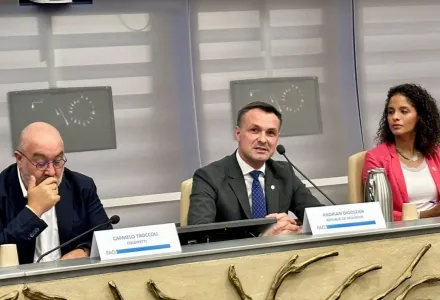
Technical talks between Adrian Digolean, State Secretary of the Ministry of Agriculture, Forestry, and Food (MAIA), and Viorel Guts, Deputy Director-General and Regional Representative of the UN (FAO) Viorel Gutsa took place as part of the Global Conference on Smart Agriculture, held July 1–3 at FAO headquarters in Rome.
Neuralink announced the first use, as part of clinical trials, of a method for implanting electrode threads through the intact dura mater.

After Apple raised prices on Macs, iPads, and a number of accessories by 15–25%, analysts at Morgan Stanley said the company took this step to maintain its profitability, rather than simply to offset rising costs.

Artificial intelligence is becoming a new arena of global competition, but in this race, small countries are not necessarily doomed to remain mere consumers of technology. Their opportunity lies in developing specialized solutions, data, and expertise for specific industries.

This institution will develop as an interuniversity research platform.

Amazon founder Jeff Bezos said that the development of artificial intelligence will not lead to mass unemployment, but rather to a labor shortage.

Israel invests the largest share of its GDP in innovation—6.3%. The country also regularly ranks as the world leader in the number of startups per capita. Liechtenstein ranks second in terms of the share of GDP spent on research and development projects—about 6%—while South Korea ranks third, at 5%.

Goldman Sachs analysts believe that investments by major technology companies in artificial intelligence infrastructure could spark a new cycle of growth in capital expenditures.

Today, June 17, Moldova, like many countries around the world, is observing the World Day to Combat Desertification and Drought.