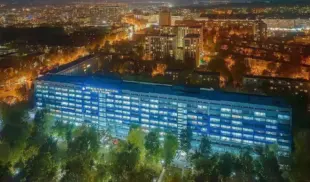
Privatisation made the flats private property, but the roof, basement and land remained unowned. The condominium was supposed to resolve this issue: the common areas are owned by the flat owners, and they pay for their upkeep.
That is why a condominium can be called a ‘capitalist housing management organisation’ – it is essentially the same as a building management company, except that it is owned by those it serves.
But capitalism has one essential condition: property. It must first be established, registered and made transferable – and only then can it be managed, mortgaged or invested in. This is precisely where the Moldovan model breaks down.
The main problem: there is no ownership
The government itself acknowledges this fundamental flaw. In the explanatory memorandum to the draft state programme for the registration of property in blocks of flats, tabled in January 2026, the Ministry of Infrastructure states: the privatisation legislation of the 1990s focused solely on flats and did not fully resolve the issue of ownership of land and the common parts of buildings.
According to the Real Estate Cadastre, there are around 12,580 multi-apartment buildings registered in the register, in which the state or an administrative-territorial unit is still listed as the owner. In Chisinau alone, there are 5,395 such buildings.
The land beneath the buildings has been a problem from the very beginning. The 2005 instructions on maintaining the register explicitly stated that if the land belongs to the state or a territorial unit – as is the case with a block of flats – a site plan need not be drawn up, and a note stating ‘registration of title not requested’ may be made in the register.
Act No. 913/2000 promised the free transfer of the land beneath the buildings into the joint ownership of the residents, but only the residents’ association could apply for this. According to practitioners, there have been very few such transfers since 2000, whilst the authorities have been allocating parts of the land adjacent to the buildings for new construction.
Act No. 187/2022 sought to resolve the issue in one fell swoop: buildings in which flats are registered with separate cadastral numbers are declared to be a condominium by operation of law.
If all premises are registered, the entry listing the state as the owner of the building is removed and the entry ‘condominium’ is added. If not, the previous owner remains in the register, and the note ‘incomplete condominium’ is added to the entry.
At the same time, the government clarifies that no entry in the register is made automatically: each decision is taken by the registrar on the basis of supporting documents.
In other words, the law has recognised the condominium but has not established it as a property entity. The registration of the land and building as a single entity belonging to the co-owners is not provided for by law. The transfer of ownership under the law of the Republic of Moldova and the Civil Code is either impossible or extremely difficult. No title to the land and building has been established.
Even the co-owners’ shares remain in limbo: provisional shares are not recorded in the register, whilst final shares are approved by more than half of the votes of all the building’s owners.
The Congress of Local Authorities (CALM), in its opinion on the draft programme, described the situation in the harshest terms: local authorities have only a formal record of the buildings, which confers no property rights upon them, and ownership of this property is illusory.
The draft programme allocates 15.85 million lei for implementation in 2026–2028, of which 999,180 lei is earmarked for 2026. The focus is on researching archives and making entries – not on demarcating plots or establishing the co-owners’ property rights.
Why nothing else works without ownership
An association that manages property it does not own is not a capitalist housing management organisation, but simply the same old housing management organisation under a new name. The consequences are immediately apparent in three areas.
Firstly, money. The FEERM programme – the Residential Energy Efficiency Fund – was approved by the government on 10 April 2024; for the period 2024–2027, it is set to mobilise around 1.4 billion lei, with the association receiving a grant of up to 70 per cent of the cost of the works.
However, by April 2026, the CNED was working with only 72 associations, and only 17 had secured funding agreements. The remaining 30 per cent of associations require a loan, but, as the state agency Moldpres notes, the associations have no assets to offer the bank as collateral.
Consequently, in August 2026, the government approved a mechanism whereby the CNED guarantees a loan of up to 10 million lei to an association for seven years and subsidises interest rates above 5 per cent. The state is forced to guarantee what, in a normal system, the property itself would provide.
Secondly, there is the organisational aspect. To speed up the transition, the legislator has permitted the formation of an association at the initiative of five owners. The author of the current amendments, PAS MP Vasile Grădinaru, explained that in Chișinău, the housing stock is mainly managed by municipal enterprises in insolvency proceedings, which fail to provide the services for which residents continue to pay.
This simplification resulted in ‘mega-associations’ covering dozens of buildings in different areas, without any common ownership. Law No. 70 of 30 April 2026, published on 21 May, tightened the requirements; at first reading, the draft bill stipulated that signatures from at least a quarter of the owners were required for a single block of flats and half for several blocks.
Thirdly – the fund. The Act and Government Decree No. 296/2023 have properly established the repair and development fund: a contribution is mandatory for every owner; the money is held in a separate account; and it is prohibited from being seized, except under contracts with a direct provision for payment from the fund. The amount of the contribution and every use of funds outside the budget is approved by the general meeting.
However, the fund accumulated for the repair of a building that is registered in the state’s name remains money intended for someone else’s property.
How this has been resolved in Germany and Austria
In Germany and Austria, the question of ownership does not arise: a flat and a share in the common property constitute a single registered entity. Consequently, the debate there centres on management.
Through a reform that came into force on 1 December 2020, Germany simplified decisions regarding building alterations and made the owners’ association the sole body responsible for management. From 1 December 2023, any owner will be entitled to request the appointment of a certified manager who has passed an examination at the Chamber of Commerce and Industry – whereas previously, anyone could manage the building.
German studies (IÖW, dena) identify disagreements amongst owners, financing difficulties and a lack of information as the main obstacles to renovation: over 60 per cent of owners have little or only partial knowledge of renovation.
Austria has addressed the issues of funding and apathy. Until 2022, the law did not stipulate a minimum repair fund: owners paid little, and when major repairs were needed, they took out a loan or collected a large one-off contribution. Since 2022, the contribution has been at least €0.90 per square metre per month. A resolution at a general meeting is now passed if it receives two-thirds of the votes cast and these votes represent at least one-third of all shares – because previously, resolutions would fail simply because the majority did not vote.
Simple solutions
Firstly, establish ownership. Demarcation and registration of the land plot under the building, and registration of the building as a condominium with co-owners’ shares – as a single entity that can be transferred and mortgaged. The government programme should fund precisely this, rather than mere changes to entries in the register.
Secondly, one building – one association – one account. Law No. 70/2026 is already moving in this direction. An association covering dozens of buildings is no different from a housing maintenance organisation (ZHEK) for residents.
Thirdly. Contributions to the fund should be calculated per square metre, with a minimum threshold. The Austrian experience shows that without a minimum contribution rate, associations save money today at the expense of a one-off levy tomorrow.
Fourthly, a quorum that is not dependent on apathetic residents. The Austrian formula – two-thirds of those present, representing at least one-third of all shares – is worth discussing in Moldova.
Fifth. Qualifications of the administrator. An examination and the right of any owner to demand a manager who has passed it, as in Germany.
Sixth. Transparent accounting. The building’s income and expenditure – published monthly and accessible to all. The fee should be the price for a specific list of works, not just a figure on a receipt.
In conclusion
The housing and communal services agency failed not because it was state-run, but because no one was accountable to the residents for their money.
A condominium will suffer the same fate if it remains merely declared but not formally established. A ‘capitalist’ housing management organisation begins not with a charter or a service charge, but with an entry in the land registry: here is the plot, here is the building, here are the shares, here are the owners.
Until this entry is made, associations are managing property that does not belong to them, banks do not recognise the collateral, and the state is forced to guarantee what ought to belong to the people.
Dmitry Taraburca,
economist
Veacheslav Tiosa-Romanciuc,
specialist in housing stock management and the administration of condominiums
Follow our updates
Have information for the newsroom? Share it with Logos-Press