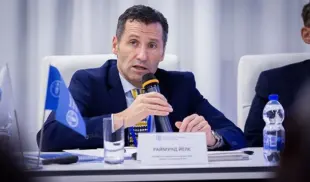
Igor Munteanu
Igor Munteanu’s post, published on social media, presents a fairly comprehensive vision and argumentation on the part of the author. We are therefore reproducing it almost in its entirety.
The 10-district model lacks a foundation for development
The Republic of Moldova needs three regions that are radically different from the old district system.
I have carefully studied the government’s proposed 10-district plan and felt sorry for us. And for all our suffering caused by mergers and cutbacks, which may lead to us ending up in the very same quagmire of inefficiency and administrative control found in some of the old districts.
As the ancients used to say, the mountains laboured and brought forth a mouse. Retaining 10 out of 32 districts strikes me as a bad idea, devoid of vision. Moreover, I believe that the Republic of Moldova needs only three regions, and I can support that.
Why do we NOT need new districts?
1. Because none of the 10 districts meets the threshold for EU regional funding. Regulation 1059/2003 requires a programme region to have a population of at least 800,000 (NUTS 2).
The average population of a district proposed by the government is 277,000 – a third of the threshold. Even the five existing development regions (ADRs), whose areas exceed the range desired by the government, fall short of this target: North – 609,000; Centre – 670,000; South – 307,000; Gagauzia – 104,000; Chisinau – 720,000.
Today, none of the five ADRs meets the criteria for statistical regions under European Union rules; tomorrow, none of the ten will. The direct consequence of this is that, despite the reforms carried out, the regions will not be eligible for funding. (NUTS 2 does not directly impose such restrictions – LP note)
2. The main reason is not political, but purely technical. The reform model promoted by the government does not address the real problem, which stems from the inability of local authorities to exercise their powers effectively and in a decentralised manner, rather than being subservient to the districts.
Even the government’s own research shows that 34 per cent of households lack water supply and sewerage, whilst 80.5 per cent of mayors do not have specialists to develop European projects; 776 out of 898 mayors on the right bank of the Dniester have a population of fewer than 3,000. The situation cannot be resolved simply by reducing the number of districts from 32 to 10; the problem is structural in nature and runs deeper.
3. Demographic pressure. The population is declining, and the districts are unable to slow down this process of accelerated depopulation. Over the past decade, the population has fallen by 13.6 per cent; in Oknica, Leova and Briceni, the decline has been approximately 29 per cent.
The district proposed by the government, with a population of 277,000, will, at the same rate, shrink to fewer than 200,000 by 2031. This means that we will have to carry out yet another reform in 2032, with significant political costs.
We need to introduce radically new approaches to build local capacity and improve the quality of life and the economy.
4. Mechanically reducing the number of districts from 32 to 10 would cut the costs of the existing system by 69 per cent, but it would not create the critical mass necessary for regional development in the context of EU accession funds.
None of the 10 districts proposed by the government possesses the critical mass required for its own strategy of knowledge-based specialisation, a mature procurement department or a European project manager with practical experience. This is a sham, not territorial reform. The savings are obvious, but not structural.
5. The new system of districts offers no effective solutions for any of the existing territorial divisions between the two banks of the Dniester. Transnistria remains, as it is now, a separate legal category with no place in the architecture of the 10 districts, which is designed exclusively for the right bank.
Gagauzia is treated as a larger district with the same centrifugal characteristics.
The territorial reform creates no incentives for convergent, effective regional development that makes rational use of available resources.
Why do we need genuine regions?
Because, if you wish to attract European funds, you must operate according to European rules. The NUTS 2 model, comprising three regions, is the only crisis-resilient and pro-European system feasible for the Republic of Moldova. Of course, this is provided we do not intend merely to imitate processes, but rather to address the real problems of today and tomorrow.
We shall explain this by referring to some key European Union documents.
– Regulation (EC) No 1059/2003 – NUTS Classification. This establishes a reference range of 800,000–3,000,000 inhabitants for NUTS 2, calculated on the basis of the resident population. It is required that the classification be based on existing administrative units; the population thresholds apply primarily to non-administrative units created through statistical aggregation, which may deviate from them due to geographical, socio-economic, historical, cultural or environmental circumstances.
This has two practical consequences: if the Republic of Moldova establishes administrative regions of an appropriate size, Eurostat will take them under its purview; if, however, it does not establish any, Eurostat will aggregate districts into statistical units with no political counterpart. The Republic of Moldova will then have regions on paper but no real regional counterpart. Zero.
-Articles 174–178 TFEU — territorial cohesion. The ‘cohesion’ policy applies to categories of regions defined by their GDP per capita relative to the EU average, measured at NUTS 2 level. Not at district level.
In a country without its own NUTS 2 system, there is no unit of measurement against which decisions on the allocation of funds are made. In a country that constitutes a single NUTS 2 region, the GDP of the capital masks the poverty of the rest of the country.
In the absence of such regions, the EU treats the state as a single statistical unit and allocates (or fails to allocate) funding without taking regional characteristics into account, distributing funds from external sources.
Three development regions in the Republic of Moldova
In our view, the only effective solution to overcome the shortcomings of the old system—based on Soviet-style districts and centralised administration—is to replace it with a model comprising three regions, each with a population of over 800,000.
The average figure for the districts proposed by the government (out of 10) barely reaches one-third of the criterion set by the EU. This reduces the entire reform announced by the government to a statistical classification without funding: NUTS 3 may be useful for reporting purposes, but is completely useless for planning funding.
In my view, the optimal regionalisation model for the Republic of Moldova should be:
– The North-Western region, centred on Bălți – 854,200 inhabitants. It comprises 18 current administrative units: the municipalities of Bălți, Briceni, Dondușeni, Drochia, Edineț, Fălești, Florești, Glojen, Ocnita, Riscani, Sîngerei, Soroca, Orhei, Rezina, Telenesti, Soldanesti, Kamenka and Rybnitsa.
– The capital region around Chișinău – 1,082,600 inhabitants. It comprises 8 current administrative units – the municipalities of Chișinău, Ungheni, Călărași, Strășeni, Ialoveni, Criuleni, Dubăsari (left), Dubăsari (right).
– The South-Eastern region, centred on Tighina, with a population of 837,400. It comprises 16 administrative units – the municipalities of Bender, Tiraspol, Grigoriopol, Slobozia, Anenii Noi, Căușeni, Ștefan Voda, Hîncești, Nisporen, Cimișlia, Basarabeasca, Leova, Cantemir, Cahul, Taraclia and the Autonomous Territorial Unit of Gagauzia.
Each region has a population of over 800,000.
The ‘Three Gates’ model
We have named this model the ‘Three Gates’, a name that highlights the regions’ key functions: transport accessibility, planning and development.
For the first time in the history of the Republic of Moldova, all three regions proposed in this model can be classified as direct partners of the EU in operational programmes worth hundreds of millions of euros, rather than relying on budgets allocated on a grand scale from the centre.
Moreover, the regions do not usually take the form of virtual circles drawn around cities, but rather as bands or strips crossing the entire territory of Moldova, from the Prut to the Dniester – one in the north, one in the centre and one in the south, with not a single corner falling outside the scope of any development project.
Now, briefly, the systemic advantages of the three-region model are as follows:
– It covers the entire territory without leaving any areas out. The bands stretch from the Prut to the Dniester and are in close contact with one another – there is not a single district that does not fit into one of the three, as is the case with districts built around a city centre, where the areas between the poles remain grey zones with no clear affiliation. Every square metre of the country is included in a regional development project only once.
– Each region constitutes a functional whole, rather than merely the sum of neighbouring regions. Each region encompasses urban, rural, agricultural and industrial zones – there are no regions consisting ‘only of villages’ or ‘only of towns’. This means that no region is structurally dependent on another in performing its core functions, which reduces the need for complex coordination between regions.
– Regions are formed from existing units, rather than from newly carved-out territories. Regions do not carve out parts of existing districts (gerrymandering). This means fewer boundary disputes, far fewer arbitration commissions over border villages, and a realistic implementation timetable, as the reform aggregates rather than redraws boundaries from scratch.
– These three regions distribute the population evenly, rather than concentrating demographic decline. As each territorial strip has its own mix of urban and rural areas, from one end of the country to the other, population decline affects all three regions proportionally, rather than just the peripheral ones. The 31/39/30 per cent balance is not a snapshot, but a structure that resists a uniform rate of decline in the long term. This contrasts with a model featuring concentric regions, where the periphery is depopulated whilst the centre grows until the entire balance is lost.
– The reintegration of the Republic of Moldova should be addressed by setting economic objectives, rather than through a second reform. Each territorial layer naturally extends from the Prut to the vicinity of the Dniester, and to the area situated to the right of it.
I am convinced that no separate or ‘special’ legal regime should be devised for the Left Bank, nor should a second administrative reform be discussed on the day of reintegration – the framework already exists, ready to incorporate the territory strip by strip.
Preliminary conclusion
This model is the most balanced model of regional development that Moldova can afford today. It encompasses infrastructure, industrial centres and extensive agricultural areas, as well as large settlements that will remain stable despite the rates of demographic decline and emigration.
In our regionalisation model, comprising three regions, each with over 800,000 inhabitants and more than 200 municipalities, the regions do not dictate. The regions coordinate. They set priorities rather than imposing them.
This is a significant difference from the government’s plan. Whether there are 10 or 32 districts, the same pyramid of vertical control remains, only with fewer levels, each painted a different colour.
Ask the government what the districts will do if they are not entitled to receive funding from the EU Cohesion Funds, and you will realise from their silence that they have not answered.
In our model, three regions eligible for the NUTS 2 programme mean immediate access to funding of over €600 million allocated to each region under the EU Growth Plan.
Ten districts mean money being distributed in dribs and drabs, as is the case today. Territorial reform takes place once in a generation. It should not be carried out with boundaries that do not meet the established requirements from the outset. We need a reform that will deliver on what we promise to citizens.
P.S. Our model is accessible, easily identifiable and implementable. We would like to hold an open and documented discussion of this model with government bodies, CALM and the relevant academic community.
Follow our updates
Have information for the newsroom? Share it with Logos-Press