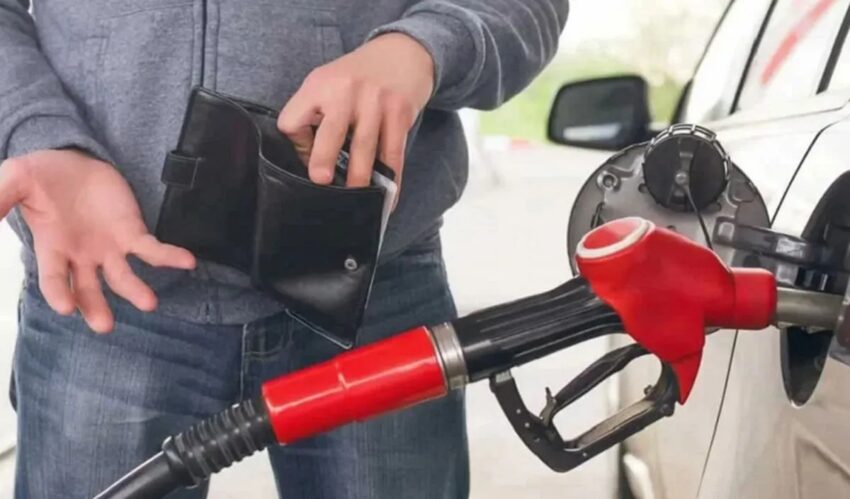
To put the rate of increase into perspective: as recently as 5–7 September, A-95 cost 31.96 lei and diesel 32.91. In other words, in ten days, diesel has risen in price by just over 2 lei – more than 6 per cent. This is not a ‘gradual increase’. It is a jump.
And most importantly: today’s price is not the full story yet. The NARE formula calculates the price based on average international quotes for the previous 14 days and the average leu-to-dollar exchange rate for those same 14 days. This means that last week’s global price surge is not yet reflected on the price board. It will come. Just with a two-week delay.
The same lag, incidentally, works both ways. If the global price falls tomorrow, petrol stations will only see it reflected in their prices in two weeks’ time, not before. You shouldn’t expect any quick relief in either scenario.
Where the price comes from
The reason does not lie with Moldova, and this must be stated plainly. Brent is trading at around $107–110 per barrel – roughly a fifth more expensive than a month ago.
The market is pricing in not an actual shortage, but the risk of a shortage: the Strait of Hormuz is effectively closed, and the Saudi pipeline – which served as a bypass route to the Red Sea and transported around 7 million barrels a day – has been shut down following drone attacks.
Around a quarter of global trade in crude oil and petroleum products passes through the Strait of Hormuz and the Red Sea – an estimate that also features in our own government’s documents.
For Moldova, it is not Brent that matters most, but diesel prices. Platts’ diesel prices have returned to around $1,300 per tonne, compared with $880–900 in mid-June. We purchase fuel from Romanian refineries, which have also been affected by the accident on the Caspian pipeline.
The conclusion is unpleasant but honest: the Moldovan government has no influence over the Strait of Hormuz, Brent or Platts. Demanding cheap diesel from it is demagoguery. It should be held to account for other matters.
The state has already intervened. Only in the opposite direction
Here is a detail that is hardly ever mentioned, even though it is right there on the NARE website.
At the end of July, when the country’s diesel reserves had fallen to roughly seven days’ consumption – less than half of what they were at the end of June – the National Crisis Management Centre, by Decision No. 1/2026, authorised the inclusion of an additional surcharge of $25 per tonne of diesel in the pricing formula. Prime Minister Vasile Tofan himself put a figure on the cost of this decision at the time: around 37 bani per litre.
In other words, part of what you pay at the petrol station is not determined by the global market. It is a decision by the Moldovan state, which deliberately raised the price cap.
And this decision, it must be admitted, is justifiable. With only a week’s worth of reserves, a strict price cap would have resulted not in cheap diesel, but in empty pumps at the height of the harvest. The choice between ‘expensive’ and ‘none at all’ is a real one, and the authorities chose ‘expensive’. It is difficult to argue with that.
The problem lies elsewhere. Having chosen ‘expensive’, the state failed to take the next step. It resolved the question of whether there would be fuel in the country. It did not resolve the question of whether a specific individual would be able to afford it. Nor did it even articulate this as a choice.
Plan for the winter: 52 measures to ensure there is enough
On 9 September, the Government approved the Action Plan for Preparing for the 2026–2027 Heating Season. It contains 52 points, and this is a genuine plan, not just a piece of paper: Energocom is to replenish safety reserves by 1 October; gas suppliers are to build up a reserve equivalent to 15 per cent of consumption by 1 November; 135.9 million cubic metres have been set aside for the Left Bank; the 400 kV Vulcănești–Chișinău line is due to enter commercial operation by the end of October, technical work on the grids must be completed by 15 October, generators for critical consumers, and contingency plans in the event of disruptions.
Read this list again. All 52 measures answer one question: will there physically be any energy available?
Energy Minister Dorin Junghietu has formulated the objective as access to energy for every household, regardless of what is happening on global markets. This is where the confusion lies.
‘Access’ means having gas in the pipes and diesel at the pump. ‘Affordability’ means a family having enough money to pay for it. These are two different indicators, addressed by different mechanisms, and the 52-point plan covers only the former.
This is what people call indifference. But it would be more accurate to put it another way: there is no government department for which the figure 34.97 is recorded as an indicator of responsibility.
The Ministry of Energy deals with cubic metres, megawatts and kilometres of grid infrastructure. The National Agency for Energy Regulation has a formula it is obliged to apply. The Ministry of Finance deals with budget revenue, into which excise duty and VAT from the price rise in fuel flow in increased volumes.
No one has lied, and no one has been slacking off. It’s simply that the compass is calibrated to physical volumes, whilst the country lives by the lei per litre.
What comes next
Fuel is not an end product. In a week or two, the price rise will begin to feed through into the cost of transport, field work, building materials and foodstuffs. Autumn sowing and the harvest are tied to the calendar: more expensive diesel in September means higher production costs for bread next spring.
At the same time, there is pressure from the other side. European gas storage facilities are approximately 67 per cent full – below last year’s level. Interest rates in the eurozone are high, which means external financing for Moldova is more expensive. Demand in the EU for Moldovan goods is weakening.
This amounts to four blows at once: expensive gas, expensive petroleum products, expensive imported electricity and expensive borrowing.
What can be done
Retail prices cannot be frozen – with only seven days’ worth of stocks, this is a direct route to queues and the black market. We’ve already been through this in July.
A viable option is to temporarily compensate part of the costs for those through whom fuel prices are passed on throughout the economy: public transport and small-scale agricultural producers. Strictly on condition that fares and selling prices do not rise. Without this condition, the aid will simply be absorbed into the trade margin, and we will end up paying twice.
This proposal has genuine weaknesses, and it is important to acknowledge them. Compensation costs money, and the budget is already under pressure. Someone must monitor compliance with the conditions, and administration in Moldova is notoriously problematic. Temporary schemes have a habit of becoming permanent. And the mechanism must be up and running within weeks; otherwise, it will be too late for the sowing season and will become pointless.
But we already have a framework in place: the Energy Vulnerability Reduction Fund and the compensation system categorised by household type. It is designed for heating and gas. Motor fuel is simply not included – not because it was discussed and rejected, but because it was never got round to.
Three questions the government can answer with figures
Not slogans, but verifiable facts:
– Until what date does the $25-per-tonne surcharge under Decision No. 1/2026 remain in force, and at what stock level will it be abolished? Please specify the date and the threshold.
– How much additional revenue did the budget receive from excise duty and VAT on petroleum products in July–September compared to the target? Has this figure been calculated?
– Is there at least one item in the plan of 52 measures that is measured in lei per household, rather than in cubic metres, megawatts and kilometres?
Until there are answers to these three questions, talk of preparations for winter remains nothing more than talk of pipes. Yet it is people who will be spending the winter.
Dumitru Taraburca,
expert in real estate appraisal and development
Follow our updates
Have information for the newsroom? Share it with Logos-Press