News about Transportation
The Transnistrian authorities have not given up hope of successfully selling the Bender River Port, which is owned by the (internationally unrecognized) state. The facility will once again be put up for privatization. The owner intends to raise at least 1.2 million rubles (local currency, presumably, approximately $74,500).

New European requirements for social data are creating additional challenges for the automotive transportation sector.

Spain has received a record number of applications for legalization: more than a million migrants want to come out of the shadows

Romania’s automotive industry is having a difficult year. In the first half of 2026, the Dacia and Ford Otosan plants produced 247,972 passenger cars—12.7% fewer than during the same period last year. Moreover, the decline is accelerating: in June alone, production plummeted by 16%.

Soon, drivers will have to pay to travel through Belgium. Belgium’s three regions have announced that they will introduce a road toll next year, which foreign drivers passing through the country will also have to pay.

Wizz Air announced today the launch of a new route from London Gatwick Airport to Chisinau, Moldova.

Turkey turned out to be the most affordable destination among popular European tourist countries. However, it is also the country where travelers will have to pay the most for alcohol. This is the conclusion reached by an analysis by Euronews Business based on Eurostat data.

The Russian Ministry of Defense reported that on Friday night, the Russian military carried out a coordinated strike on port infrastructure facilities in the Odesa region that were being used to receive, store, and transship military cargo.

The implementation of the new law on vehicle compliance certification will require additional spending and an expansion of the administrative apparatus; however, the government has not disclosed how much this will cost.

The parliamentary opposition will establish an investigative committee to examine the situation at state-owned enterprises and public institutions, as well as the salary system.

On July 9, Volkswagen’s Supervisory Board will review a plan for a large-scale restructuring of the company, which calls for additional job cuts and the possible closure of several plants in Germany.

The National Road Administration has announced a public tender for the development of the “Public Roads Registry” Information System—a unified digital platform for tracking Moldova’s road infrastructure.

Road vehicles and auto parts will be subject to type approval (certification) before being placed on the market.

The Republic of Moldova is involved in coordinating European efforts to strengthen transportation infrastructure and logistics routes in the Danube-Black Sea region.

The regulations on bus passengers’ rights will establish new obligations for market operators and strengthen the protection of passengers’ rights. The draft will soon be approved by the government.

The European Parliament has put an end to a long-standing dispute over air passenger rights. After more than a decade of negotiations with EU member state governments and airlines, lawmakers have finally approved updated rules that maintain free carry-on baggage and the right to compensation for long flight delays.

Electric vehicles are rapidly gaining popularity in Romania. While the overall new-car market grew by just 0.3% in the first half of 2026, sales of fully electric vehicles jumped by 76.6%. Their market share reached 8.5%.

Greece, Bulgaria, and Romania are jointly developing a new multimodal transport corridor that will connect ports on the Aegean and Black Seas to the Danube via a network of roads, railways, and seaports. The project will be part of the EU’s Trans-European Transport Network (TEN-T) and is expected to strengthen the region’s transport connectivity.

Work on its modernization has entered a new phase. According to the city government, the project calls for reorganizing traffic flow through the creation of a smart transportation corridor, which will increase road capacity.
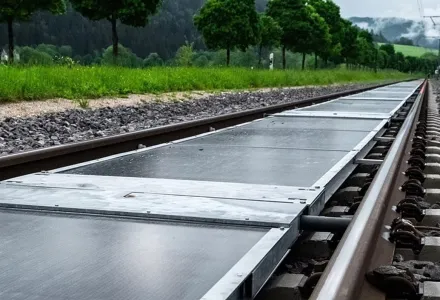
A new type of energy infrastructure may emerge in Europe: railroad tracks converted into solar power plants. The Swiss startup Sun-Ways announced the successful completion of the first year of testing a system of photovoltaic panels installed directly between the rails of an operational railroad&