

Elon Musk announced on the social media platform X that Grok 4.5 “has just solved” a graph theory problem that had remained unsolved for nearly three decades.
This refers to Graffiti Conjecture 284—one of the conjectures formulated by the Graffiti system, created in the 1980s by mathematician Siemion Fajtlowicz. This program automatically generated mathematical conjectures in the field of graph theory, many of which subsequently became the subject of scientific research.
According to the developers’ published explanation, the Capy agent, running on the Grok 4.5 Medium model, discovered a counterexample that refutes the conjecture in less than ten minutes during a discussion on Slack.
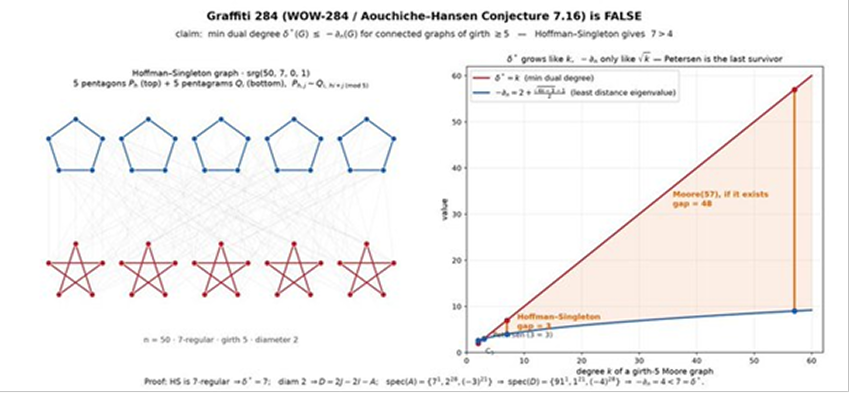
The counterexample was the Hoffman–Singleton graph
The Hoffman–Singleton graph—a well-known object in graph theory with 50 vertices, degree 7, span 5, and diameter 2—was used as the counterexample.
According to the published diagram, this particular graph does not satisfy the inequality formulated in the Graffiti Conjecture 284. If the mathematical proof is confirmed, it will mean that the conjecture is false.
The published image shows that the dual minimum degree (δ*) of the Hoffman–Singleton graph exceeds the value bounded by the conjecture, thereby violating it.
AI Capabilities Expand the Horizons of Science
Although the refutation of a single hypothesis is not in itself revolutionary, this case demonstrates the growing capabilities of modern AI systems in the field of fundamental science.
Unlike most tasks involving the generation of text or program code, the verification of mathematical hypotheses requires the analysis of complex structures, the search for counterexamples, and rigorous logical reasoning.
If the results are confirmed by independent researchers, this will become one of the most notable examples of the use of generative AI in mathematical research.
So far, the information is based on statements by Elon Musk and the project’s developers. As of this publication, no independent confirmation of the results has been presented in peer-reviewed scientific sources.


