News about Agribusiness
The Ministry of Agriculture of Kazakhstan intends to restrict the import of apples into the country. The relevant order has been submitted for public comment. According to the draft, from August 1 through December 31, 2026, the import of apples into Kazakhstan by road, rail, and water is planned to be banned.

The Azerbaijan Food Safety Agency (AQTA) has announced the launch of a large-scale digitalization initiative for the livestock sector, under which the country will completely phase out traditional physical livestock markets in favor of electronic commodity exchanges.

The milk production sector (raw milk) is undergoing a period of structural transformation: the gradual (though not very rapid) expansion of industrial dairy farms is accompanied by a steady decline in milk production on small farms and in the households of the country’s rural population.
The Turkish government has decided to introduce a tariff quota on imports of sunflower seeds and unrefined sunflower oil. The document provides for preferential terms for importing raw materials to support the domestic processing industry and ensure a stable supply of vegetable oil to the domestic market.

Moldova’s leadership intends to finally recognize the Chinese market as strategically important for the country and to actively increase exports of domestic products to China.

Global wheat prices fell by 4.4% in June due to active harvesting and favorable supply prospects for this commodity in the Black Sea region. This is discussed in the June report by the Food and Agriculture Organization of the United Nations (FAO).

Turkey will implement updated phytosanitary control regulations for wheat imports effective August 5, 2026. Under the new requirements, four fungal pathogens will be classified as prohibited for import with imported products. Their presence or absence will be determined based on the results of laboratory analysis.

The Moldovan Ministry of Foreign Affairs and the Ministry of Agriculture and Food Industry organized the “Diplomatic Peach and Cherry Harvest.” According to the organizers, the event is intended to promote Moldovan agriculture and strengthen economic diplomacy.

Representatives from the Ministry of Agriculture and Food Industry participated in the Global Conference on Smart Farming, which took place July 1–3 at FAO headquarters in Rome.

Parliament Speaker Igor Grosu promised farmers that the issue of a potential increase in the VAT on agricultural products to 20% would be resolved in a way that was “better than they had asked for.”

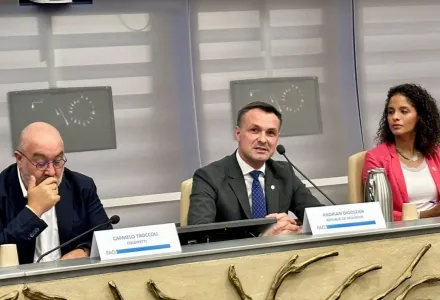
Technical talks between Adrian Digolean, State Secretary of the Ministry of Agriculture, Forestry, and Food (MAIA), and Viorel Guts, Deputy Director-General and Regional Representative of the UN (FAO) Viorel Gutsa took place as part of the Global Conference on Smart Agriculture, held July 1–3 at FAO headquarters in Rome.
Ukraine is tightening controls over its organic food market. The country’s parliament recently passed a new law on state regulation of organic production, distribution, and labeling of organic products.

Agri-food producer associations did not appreciate “Minister MAIA’s ostentatious intolerance of any form of corruption, abuse of power, or protectionism.” However, the leaders of these organizations—some openly, others anonymously—felt it necessary to remind the head of the Ministry of Agriculture and Food Industry of the existence of “the presumption of innocence, professionalism, and human decency as a matter of principle.”

Starting in 2027, farmers will be able to take advantage of the “zero VAT rate,” said Parliament Speaker Igor Grosu. According to him, the main problem lies not in the VAT rate itself, but in the accumulation of VAT in the accounts of economic entities and delays in its payment.

This year, 300 Moldovan companies—twice as many as last year—will participate in the second “Domestic Product” exhibition. It will take place August 28–30 at “Moldexpo” in the capital.

The searches and the detention of an official at the Ministry of Agriculture, Food, and Industry (MAIA) are related to Order No. 263 dated June 18, 26, signed by the Director General of the National Food Safety Agency (ANSA) Radu Mustiață. According to information on the agency’s website, the order remains in effect and has not been revoked.

This week, the heads of the Ministry of Agriculture, Food, and Industry (MAIA) and the ANSA agency made a working visit to Brussels (Kingdom of Belgium). The visit’s itinerary included a series of high-level meetings with representatives of the European Commission.

Officials from the National Anti-Corruption Center (NAC), acting under the procedural guidance of the Anti-Corruption Prosecutor’s Office, detained Tatyana Nistorica, State Secretary of the Ministry of Agriculture and Food Industry, as well as a representative of one of the commercial companies. The detention took place as part of a criminal case initiated on charges of corruption.

Farmers agreed to suspend their roadside protests in exchange for a promise from ministry officials and the government as a whole to set forth a clear, official position on the proposed reform of the VAT system for agricultural products by June 30. However, no official statements on this matter were issued by the agreed-upon deadline, according to the administration of the “Forța Fermierilor” Association of Grain and Oilseed Producers.

In the second quarter of 2026, 854 million lei were injected into the country’s economy through the Credit Guarantee Fund, which is administered by the Organization for Entrepreneurship Development (ODA).