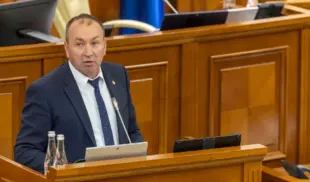
Adrian Belîi
According to Adrian Belîi, Chair of the parliamentary committee on social protection, healthcare and the family, artificial intelligence is already being actively used at the Institute of Oncology.
‘Elements of AI are used at the Institute of Oncology to detect and diagnose tumours, as well as to classify them using radiological images. We are already using artificial intelligence in our field, including our own developments. This is an inevitable and practically indispensable development that must be pursued. In fact, it is already a reality today,” said Adrian Belîi.
For his part, MP Ion Chicu emphasised the need to pay greater attention to this area and to allocate the necessary financial resources.
Health insurance funds are growing
Following the debate, the draft law amending the Law on Compulsory Health Insurance Funds for 2026 was approved at first reading.
According to the document, the revenue and expenditure of the compulsory health insurance funds will each increase by 167.45 million lei, or by 0.9 per cent. As a result, revenue will total 18.99 billion lei, whilst expenditure will amount to 19.38 billion lei.
The Ministry of Labour and Social Protection clarified that the rise in revenue is linked to an increase in the number of people paying a fixed insurance contribution, as well as to higher receipts from the flat-rate tax levied on residents of IT parks and self-employed individuals. In addition, voluntary donations from external sources to fund medical services provided to refugees from Ukraine have increased.
Following the adjustment to the FAOAM budget for 2026, the deficit will stand at 385.2 million lei.
A draft law amending the Law on Compulsory Health Insurance Funds for 2026 will be submitted to Parliament for consideration at second reading.
Follow our updates
Have information for the newsroom? Share it with Logos-Press