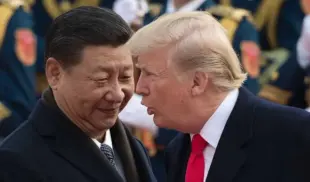
Xi Jinping and Donald Trump. AP Photo/Andy Wong
According to the state news agency Xinhua, cited by Euronews, the investment is intended to strengthen financial institutions’ “operational resilience, ability to withstand risks and serve the real economy”.
Beijing has opened its chequebook
The bulk of the funds, around 290 billion yuan (€37.2 billion), will go to Chinese banks. It is intended to preserve their lending capacity, as Beijing is requiring them to step up their support for economic activity.
The Agricultural Bank of China plans a private placement of Class A shares worth up to 160 billion yuan (€20.5 billion), whilst the Industrial and Commercial Bank of China plans a placement of up to 100 billion yuan (€12.8 billion). The Ministry of Finance will be among the investors.
Unusual participants include the China National Tobacco Corporation, which operates the state tobacco monopoly, and the Export-Import Bank of China, which will receive 30 billion yuan (€3.85 billion).
Insurers will receive 70 billion yuan (€9 billion)
China Life Insurance Group, the country’s largest life insurer, will receive 35 billion yuan (€4.5 billion), whilst China Taiping Insurance Group will receive 7 billion yuan (€900 million).
The People’s Insurance Company of China intends to raise up to 15 billion yuan (€1.9 billion) through a private placement for the ministry, the China Export and Credit Insurance Corporation will receive 10 billion yuan (€1.28 billion), and the China Reinsurance Group is raising 3 billion yuan (€385 million).
Insurance companies have found themselves squeezed from both sides: years of low interest rates have eroded the returns on their investments, whilst the authorities have simultaneously directed their funds towards investments in Chinese shares.
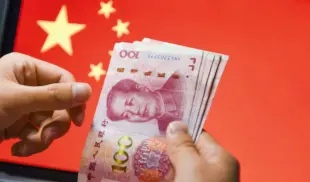
The currency is moving in the same direction. On Monday, the Chinese yuan reached its highest level against the US dollar since January 2023, trading at around $0.149. The stronger exchange rate simultaneously weakens long-standing US criticism of China’s currency policy – ahead of talks in Washington on 24 September.
A busy month for Beijing
Capital investment is not the only move Beijing is making this month. Chinese President Xi Jinping is preparing to bring a large delegation of business representatives to Washington.
This would mark a notable departure from standard practice. Xi rarely travels accompanied by the business elite. Many of its representatives have lost their positions following the crackdown on the technology, education and property sectors that began in 2020. The last comparable delegation accompanied him on a trip to the US more than a decade ago, in 2015.
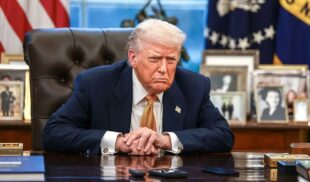
In any case, this gesture would have been reciprocal. When US President Donald Trump visited Beijing in May, he brought with him a delegation of American CEOs, including Elon Musk, Tim Cook and Jensen Huang. Inviting their Chinese counterparts to Washington would signal a willingness to invest in and trade with the US, whilst also providing the White House with potential achievements in the run-up to the November mid-term congressional elections.
Expectations for the summit itself remain modest: the parties continue to disagree on which goods should be considered non-sensitive within the framework of trade agreements.
Follow our updates
Have information for the newsroom? Share it with Logos-Press