

While the police report on their efforts to combat the “external threat,” suspicion is growing among the public that such a large-scale operation could not thrive without “protection” from the highest echelons of power, including the Ministry of Internal Affairs. Parliament has established an investigative commission that promises to “analyze the causes and protect the people.”
Between 2023 and 2026, Moldova faced an unprecedented surge in cybercrime. Fraudsters are adapting to modern technologies, turning isolated incidents into large-scale transnational networks.
In the first five months of 2026 alone, 1,767 cases of fraud were reported, and the losses to citizens exceeded 157 million lei.
Trends in reported fraud cases
2023: 924 cases
2024: 1,106 cases (+20%)
2025: 1,757 cases (+59%)
First 5 months of 2026: 1,767 cases.
Currently, fraud accounts for 19% of the total 9,326 calls registered by the 112 Service as of June 5, 2026. That is nearly one in five calls.
Financial losses
2023: 40 million lei
2024: 130 million lei
2025: 272 million lei
First 5 months of 2026: 157.3 million lei.
Types of Fraud (January–May 2026)
One of the most common schemes—515 reported cases, or 29.15% of the total—is bank fraud. Criminals operating from abroad spoof the caller ID, causing the subscriber’s screen to display a local number. Posing as employees of financial institutions, the perpetrators use social engineering techniques to gain the trust of citizens and fraudulently steal their funds.
Fictitious investments (Cryptocurrency / Forex / Trading): 310 cases (17.54%) / Scammers contact users of trading platforms via messaging apps under the guise of potential buyers. During the conversation, the victim is sent a malicious link; clicking on it leads to the compromise of personal data and unauthorized access to banking apps.
Contract / telecommunications service renewals: 230 cases (13.02%) The “fake tech support” scheme relies on exploiting trust in specialists. Scammers call citizens, posing as employees of IT departments or technical support services of well-known companies. Under the pretext of “fixing system errors” or “configuring security settings,” they coerce victims into disclosing confidential data.
Fraud involving law enforcement personnel: 170 cases (10%)
Other types of fraud: 31%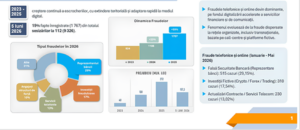 Telephone and online fraud is becoming dominant, driven by the accelerated digitization of financial and communication services. Of the total number (over 750 victims) 50% are Orange subscribers, 23% are Moldcell subscribers, and 19% are Moldtelecom subscribers. In principle, the statistics are proportional to the number of subscribers.
Viorel Cerneuțanu, Head of the General Inspectorate of Police at the Ministry of Internal Affairs: “I would like to note that, including at the global level, Interpol’s analysis has confirmed the rapid diversification of technologies through the use of digital tools, as well as cross-border transport and logistics networks.”
And who is responsible for this?
According to him, other countries around the world are also facing the same types of fraud. He also states that 90 percent of these numbers, in terms of detection, originate from outside the Republic of Moldova.
The authorities do not name specific “countries of origin,” but Logos Press has previously reported on where exactly these call centers might be located.
Chief Prosecutor of the Prosecutor’s Office for Combating Organized Crime and Special Cases (PCCOCS), Victor Furtună:
“The vast majority of criminal cases in which the PCCOCS is conducting criminal proceedings are committed outside the territory of the Republic of Moldova. Consequently, an objective investigation into such a criminal case requires international legal assistance in criminal matters or, depending on the circumstances, the creation of joint investigation teams through Eurojust.”
At the same time, the prosecutor acknowledges the existence of gaps in “ensuring the internal security of personal data operators.” There have been cases where the databases of certain institutions were attacked or simply “leaked.”
“It is possible—such a situation cannot be ruled out—that someone intentionally leaked them online, because when criminals call, they often possess very specific information about a person: which bank they have an account with, how much money they have, what category of banking service beneficiaries they belong to…”.
“If I were to shoot you…”
There are speculations in society that such large-scale and organized networks could not function without some support or non-interference from government authorities.”
Stefan Gligor, leader of the “Party of Change,” has himself fallen victim to scammers. The politician reported that his account on the 999.md platform had been hacked: money was stolen from his personal account, some listings were deleted, and others—outdated ones—were put up for sale with fake details and the criminals’ Viber contacts listed.
“According to my sources, the ‘establishment’ (or ‘setup’) of fraudulent call centers began in 2024 with the knowledge of a number of individuals holding high-ranking positions in the Ministry of Internal Affairs, the Prosecutor’s Office, and the government. Since then, the Republic of Moldova has been a hub for fraudulent operations in the region,” Gligor shared on social media.
Moreover, according to him, “several organized criminal groups are operating from the territory of the Republic of Moldova, carrying out fraudulent schemes both against Moldovan citizens and with the aim of stealing funds from citizens of Romania and other countries in the region.” Earlier, as a result of joint operations by the National Inspectorate for Investigations and Romanian intelligence agencies, approximately six fraudulent call centers were shut down, one of which was located right on a pedestrian street in the heart of the capital.
“Telegram channels are overflowing with details about how Katlabuga and Cerneuțanu came into conflict over these operations; how the arrests took place; who the beneficiaries are; what amounts of bribes are being paid; the addresses of the call centers; the names of family members; the structure of the organized groups; who is “protecting” them; how the NCBK intervened, etc. “I don’t know if all this information is true—that’s for the Prosecutor General’s Office to determine,” the opposition politician asserts.
For his part, Police Chief Viorel Cerneuțanu categorically rejects these accusations. He asked: why, he said, would the police fight fraud “so actively” if they themselves were involved in it?
“I’m very sorry that you’re getting your information from certain Telegram channels that are of no use, at least in terms of providing documentary evidence and facts. The calls are coming from outside the Republic of Moldova. That is, these are calls initiated from outside the Republic of Moldova. If this were happening somewhere inside the country, as is being claimed in the public sphere, what interest would there be in stopping it, in pursuing this fight against such phenomena so actively?” stated Cernăuțanu.
The Cost of Protection
Data from the National Agency for Regulation in the Field of Electronic Communications and Information Technologies attests to the colossal scale of telephone fraud: during the reporting period alone, the protection system blocked over 1,083,000 fraudulent calls.
Sergiu Postică, Director of Strategy, Development, and Regulatory Affairs at Orange Moldova, confirms: all detected fraudulent calls originate from outside the country. Despite the widespread belief in the ubiquitous use of IP telephony, he points to the active use by attackers of TDM (Time Division Multiplexing) technology.
TDM is a communication method that allows multiple telephone signals to be transmitted simultaneously over a single physical channel, distributing them across time intervals (slots). It is precisely this architecture that creates a critical problem for subscribers: when a victim tries to call back the number from which the suspicious call originated, they end up speaking to a random person—the actual owner of that number, who has no connection to the scammers.
Moreover, the very nature of TDM technology makes it extremely difficult to identify the true source of the call, which significantly hinders operators’ efforts to track and block such attacks.
“We have agreed on a method that allows us to effectively block these caller ID spoofing phenomena ‘at the very first point of entry,’ and it is called the GSM IP Gateway. However, these systems are quite expensive and complex to implement. Mobile operators process millions of calls daily (in our case, 10–12 million), and these are professional systems developed by industry-leading vendors, not in the Republic of Moldova. We have analyzed the solutions. Implementation plans were agreed upon among operators on the ANRCETI platform, and we have already begun working with suppliers. “In fact, the current plan—which involves, on the one hand, bringing in and launching the system, and on the other hand, conducting tests and implementing interoperability—will take about six months,” noted the Orange representative.
Coordination is needed
During the parliamentary hearings held on Thursday, June 11, experts emphasized the critical need to create a unified interagency mechanism. According to the participants in the discussion, the formation of a special structure or unit to ensure the rapid exchange of data between the General Inspectorate of Police, the National Bank, and the National Commission for the Financial Market is a key factor in the preventive fight against telephone fraud.
The chairman of the “Our Party” faction proposed creating a National Anti-Fraud Coordination Center, which would coordinate measures online and in real time to prevent and block fraudulent schemes and inform citizens.
Experts warn that current methods of combating fraud are only a temporary measure. Criminal technologies are evolving rapidly, and protection must develop at a faster pace. We must look to the future, when the main threats will be artificial intelligence algorithms and next-generation investment platforms.
P.S. Recently, parliament established a special investigative commission to look into the causes of the rapid rise in telephone and online fraud in the country.
“This phenomenon has become a veritable epidemic, affecting an increasing number of citizens of the Republic of Moldova. People who have saved their entire lives are losing their savings in a matter of minutes as a result of increasingly sophisticated scams. We will analyze the factors contributing to the rise in these crimes, evaluate the work of the responsible agencies, and determine the necessary measures to more effectively protect citizens,” promised Alexandru Kitsu, secretary of the newly formed commission and a member of the Democrația Acasă faction.


