

Vladimir Golovatiuc
As the expert notes on his Facebook page, in May 2026, exports of Moldovan food products and agricultural raw materials totaled nearly 100 million euros, while imports of goods in this category amounted to about 145 million euros. For the first five months of this year, the figures were 670 million euros and 700 million euros, respectively. “The difference is smaller (about 4%), but it still exists and does not favor exports,” Vladimir Golovatiuc points out. “A year earlier, the difference was 18%.
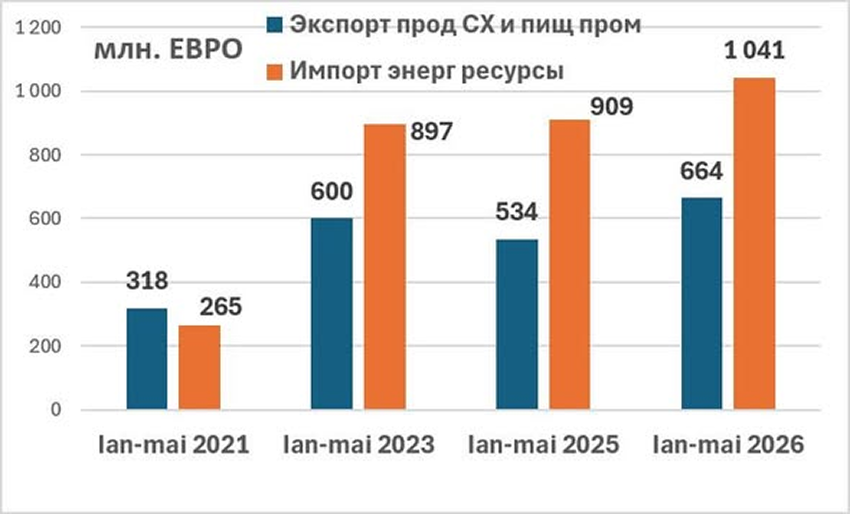
In other words, we buy more food than we sell. Consequently, Moldova has turned from a ‘blooming garden’ into a large dining hall where all dishes and/or semi-prepared foods are imported.”
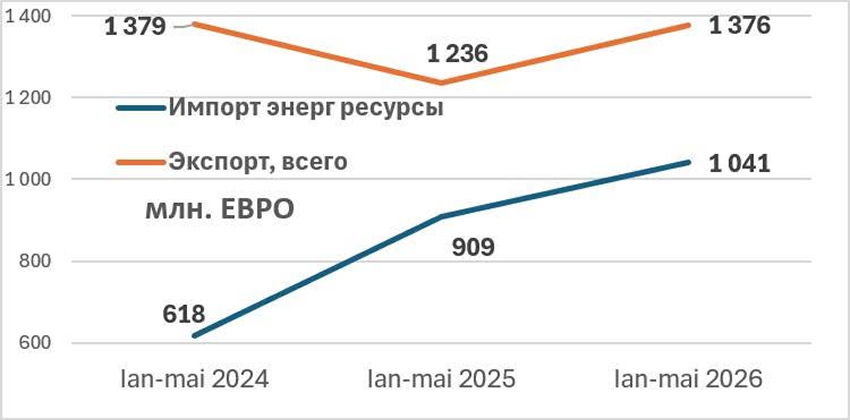
At the same time, energy imports in May totaled 160 million euros, and for the first five months of this year—1.041 billion euros. “It is clear that the foreign currency flowing into the country from exports of agricultural and industrial products—which account for more than half of Moldova’s total exports—is insufficient to pay for energy imports,” the expert concludes.
According to him, it is also interesting that exports of agri-food products, in financial terms, have nearly doubled over the past five years (compared to the figure for January–May 2021), “which, by the way, is quite good; but, nevertheless, energy imports have increased nearly fourfold.”
“Let’s take a broader view of the problem and compare the total volume of exports with imports of just one group of goods—energy resources. Moldovan exports for the first five months of 2026 totaled 1.376 billion euros, while energy resource imports amounted to 1.041 billion euros. In other words, 76% of the country’s total export revenue goes toward paying for gasoline, diesel fuel, natural gas, electricity, and other energy sources. Of course, energy resources are critically important imports for us, and the country (its economy and population) cannot function normally without them. Nevertheless, I believe such an imbalance is unjustified.
I am not calling for a reduction in imports of goods that the country is physically unable to produce. I am speaking exclusively about increasing exports and boosting the national economy. Moreover, I am confident that the physical volume of imported energy resources did not triple during the specified period—even taking re-exports into account!
Most likely, the reason lies in the rise in prices for gas, electricity, and so on. After all, we all remember well what happened at the end of 2021 and what continues to happen today: where we are buying all of this from, at what prices, and what role political factors play in this matter. It wasn’t always this way. Until 2022, agri-food exports exceeded the volume of imported energy resources.”
Note from the author of the Logos Presspublication : There is a subjective sense that during the mentioned period of this year, not only is very slowly, the balance (the imbalance is narrowing) between Moldova’s agri-food exports and imports is evening out, but its structure is also changing slightly (improving). At least in some sectors, Moldova has begun to export more finished products and fewer raw materials this year. For example, in the oil and fat sector, Moldova has begun to regain its status as a major regional exporter of vegetable oils, partly due to imports of raw materials (sunflower seeds). Or take another example: some of the country’s dairy plants are increasing their imports of raw milk, which is used to produce dairy products, and these products are partially (though still to a very limited extent) replacing imports of similar products. Yes, the problem of price imbalances for production inputs (energy, fertilizers, etc.) is intensifying, and it is a global issue. Without its own production base for these resources (or guaranteed preferential import access), Moldova is unlikely to be able to radically change the situation. An unexpected (and likely small) opportunity for the country’s (agricultural) economy lies in the fact that during the current marketing season, despite the projected good harvests in a number of regions around the world, global prices for agricultural commodities and food products will most likely resume rising and/or continue to rise.


