

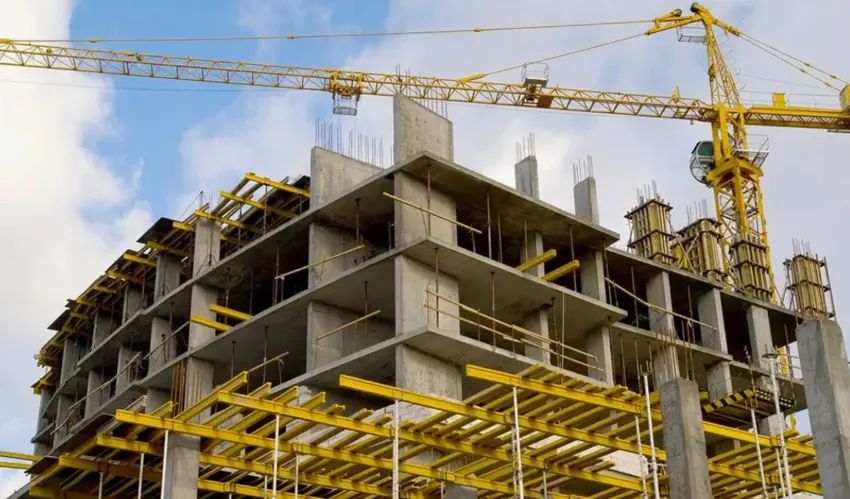
Between January and September 2026, 2,124 building permits were issued, which is 2.9 per cent fewer than in the same period of 2025.
- Residential buildings: 1,588 permits (a decrease of 1.9 per cent).
- Non-residential buildings: 536 permits (a 5.8 per cent decrease).
The statistics point to a general cooling of the construction market, with the commercial property sector contracting almost three times as sharply as the residential sector.
The more pronounced decline in the non-residential (commercial) construction sector compared with the residential sector is explained by differences in the nature of demand, investment risks and the current state of the economy in 2026. Experts highlight several key reasons, including a decline in business activity and economic stagnation.
Companies are cutting their development budgets and optimising operating costs. Rather than building new offices or industrial warehouses, businesses prefer to rent existing vacant premises. The market is saturated with such properties. Developers are putting new planning applications on hold, as projects already underway are meeting current business needs.
Investment risks and tighter controls
The construction of a non-residential property requires long-term planning and substantial one-off investments. In 2026, companies are facing strict budgetary controls and the need for precise cash flow management. Investors are reluctant to commit to new commercial projects, given the protracted payback period for such buildings against a backdrop of regional instability.
Veaceslav Ionita, an economic policy expert at the IDIS Viitorul Institute: “Today, the construction of a large warehouse, office block or shopping centre requires colossal capital investment, whilst the cost of materials has risen sharply. At the same time, payback periods in the commercial sector have stretched out over several years. Businesses are not prepared to risk ‘long-term capital’ in a stagnant economy.
It is much easier and safer for investors to use existing, previously built premises than to get involved in long-term construction cycles with unpredictable returns. This has led to a threefold greater decline in building permits issued in the non-residential sector compared with the residential sector.”
Why is the residential sector holding up more steadily?
Residential construction fell by just 1.9 per cent, remaining more resilient for two reasons: there is underlying demand from the population and government support. The demand for housing within the country (particularly due to internal migration to the capital) persists, even despite record prices per square metre.
Housing projects are supported by government programmes and the development of the Prima Casă mortgage scheme, which encourages developers to continue applying for planning permission and planning new residential complexes for the future, unlike the commercial sector, which depends entirely on the business climate.
A sevenfold gap in actual construction progress
The trend in actual work completed confirms a deep crisis in the commercial sector: whilst the number of building permits issued for non-residential buildings fell by 5.8 per cent over nine months, the volume of work actually completed in the non-residential segment plummeted by as much as 19.2 per cent (according to official NBS data for the first half of 2026).
This proves that investors have not only become less likely to apply for planning permission for new projects, but have also sharply halted construction work already underway on commercial, industrial and administrative properties.
A comparison of the situation in the residential and non-residential sectors, based on data from the National Bureau of Statistics, is as follows:
| Construction market indicator (2026) | Residential buildings (Housing sector) | Non-residential buildings (Commercial sector) |
| Building permits issued (January–September) | -1.9% (1,588 permits) | -5.8% (536 permits) |
| Volume of work actually completed (January–June) | -2.8% (moderate decline) | -19.2% (sharp fall) |
This story was translated with the assistance of artificial intelligence.The translation was also reviewed by the Logos Press editorial team.
Follow our updates
Have information for the newsroom? Share it with Logos-Press





















Comments
0No comments yet. You can start the conversation.
Comments are open to readers with a Logos Press account.
Sign in to comment