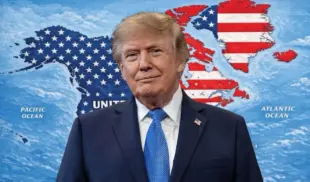
Donald Trump © REUTERS / Evelyn Hockstein
Trump’s narrative of victimization has long animated the MAGA movement. His triumph, he vowed in his first inaugural address in 2017, would end “this American carnage,” and his return to the White House, he declared eight years later, marked the end of American “decline.”In recent years, that rhetoric has spread to Europe’s Trumpian far right. Former Hungarian Prime Minister Viktor Orbán, whose government adopted “Make Europe Great Again” as the official motto for Hungary’s presidency of the Council of the European Union in 2024, praised the Trump administration’s latest National Security Strategy for recognizing Europe’s “civilizational-scale decline.”
Elon Musk has echoed the same message, both in newspaper commentaries and in a virtual appearance at a campaign rally for Germany’s Alternative für Deutschland.The idea of Western decline is not limited to far-right populists. Presenting his 2024 report on European competitiveness, former Italian Prime Minister Mario Draghi called for an EU turnaround in order to avoid the “slow agony” of decline. The newly established Rhine Group, led by Draghi and tech billionaire Patrick Collison, frames the stakes in similarly existential terms, albeit without MAGA’s nativist hysteria.
Confusion of concepts
Tellingly, these warnings almost never specify what, exactly, is declining. The term is being used to describe two different phenomena. One is absolute—and easily disproved. Are Americans and Europeans getting poorer in terms of GDP per capita, average income, or life expectancy? No. They are richer than ever. The other is relative: Is the West’s share of global output shrinking? Yes, but this has been the case for decades. The populist sleight of hand depends on collapsing the distinction between them.
The West’s declining share of global output can be largely attributed to two trends. The first is convergence: poorer countries have been catching up. Research by Nobel laureate economist Michael Kremer, Jack Willis, and Yang You finds that while real per-capita GDP in poor and rich countries diverged at an annual rate of 0.5% between 1985 and 1995, the trend subsequently reversed; GDP growth between 2005 and 2015 converged at an annual rate of 0.7%. Second, Western countries are further along in their demographic transitions. A country with a growing workforce can increase its share of global GDP even if no one gets a dollar richer.
Neither trend implies that the West has done something wrong, and neither trend prevents living standards in Western societies from rising. If anything, the opposite is true.
There is, however, one domain in which the West has actually declined: geopolitics. Relative GDP is the currency of international power, and power is much closer to being zero-sum than prosperity is. Given that much of the world’s economic activity has been concentrated in a handful of Western economies for most of the past two centuries, some loss of relative power was inevitable once the rest of the world began to catch up.
Populists seeking to exploit this shift are helped by genuine domestic grievances. While aggregate living standards across the West have risen, the gains have been unevenly distributed. US median wages, for example, barely moved between the 1970s and the mid-2000s, even as top incomes soared. More recently, post-pandemic increases in wealth and spending have been heavily concentrated among wealthy households.
Not All Decline Is Created Equal
These dynamics, sometimes described as “K-shaped growth,” point to a real decline in living standards for large segments of the population in the US and other Western countries. That’s not the same as a decline of the West as a whole, though it has turned other countries into a convenient culprit for populists seeking to leverage nationalist resentment by exploiting legitimate complaints over the distribution of income and wealth.
How political leaders define “decline” determines the agenda they pursue. If they recognize that relative decline can coexist with rising welfare everywhere, they can accept convergence and seek to establish international rules better suited to a multipolar world economy. But that path is slow. It depends on the goodwill of countries the West has spent two centuries dominating, and trust is in short supply these days.
The alternative is to treat GDP as a zero-sum contest. That path, while currently politically expedient, is likely to make almost everyone poorer.
Trump’s tariffs illustrate the second approach. As a tool for maximizing American incomes, they are absurd. But as a tool for maximizing America’s income relative to Europe’s, they make considerably more sense. At least that’s a coherent objective, though not the one Europe thinks it is negotiating over, which helps explain why Europeans have found trade talks with the Trump administration so confounding. If Europe responds to Trump’s bullying tactics in kind, the result will be a standoff that leaves both parties worse off.
Conflating absolute and relative decline is more than just sloppy thinking. Declinist rhetoric nurtures political consent for a zero-sum approach to trade and economic growth. But rejecting the harder but better collaborative path could mean having it forced upon us later, after zero-sum logic has run its course, triggered a major crisis, and forced Western governments back to the negotiating table.
From the Concert of Europe to the Bretton Woods system, new international orders have historically emerged in the wake of catastrophic wars. Waiting for another post-crisis window would be an enormously expensive and painful way to relearn the lesson that playing zero-sum games in a positive-sum world can leave everyone with less.

Carl Johan Dalgaard
is Professor of Economics at the University of Copenhagen and a former chair of the Danish Economic Councils.
Mark Medish,
a member of the US National Security Council under President Bill Clinton and a former deputy assistant secretary of the Treasury, is Vice Chair of Panterra.
© Project Syndicate, 2026.
www.project-syndicate.org
Follow our updates
Have information for the newsroom? Share it with Logos-Press