

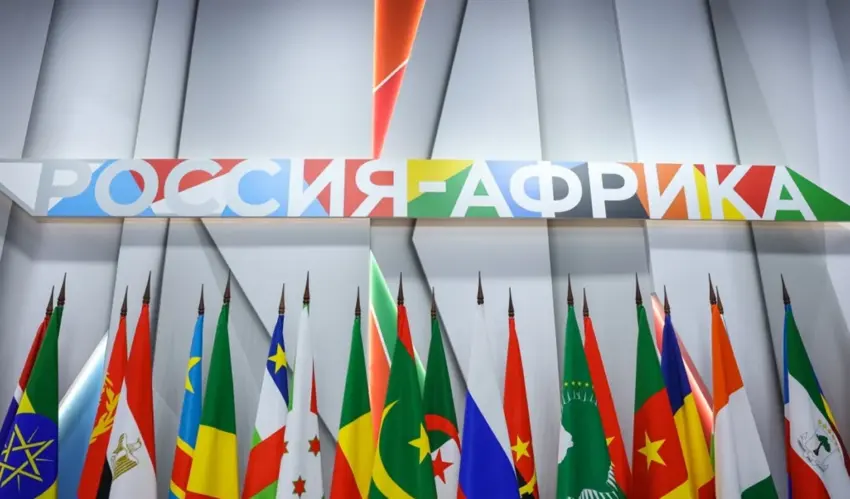
The summit is being closely watched in the US, Europe and even China. Each of these geopolitical centres has its own interests in the ‘Dark Continent’. The summit is not yet over, and its outcomes will be scrutinised closely for some time to come, particularly in Western countries. But the first assessments and comments are already emerging – regarding the seriousness of Russia’s ambitions in Africa and how this might infringe upon the interests of other major players.
Russia’s economic proposals
According to Reuters, delegations from 48 African countries are taking part in the summit, including 22 heads of state. The Russian side is seeking to expand the presence of its companies in the extractive industries, energy, agriculture and infrastructure.
The publication notes that, in his speech at the forum, Russian President Vladimir Putin stated that Moscow was prepared to transfer technology to its partners and develop production directly within African countries. According to him, Russia intends not only to purchase raw materials, but also to contribute to job creation and the generation of tax revenue in its partners’ economies.
“Russia is ready to share its experience, including in the digital sphere,” Reuters quotes the Russian leader as saying.
Among the areas of cooperation, Putin cited transport and agricultural infrastructure, the expansion of grain and fertiliser supplies, and strengthening the representation of African states in international financial institutions.
According to the Associated Press, it was announced at the forum that Russian-African trade exceeded $27 billion in 2025. Russia also supplied more than 18 million tonnes of grain to African markets last year and a further 13 million tonnes in the first nine months of 2026. Exports of mineral fertilisers, according to the figures he cited, amounted to around 1.5 million tonnes in 2025 and exceeded 2.2 million tonnes in the first nine months of this year.
But these figures relate to trade. At the summit, however, there was also discussion of Russia’s readiness to make substantial investments in African countries.
Nuclear energy: negotiations on floating power stations
One of the most concrete areas for potential investment is nuclear energy. The state-owned corporation Rosatom reported that negotiations are at an advanced stage regarding the possible supply of floating nuclear power stations to at least four African countries: Egypt, Togo, Namibia and Tanzania.
According to Reuters, Vladimir Aptekarev, deputy head of Rosatom’s engineering division, described floating nuclear power plants as a possible way for countries to begin developing nuclear energy and meet part of their electricity needs.
The proposed model involves the use of power purchase agreements, whilst maintenance and refuelling will be carried out in Russia. This could reduce the need to build some of the infrastructure on land, but at the same time implies long-term technological and service dependence on the supplier, the publication notes.
Rosatom chief Alexey Likhachev confirmed to Reuters that talks on potential projects are under way with several African countries. However, nothing is yet known about confirmed contracts with an announced value or a financing schedule, the publication states.
Another major project is the El Dabaa nuclear power station in Egypt. The plant comprises four power units, each with a capacity of 1,200 MW, fitted with Russian VVER-1200 reactors. It is currently under construction. Chatham House also highlights an agreement to build a nuclear power station in Ethiopia, noting that this project has not yet reached the stage of completed construction.
Thus, nuclear power remains one of the most promising areas of Russia’s presence in Africa, but its economic impact will depend on financing terms, the cost of electricity, construction timelines and the distribution of risks between the states and the supplier, Reuters explains.
First confirmed agreement: a cooperation plan with SADC
One of the summit’s tangible outcomes was the signing, on 28 October, of a cooperation plan between Russia and the Southern African Development Community (SADC). The document was signed by the organisation’s Executive Secretary, Elias Magosi, and Russia’s Minister of Foreign Affairs, Sergey Lavrov.
According to the SADC’s official website, the plan covers agriculture and food security, trade and investment, industrialisation, energy, mining, transport and information and communication technologies. It also provides for cooperation in education, healthcare and other areas.
The document establishes a framework for further work, knowledge-sharing and technical cooperation. However, the published statement does not specify the total funding amount, the cost of individual projects or any specific investment commitments.
Big plans and limited capabilities
Western analysts believe that Russia’s desire to strengthen its presence in Africa is hampered by its limited investment capacity and the reluctance of a number of countries to risk falling foul of Western sanctions as a result of cooperating with Moscow.
In an analysis published on 27 October by the British think tank Chatham House, the director of the Africa Programme, Tigisti Amare, notes that the economic results of Russia’s presence on the continent remain limited, despite the expansion of contacts.
“African governments view Moscow as one of several partners,” she emphasises. In her view, the scale of participation in the summit alone is not a reliable indicator of the sustainability of economic ties.
The analyst points to constraints linked to Russia’s war against Ukraine and the strain on Russian resources. In her view, new agreements may emerge, but the summit is unlikely to automatically resolve the structural problems in Russian-African cooperation.
Chatham House provides comparative data for 2025: Russia’s trade with Africa was estimated at approximately $27 billion, whilst Africa’s trade with China stood at around $348 billion and with the EU at around €355 billion. These figures illustrate the difference in the scale of trade relations, although they do not in themselves allow for an assessment of the quality of individual projects or their impact on the development of African economies.
At the heart of the critical assessment lies the question of the extent to which political declarations are translated into completed projects. In particular, agreements in the nuclear energy sector do not yet mean that new power stations have been commissioned, and the expansion of trade does not guarantee growth in local production and employment.
The economic outcome of the summit
The Russia–Africa Summit demonstrates Moscow’s desire to strengthen its position in trade, energy and the extraction of raw materials. The most concrete areas are food supplies, Rosatom’s projects and the framework agreement with SADC.
In this context, Western analytical assessments generally conclude that political rapprochement between Russia and African states is currently outpacing economic results. To assess the long-term impact of the summit, it will be necessary to monitor not only the final declaration but also new contracts, actual investment flows and the progress of previously announced projects, Western publications note.
This story was translated with the assistance of artificial intelligence.The translation was also reviewed by the Logos Press editorial team.
Follow our updates
Have information for the newsroom? Share it with Logos-Press














Comments
0No comments yet. You can start the conversation.
Comments are open to readers with a Logos Press account.
Sign in to comment