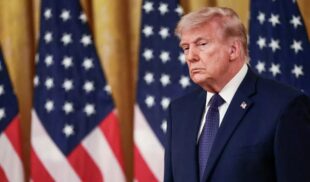
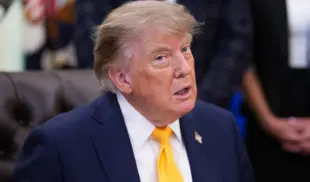
US President Donald Trump tops the ranking of people with the greatest influence on Israel’s economy for the second year running. Yet he was not elected by Israelis, holds no office in the country and has no official authority there.
This is reported by cursorinfo.co.il.
Moreover, by Rosh Hashanah, even the concept of ‘influence’ may no longer fully reflect the scale of his role. Trump has, in effect, become a figure whose decisions directly affect virtually every sphere of life in Israel. His influence on the financial situation of ordinary Israelis today is perhaps even more noticeable than that of any member of the Knesset’s Finance Committee or the Minister of Finance.
It would be more accurate to compare the American leader not with a minister or a regulator, but with a force of nature, such as an earthquake: it is impossible to control it; all one can do is try to prepare for the consequences in advance. In Trump’s case, even that is often extremely difficult.
Trump’s impact on Israel’s economy manifests itself in several areas at once. The most significant of these remains geopolitics, followed by trade policy – and, above all, tariffs – monetary conditions, including interest rates and the dollar exchange rate, as well as the reaction of the financial markets.
Sometimes a single executive order, news of new duties or a post by Trump is enough to trigger a reaction in the stock market and the shekel, and to prompt the Ministry of Finance to convene an urgent meeting.
Five channels of influence
The first and most specific channel through which the US President exerts influence is the geopolitical one. For Israel, security directly determines the state of the economy. A decision by Washington to go to war with Iran could lead not merely to economic consequences, but to the closure of airports, the mass mobilisation of reservists and the shutdown of production.
Over the past year, on many key issues, the decisive influence has come not from Balfour Street, but from the White House.
Trump largely determined the course of the confrontation with Iran, the approach to the future of Gaza and the disarmament of Hamas terrorists, as well as the regional system of pressure and the prospects for expanding the Abraham Accords.
As the situation in the Middle East improved, the risk premium narrowed: government bonds became cheaper, capital flowed into Israel, the shekel strengthened and borrowing costs fell. This created the conditions for the Bank of Israel to cut interest rates.
The second channel is Trump’s trade policy. Israeli exports to the US, which account for around a third of the country’s goods exports, are subject to a 15 per cent tariff.
The third factor is interest rates. The Bank of Israel’s decisions are not dependent on the Fed, and the interest rate differential between the two countries has not been the main factor driving the dollar-shekel exchange rate.
The fourth factor is the dollar. Its weakening is largely linked to Trump’s policies, including rising deficits and public debt, and pressure on the Fed’s independence.
The fifth and most difficult-to-measure factor is Trump’s influence on the system of government, where independent professional institutions are increasingly viewed as an obstacle.
Follow our updates
Have information for the newsroom? Share it with Logos-Press