

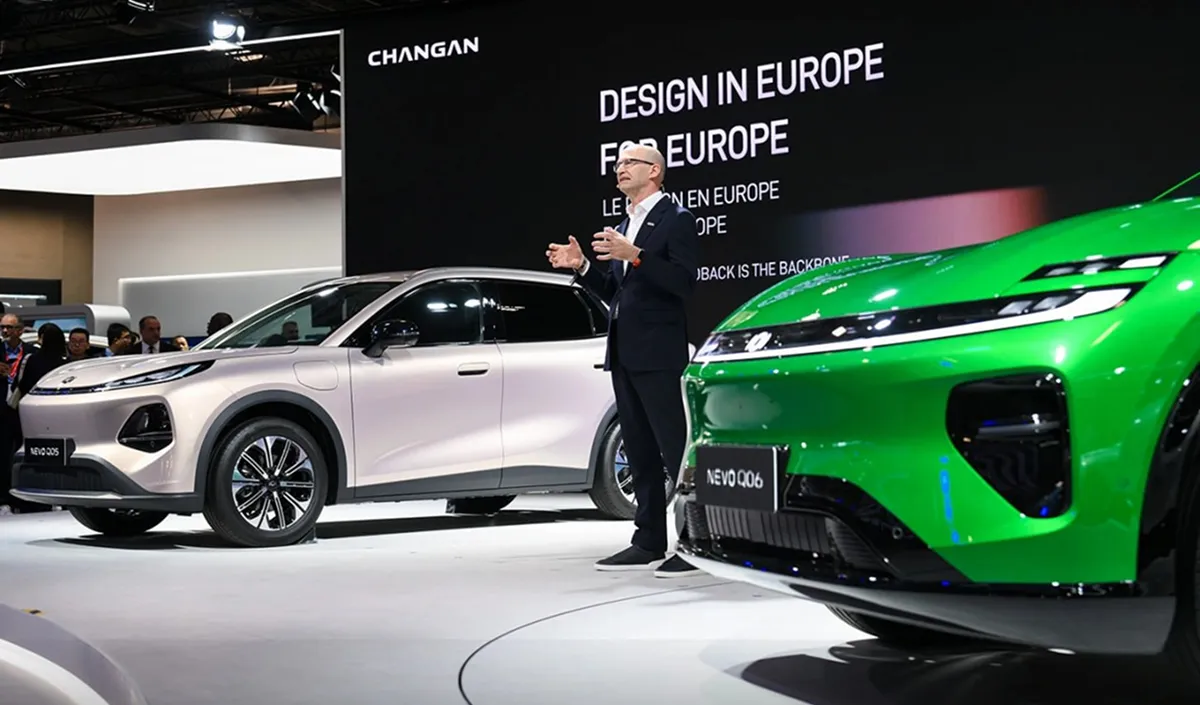
Photo: Press office of the automotive brand Changan
Three new models a day – and fewer and fewer buyers
There are over 100 car manufacturers operating in China. State support has allowed many of them to continue competing for market share, delaying a reduction in the number of players. But now the industry is facing overcapacity and weak demand, writes Reuters.
In the first half of 2026, new car sales in China fell by 20 per cent, and a rapid market recovery is not expected. According to a forecast by the consultancy firm AlixPartners, sales will not return to 2025 levels until 2030. However, manufacturers continue to ramp up supply: according to Omdia analyst Chris Liu, the Chinese car industry is launching an average of three new models a day this year. “This is the worst possible year to launch a new car in China,” he noted.
The US market is largely closed to Chinese brands, so Europe is becoming a key focus for expansion. “If they cut exports to Europe, they will go bankrupt,” warned François Rudier, Secretary-General of the International Organisation of Motor Vehicle Manufacturers. According to him, the new EU-China agreement, which provides for a halving of imports of Chinese hybrid cars into the European Union, will intensify competition within China even further. “Now you’ll have to eat your neighbour,” he said.
Beijing is preparing the industry for consolidation
In September, the Chinese Ministry of Industry included consolidation in its roadmap for the development of the automotive sector up to 2030. The first significant step has already been taken: the agreement provides for the merger of the assets of two of Toyota’s Chinese partners — the state-owned FAW and the Guangzhou Automobile Group (GAC), which is controlled by the Guangdong provincial authorities.
Gartner Vice-President Pedro Pacheco described the project as one of the most complex from a management perspective: it involves companies reporting to different levels of the Chinese government, as well as a foreign partner.
Experts expect that, as a result, only a few globally competitive manufacturers will remain. One executive at a major Chinese car manufacturer, who wished to remain anonymous, predicts that annual sales for each of the surviving players will amount to 5–6 million cars.
In Europe, the early birds have the advantage
Success abroad could become one of the criteria by which Beijing assesses the viability of companies. “If things go better abroad, the government will say: ‘You really can survive on your own’,” noted Liu from Omdia.
BYD, Chery and MG have already consolidated their positions in Europe. Newcomers will have to compete on more than just price: they need dealerships, spare parts warehouses, repair networks and high-quality after-sales service. The residual value of cars is also important – especially in a market where more than half of new cars are purchased on lease.
Changan, which entered the European market last year, aims to establish a network of 650 dealerships by 2027. Great Wall Motor is preparing to return to Europe following an unsuccessful first attempt.
According to Philip Notard, Director of Analytics at Cox Automotive, BYD, Chery and MG have already invested heavily in strengthening their positions, leaving fewer opportunities for latecomers.
For the Chinese automotive industry, Europe is becoming not merely an export market, but a test of survival. The battle for customers and dealer networks may determine which four or five Chinese manufacturers will emerge as global leaders, and which will not survive the consolidation.
This story was translated with the assistance of artificial intelligence.The translation was also reviewed by the Logos Press editorial team.
Follow our updates
Have information for the newsroom? Share it with Logos-Press
















Comments
0No comments yet. You can start the conversation.
Comments are open to readers with a Logos Press account.
Sign in to comment