

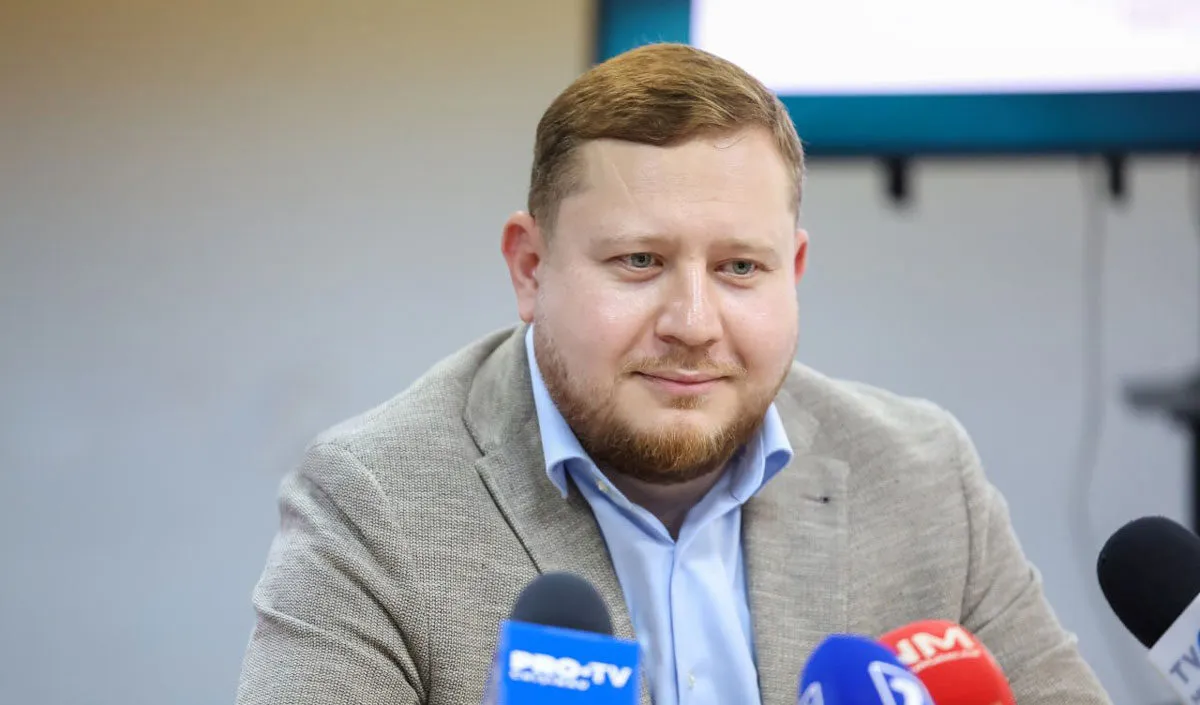
Eugeniu Buzatu/ Photo IPN / Elena Covalenco
Eugeniu Buzatu, Acting Director-General of the state-owned company Energocom, spoke in detail to Logos Press about the advantages and disadvantages of each of these methods and about the overall situation regarding Moldova’s gas supply.
LP: – At present, Energocom purchases gas under forward contracts. What does this mean?
– A forward contract is an agreement, concluded in advance, to supply a specific volume of gas at a future date (for example, next month or quarter). Its main purpose is to guarantee that, at the required time, the gas will physically be delivered to consumers in the required volume.
For a company responsible for the security of the country’s gas supply, supply security is a priority, whilst price remains an equally important criterion. The aim is to secure the necessary volumes on the most competitive market terms possible.
LP: – Why can’t Moldova purchase all its gas on regional exchanges?
– Yes, people often ask why gas isn’t purchased on the exchanges in Moldova (BRM) or Romania, where prices for short-term contracts are sometimes lower than in Europe.
Regional exchanges are a useful tool, and Energocom makes use of them. However, they have an objective limitation: liquidity. The volumes offered for sale are usually much smaller than Moldova’s monthly demand, especially in winter. If a large buyer enters such a market with a substantial volume, their demand quickly exhausts the available supply; sellers raise their prices, and as a result, the buyer pays more but still cannot purchase the required amount of gas.
Furthermore, low prices on regional trading platforms are, as a rule, a temporary phenomenon in the short term; over time, they converge with the European TTF benchmark, as market participants are quick to exploit the price differential. Therefore, a regional exchange can supplement procurement but cannot serve as the primary source of gas for the entire country.
LP: – Why are purchases made through tenders?
– To ensure it secures the required volumes, Energocom conducts competitive tendering procedures involving major international suppliers, producers and trading companies that are physically capable of delivering the required volume of gas to the Moldovan border within the required timeframes. Suppliers compete with one another; the winner is the one offering the most favourable terms whilst meeting the requirements for reliability and volumes. This mechanism ensures both competition and transparency.
How the price is determined. The price under these contracts is linked to TTF quotations – the main gas price indicator in Europe – for the relevant month of supply, taking into account the most competitive premium or discount offered by the successful tenderer.
Thus, the price reflects market conditions on the European market, whilst competition between suppliers determines the final terms. At the time of the procurement process, forecasts from specialist analytical and trading organisations gave no reason to believe that a fixed price would be more advantageous than a market-based formula.
Why, then, are forward contracts the optimal solution for Moldova? This instrument combines several essential conditions: guaranteed volumes and delivery dates, a market-based and verifiable price, standard terms accepted in European gas trading, and no need to tie up large sums in the form of exchange guarantees. It also reduces the risk that, at a critical moment, there simply will not be enough gas on the market.
LP: – Previously, Moldova used to purchase natural gas on the spot market during periods of low prices, inject it into underground storage facilities in Ukraine and Romania, and use it during the cold season. Why did you stop doing this?
– Energocom has not abandoned gas storage. Storage facilities remain one of the tools for energy security, and the company utilises them when it is economically and operationally justified.
It should be noted separately that the legislation of the Republic of Moldova, in accordance with the country’s obligations under the Energy Community, provides for mechanisms to ensure security of supply, including the build-up of gas reserves. Such stocks are established on the basis of decisions and in volumes set by the authorised state bodies, and serve primarily as a safeguard in the event of supply disruptions, rather than as a means of generating commercial profit. However, it is important to understand how the commercial storage strategy works in practice.
The profit from storage depends on the difference between the price of gas at the time of injection and the expected price at the time of withdrawal. If this difference is sufficient to cover all associated costs, storage may be justified.
However, this difference is not constant and cannot be known in advance with sufficient accuracy. If it proves insufficient, gas from storage ultimately costs more than purchasing it during the consumption period via forward contracts. Therefore, such decisions involve significant commercial risks, which are difficult to assess in advance and to accept.
If such a risk materialises, the additional costs are passed on to consumers in the price of gas, and the decision itself inevitably attracts criticism and questions from stakeholders, including regarding the extent to which such actions were in line with the powers granted to the company.
Furthermore, the cost of gas in storage is not limited to the purchase price. Added to this are charges for injection, storage, and transport to and from the storage facility, as well as the cost of financing – payment for the gas is made in the summer, whilst it is sold to consumers in the winter, meaning that funds are ‘frozen’ for several months.
It should also be borne in mind that the Republic of Moldova does not have its own gas storage facilities, so reserves can only be built up in the storage facilities of neighbouring countries. This entails additional transport costs, as well as dependence on the availability of storage capacity and transport routes, and on the conditions prevailing in those countries.
In the case of Ukraine, there are additional risks associated with military operations; the country’s energy infrastructure is regularly subjected to attacks, which creates further uncertainty regarding the safety and timely availability of reserves.
Finally, no one knows in advance which price will turn out to be the lowest over the course of the year. A decision that looks ideal in hindsight would, at the time it was taken, have been a gamble based on a forecast. Therefore, decisions on storage are made on the basis of total cost and the reliability of supplies, rather than an attempt to predict the moment when the market price will be at its lowest.
LP: – For many years, Moldova has been buying gas from the Russian giant ‘Gazprom’ under direct long-term contracts. There is now much talk about the need to conclude such contracts – if not with ‘Gazprom’, then with other suppliers. Is this feasible, and would it make gas cheaper?
– Long-term contracts are widely used in the European market, and in theory they can be concluded with various suppliers. However, having a long-term contract does not in itself guarantee a lower price. The final cost depends on the pricing formula, supply terms, flexibility regarding volumes, and the guarantees and obligations of the parties.
Firstly, regarding the pricing formula, in modern long-term contracts the price is usually linked to market indicators, most commonly the TTF. This means that as the market rises, so does the contract price. The long-term nature of the agreement ensures stability of supply, but does not protect against fluctuations in European market prices.
Secondly, it is important to understand the supplier’s economic rationale. If a seller can sell the same volume of gas at market price on liquid European trading platforms, they have no economic incentive to sell that gas at a significantly lower price for years to come. Any concession on price is usually offset by other terms: commitments to purchase minimum volumes, additional guarantees, stricter contractual obligations, or a risk allocation in favour of the seller. In other words, a ‘cheap’ long-term contract usually comes at a price in terms of other conditions of the agreement.
Thirdly, such contracts often contain a ‘take-or-pay’ clause, whereby the buyer is obliged to pay for an agreed minimum volume even in the event of a decline in consumption or a fall in market prices. For a country with relatively low and highly seasonal consumption, this can create additional financial risks.
Fourthly, long-term commitments require substantial financial guarantees, and major producers focus primarily on buyers with large and stable consumption volumes.
The regulatory and legal aspects of the matter should also be taken into account separately. In accordance with Article 85(9) of the Natural Gas Act No. 108/2016, suppliers providing gas under public service obligations are required to strike a balance between obtaining the lowest possible cost for the gas purchased and ensuring the reliability of supply to consumers over a reasonable period of time. At the same time, Act No. 74/2020 on procurement in the energy sectors provides for competitive procurement procedures that ensure the participation of all interested suppliers and the selection of the most advantageous bid.
This is precisely why traditional long-term contracts, such as the historic contracts with ‘Gazprom’, cannot be viewed solely through the prism of price. As a rule, such agreements are not the result of open competitive procedures in which all potential suppliers can participate. More often than not, they arise from direct negotiations and are frequently based on broader intergovernmental agreements and political dialogue between the parties.
For this reason, the question is not only whether there is a supplier willing to sign a long-term contract, but also whether such a contract can be concluded within the framework of current legislation and sectoral regulation. Equally important is the question of its subsequent recognition within the supplier’s regulated portfolio. In this regard, the position of the National Energy Regulatory Authority (NERA) is of significant importance, as it is the regulator that assesses the reasonableness of the costs of gas procurement for regulated supplies to consumers.
Therefore, when discussing the advantages of long-term contracts, one should take into account not only the potential price of gas, but also legislative requirements, the need to comply with competitive procedures, issues of tariff regulation and the allocation of risks between the supplier and end consumers.
Finally, dependence on a single supplier also constitutes a risk factor from the perspective of energy security. This is precisely why European practice in recent years has focused on diversifying supply sources and combining various procurement instruments, rather than relying exclusively on a single supplier or a single type of contract.
LP: – There is another type of contract in the world – futures. Can they be used, and if not, why not?
– Futures are standardised financial instruments traded on exchanges and used primarily to manage price risk, that is, to lock in a price in advance. It is important to understand that futures do not make gas cheaper. They make the price predictable; if the market subsequently falls, the buyer with a fixed price will pay more than the others.
There are also practical considerations. Futures are traded on Western European exchanges and are linked to delivery at the relevant hubs, rather than in Moldova; therefore, the physical delivery of gas still needs to be organised separately. Furthermore, the exchange requires the posting of margin and its daily top-up as prices fluctuate. During periods of sharp volatility, such as in 2022, these requirements increased to such an extent that even large European companies had to seek state support in order to maintain liquidity.
The regional context must also be taken into account. In the Republic of Moldova, there is no market for energy-related financial derivatives. In neighbouring countries, the range of such instruments offered by financial institutions remains extremely limited and, as a rule, is not designed to handle volumes comparable to Moldova’s needs. Consequently, the regional market currently offers no viable alternatives for hedging price risk, and such transactions are only possible on major Western European exchanges, with all the characteristics described above.
Consequently, for an importer obliged to ensure actual deliveries to consumers, physical contracts with clearly defined volumes, delivery dates and delivery points remain the foundation. Futures and other hedging instruments may serve as a supplement within a risk management framework, but they are not a guaranteed way to buy gas more cheaply.
LP: – Are there any other options for buying gas more cheaply than at present?
– There is no universal mechanism that would allow gas to be purchased consistently at the lowest price. Moldova is a small player in the European market and cannot influence price formation. The cost of gas for the country is determined by pan-European factors – weather conditions, seasonal demand, EU stock levels, the availability of supplies (including liquefied natural gas), and the geopolitical situation. Therefore, the issue is not about finding a single ‘correct’ instrument, but about skilfully combining the available ones.
Each of the mechanisms considered has its own advantages and limitations. Forward contracts concluded following competitive tendering procedures guarantee the required volumes at market price with a competitive premium. Regional exchanges allow for the additional use of favourable short-term offers, but are unable to cover the country’s entire demand. Storage may be justified where there is a favourable price differential, but it entails additional costs and risks. Hedging instruments help to make prices more predictable, but do not make gas cheaper and are currently virtually unavailable in the region. Long-term contracts ensure stability of supply, but do not guarantee a lower price.
This is precisely why cost reductions are achieved not by a single solution, but through a combination of measures: expanding the range of suppliers and increasing competition between them; spreading purchases over time rather than acquiring the entire volume at once; taking advantage of market opportunities as they arise; managing stocks effectively; and optimising logistics costs.
Moldova’s further integration into the European energy market also plays an important role, as this will, over time, expand access to new sources, routes and instruments.
The main lesson of recent years is that security of supply and competitive pricing are two interlinked objectives, and neither should be sacrificed for the sake of the other. In hindsight, one can always find a day when gas was cheaper on the market.
However, the lowest price on any given day does not constitute a procurement strategy for an entire country. The task of a company responsible for energy security is to make decisions based on the information available at the time of procurement and to ensure an uninterrupted supply of gas to consumers on the most competitive terms possible.
This story was translated with the assistance of artificial intelligence.The translation was also reviewed by the Logos Press editorial team.
Follow our updates
Have information for the newsroom? Share it with Logos-Press














Comments
0No comments yet. You can start the conversation.
Comments are open to readers with a Logos Press account.
Sign in to comment