


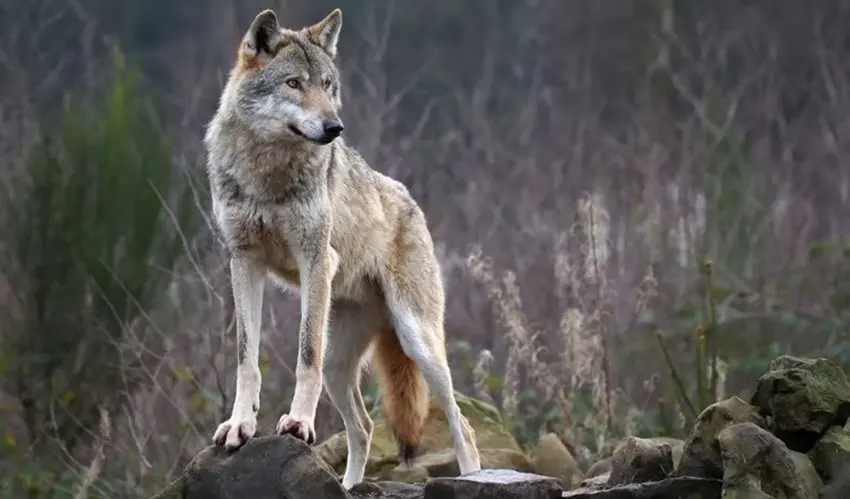
On his Facebook page, Marc Tkaciuk reported that on 4 November, the situation in Ivanovka was discussed at a working meeting in parliament. The meeting was attended by members of the parliamentary committee on the environment, climate and green transition, as well as representatives of the Ministry of the Environment, the Environmental Protection Inspectorate and the General Inspectorate of the Border Police. The following facts emerged.
According to data from the Institute of Zoology, the presence of around 15 wolves has been confirmed in the Basarabească area; these are organised into three packs and are permanent residents of this territory (note from LP: this has been the case for several years; more on this below). In addition to the resident population, packs of wolves from neighbouring natural areas in Ukraine and Romania frequently migrate through the forested regions of the south of the country. According to the Ministry of Ecology, in the autumn of 2025 and during the winter and spring of 2026, the total wolf population at national level is estimated at approximately 95 individuals, of which around 25 are concentrated in the southern region of the country.
The wolf in Moldova is a species protected at both national and international levels (including under the Bern Convention on the Conservation of European Wildlife and Natural Habitats). Consequently, hunting this species is prohibited, even if the animals approach populated areas. The use of acoustic devices is recommended as an immediate measure to deter predators. (Black humour, of course, but it brings to mind the classic: ‘Wolf, wolf!’).
According to the MP, a list of potential solutions was drawn up following the meeting. Firstly. Urgent amendments to the legislation are required. Specifically, the Nature Conservation Act needs to be amended to regulate the procedure for rapid intervention by authorised bodies in cases where individuals of protected wild species pose an imminent threat to the life, health and property of the population.
Secondly. The criteria and procedure for assessing and paying compensation for damage caused by wildlife to domestic animals must be reviewed. In this regard, it is recommended that the advisability of amending the relevant regulatory acts be assessed.
Thirdly. Administrative measures have been proposed in the field of game management. In particular, it is deemed appropriate to submit a request to the leadership of the Ministry of the Environment with a view to ‘approving an additional day per week for individual hunting of jackals and foxes, with the right to carry out specialised wolf deterrence operations to reduce predator pressure on residential properties’.
Fourthly. It has been recognised as absolutely essential to seek and secure funding for a national programme of continuous monitoring of the wolf population within the Republic of Moldova.
And what do hunters have to say?
In a comment to Logos Press, Oleg Ciocoi, chairman of the board of the Moldovan Hunters and Anglers Society, noted that the country’s population has had a ‘troubled relationship’ with wolves for several years now, and that this trend is intensifying. According to data from the Institute of Zoology, stable wolf packs have been recorded in three regions of the country – Basarabească, Căușeni and Ungheni. However, the range of these animals is expanding. Video footage has emerged confirming their regular presence in other regions as well.
According to the head of the relevant association, the measures recommended by the authorised state bodies – fencing, audio deterrents and other ‘electronic shepherds’ – are likely to provide only a temporary and limited effect. At the same time, they will entail significant costs, which, it must be assumed, will largely ‘fall on the shoulders of the population’.
Hunting, as a radical and most effective method of controlling the wolf population, is indeed prohibited in Moldova by local legislation and the aforementioned convention. However, as experience from other countries shows, in emergency situations, the issue of obligations under this international agreement can be resolved fairly quickly and easily at government level through a request or notification to the relevant European body.
As Oleg Ciocoi notes, the ‘wolf problem’ in Moldova is notable for its relative novelty and, above all, for the size and danger posed by these predators. In this sense, an analogy with the ‘Carpathian bear problem’ in Romania is apt.
However, the ‘jackal problem’ is even more acute in Moldova. These smaller predators are an invasive species that successfully compete with foxes in the ‘food chain’. In Europe, they have now spread as far as Norway. In Moldova, jackals first appeared in significant numbers in the late 1990s and have since multiplied rapidly. Under Moldovan law, the jackal is a permitted game species. Statistics compiled by the hunting association show that five years ago, around 300 of these animals were culled annually, whilst last year the figure was around 1,700. According to expert estimates, the total jackal population in Moldova exceeds 4,000 individuals. In other words, the scale of the problem is quite significant.
In this regard, the source cited notes that the presence of predators – particularly jackals and foxes – within the boundaries of Moldova’s settlements is also an indicator of their sanitary conditions. The animals are searching for food – and find it not only on livestock farms, but also at rubbish tips and in rubbish heaps near households.
There is another worrying fact: if an animal has overcome its natural fear of humans, the motive may not be limited to hunger, curiosity or an established habit. A change in behaviour may also be caused by disease, in particular rabies. Consequently, any encounter with a wild animal should be taken seriously.
This story was translated with the assistance of artificial intelligence.The translation was also reviewed by the Logos Press editorial team.
Follow our updates
Have information for the newsroom? Share it with Logos-Press





















Comments
0No comments yet. You can start the conversation.
Comments are open to readers with a Logos Press account.
Sign in to comment