


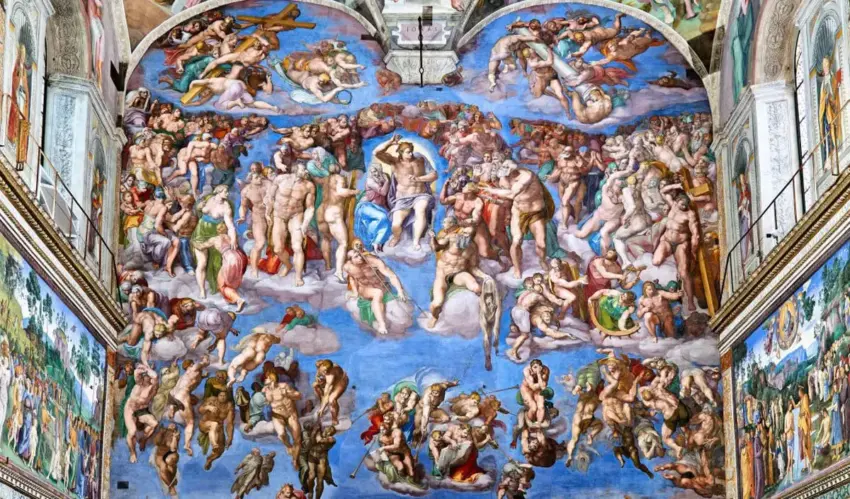
Foto Governatorato SCV/Direzione dei Musei Vatican
According to The Times, the discovery was made by Paolo Violini, chief restorer at the Vatican Museums’ Painting Laboratory. In February, when the chapel was closed to visitors and scaffolding was erected, experts were able to examine the 16th-century fresco in detail. They removed white salt deposits from its surface, which had formed, in part, due to the sweat of thousands of visitors. Demineralised water and special absorbent paper were used for the cleaning process.
Once the deposits had been removed, the original richness of the colours was restored, and with it, the distinctive features of the painting technique became apparent. Violini noted that parallel brushstrokes exhibited identical characteristic fluctuations. This suggested that the artist worked with brushes featuring multiple bristle heads, each of which left a distinct mark.
According to the restorer’s assessment, Michelangelo crafted such tools himself. Some had three bristles, whilst others were up to 15 cm wide and could comprise as many as ten working elements. This design allowed several brushstrokes to be applied simultaneously, speeding up the work and creating a hatching effect.
Violini believes that Michelangelo transferred techniques from sculpting stone into his painting. Using a multi-faceted chisel, the artist achieved a distinctive play of light on the marble and sought to reproduce a similar effect using brushes. ‘With their help, he attempted to convey that vibration of light which he had managed to create as a sculptor,’ explained the restorer.
‘The Last Judgement’, depicting more than 300 figures, was completed in 1541 after five years of work. The large-scale composition covers the wall behind the altar of the Sistine Chapel and remains one of the Renaissance artist’s most famous works.

This story was translated with the assistance of artificial intelligence.The translation was also reviewed by the Logos Press editorial team.
Follow our updates
Have information for the newsroom? Share it with Logos-Press
























Comments
0No comments yet. You can start the conversation.
Comments are open to readers with a Logos Press account.
Sign in to comment