

Photo: Oninvest
At the end of the third quarter of 2026, ASML’s revenue rose by 55 per cent year-on-year to €11.66 billion. Net profit stood at €4.96 billion, whilst the gross margin reached 57.5 per cent. The company has also raised the lower end of its annual sales forecast, reports Hotnews.ro, citing its official financial report.
Production capacity is struggling to keep up with orders
According to ASML’s CEO, Christophe Fouquet, customers continue to raise their short- and medium-term forecasts for equipment demand. Their expectations are largely linked to the scale and duration of investment in artificial intelligence.
Some customers are already considering placing orders for equipment to be delivered in 2029 and even 2030.
The company is exploring options to increase production capacity by more than 30 per cent by 2028 — exceeding its previously announced plan. However, ASML warns that current production plans will not be sufficient to fully meet expected demand in either 2027 or 2028.
In the fourth quarter, the company expects to generate revenue of €14.2–15.2 billion, with a gross margin of around 57 per cent.
Why ASML has become a key supplier to the AI industry
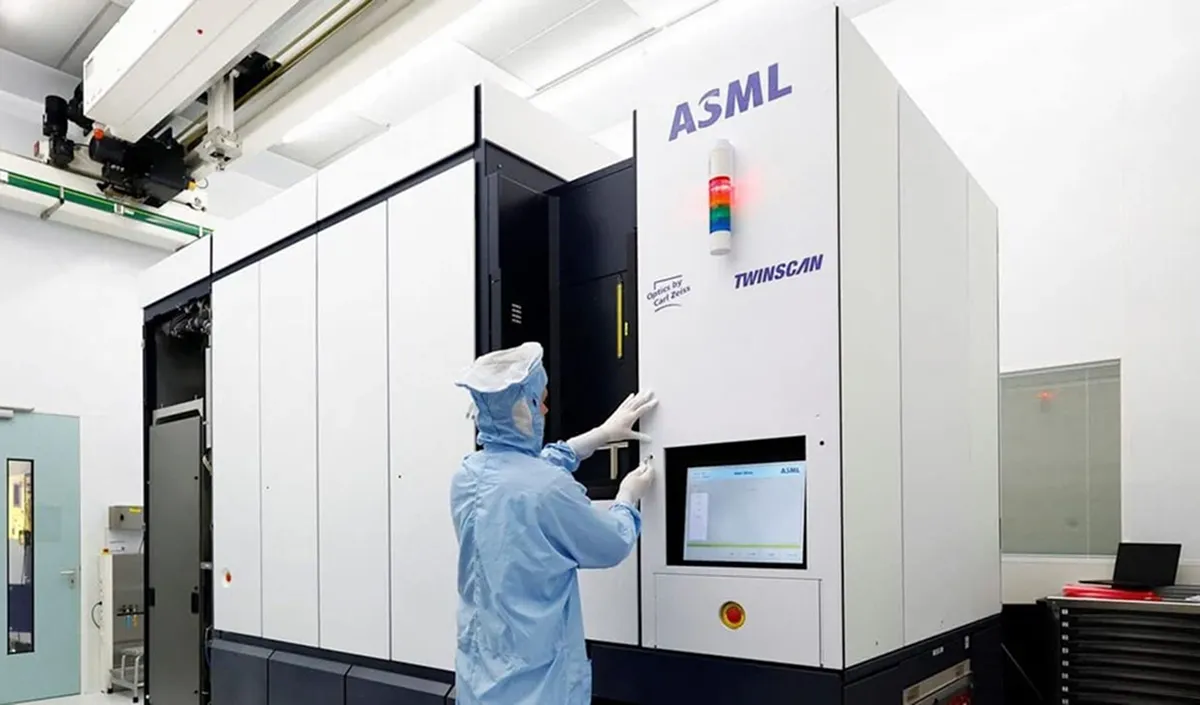
ASML manufactures equipment for photolithography — one of the most critical stages in semiconductor production. In particular, the company is the sole supplier of industrial lithography systems using extreme ultraviolet (EUV) light, which are essential for the production of the most advanced microchips.
These systems enable the etching of extremely fine structures onto silicon wafers, from which the electronic circuits of processors are formed. Such chips are used in artificial intelligence accelerators, data centres and high-performance computing systems.
Growing demand for computing power from the largest technology companies is driving investment in new production lines. As a result, there is an increasing need not only for the microchips themselves, but also for the sophisticated equipment required to manufacture them.
A distinctive feature of ASML’s business is that expanding the production of such systems requires time and the coordination of a complex supply chain. Consequently, even a sharp rise in orders cannot be immediately offset by an increase in output.
What the equipment shortage means for the chip market
The situation with ASML shows that constraints on the development of artificial intelligence are not solely linked to the availability of computing resources or the cost of electricity. The semiconductor industry’s ability to establish new production capacity in a timely manner is becoming a key factor.
If equipment deliveries fall short of chip manufacturers’ plans, the expansion of advanced semiconductor production may proceed more slowly than technology companies anticipate. This could affect the timing of new production launches and the pace of AI infrastructure development.
For ASML, the growing order book presents opportunities for further sales growth. However, the company faces a complex manufacturing challenge: to ramp up equipment production whilst maintaining the quality and technological sophistication of the systems on which a significant portion of the global advanced microchip industry depends.
This story was translated with the assistance of artificial intelligence.The translation was also reviewed by the Logos Press editorial team.
Follow our updates
Have information for the newsroom? Share it with Logos-Press




















Comments
0No comments yet. You can start the conversation.
Comments are open to readers with a Logos Press account.
Sign in to comment