

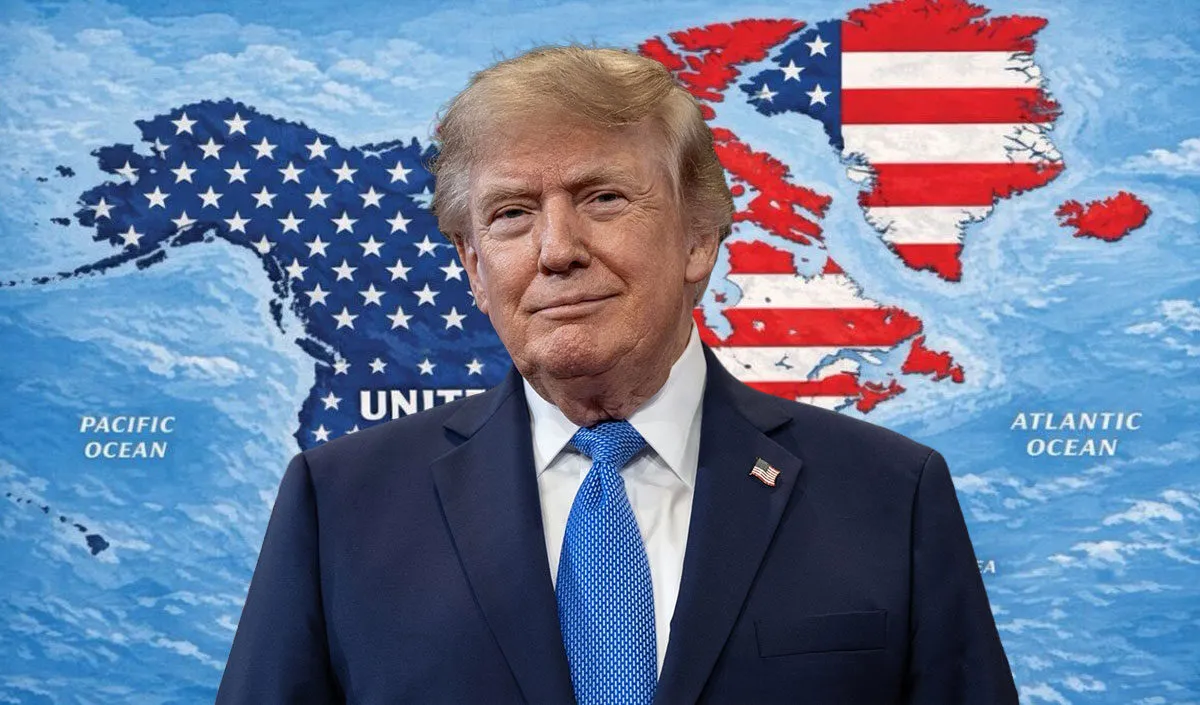
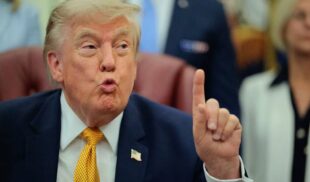
Donald Trump
The message is clear: in today’s world, where right is determined by might and geopolitical power tramples on accepted rules, territorial revisionism is once again coming to the fore.
The US, once a defender of territorial integrity, has become a force opposing the existing order and is actively undermining one of the cornerstones of the post-war world order: the belief in the inviolability of international borders. Trump is particularly fixated on Greenland – an autonomous territory of Denmark, a NATO member – insisting (without any evidence) that if the US does not seize it, China or Russia will. He has gone so far as to resort to the threat of military invasion.
Trump has also mused about annexing Canada. His statement that a border is nothing more than an ‘artificially drawn line’ is not merely a throwaway remark, but an expression of his territorial ambitions.
From the US Board on Geographic Names’ directive to refer to the Gulf of Mexico as the ‘Gulf of America’ to the renaming of Lake Ontario as ‘Lake America’ – he has repeatedly demonstrated his expansionist ambitions.
Of course, Trump’s manoeuvres have not yet led to the acquisition of new US territories, and, when it comes to a country such as Canada, they will in no way undermine its sovereignty or territorial integrity. However, they have normalised the rhetoric of territorial revisionism, whilst simultaneously advancing Trump’s efforts to bend geopolitics to his will. His threats to ‘take back’ the Panama Canal – by force if necessary – forced Panama to agree to limit China’s influence in the region and to allow for an increased US military presence.
Trump’s territorial threats have also facilitated an outrageous seizure of resources. Following the deployment of troops to Venezuela and the ousting of its president, Nicolás Maduro, Trump has repeatedly made it clear that the US would ‘run’ the country, and floated the idea of it becoming the 51st state of the US. The leader whom the US left at the helm – Vice-President Delcy Rodríguez – has now agreed to a deal that gives the US control over more than 65 billion barrels of Venezuela’s oil reserves.
Following in the US’s footsteps
Other countries are taking note. Argentina’s right-wing President Javier Milei, an ally of Trump, recently reignited his country’s long-running dispute with the UK over the Falkland Islands, bolstering Argentina’s naval presence in the region. Meanwhile, Ceuta, a Spanish exclave on the Moroccan coast, faced a border crisis under Trump.
Although Ceuta and neighbouring Melilla have been sovereign territories of Spain for centuries, Morocco lays claim to both territories. Nevertheless, Morocco has largely accepted the status quo, partly because the US ensured it was upheld. In 2002, when Morocco deployed a small contingent to the tiny uninhabited island of Perejil, located a few miles from Ceuta, Spain launched a military operation to drive them out, but US mediation prevented the conflict from escalating.
However, Morocco realises that Trump does not share his predecessors’ commitment to the territorial status quo. During his first term, he officially recognised Morocco’s sovereignty over another disputed territory: Western Sahara, a former Spanish colony that Morocco annexed in 1975, after which it entered into a struggle for control over it with the indigenous Sahrawi people.
The recognition of Morocco’s sovereignty was not a mistake: the United Nations’ efforts to secure independence for Western Sahara are simply unrealistic. However, Trump’s unilateral approach sent the wrong signal to a country seeking to assert its territorial claims in other regions. Trump’s behaviour following his return to the White House in 2025 only reinforced this signal.
Last April, the US House of Representatives Appropriations Committee published a report in which Ceuta and Melilla were described as territories under Spanish administration and ‘located within Morocco’. It also called on Secretary of State Marco Rubio to initiate negotiations between the parties regarding their ‘future status’. Morocco has been further emboldened by the cooling of relations between the US and Spain, caused by Socialist Prime Minister Pedro Sánchez’s willingness to challenge Trump (not least over the war with Iran).
Apart from reiterating their claims to Ceuta and Melilla, the Moroccan authorities did nothing last month to prevent tens of thousands of young Moroccans from crossing the border into Ceuta (they returned to Morocco shortly afterwards).
Although the details of how this influx came about remain unclear, it is quite likely that Moroccan agents allowed it to happen with their tacit consent. In any case, Trump was delighted that Spain had failed to defend its borders, and there are grounds for believing that his administration may consider re-examining the issue of Ceuta as an unresolved territorial dispute.
Dangerous precedents
The implications of Trump’s support for territorial revisionism extend even further. If the US can lay claim to territories on the basis of vague ‘national security’ justifications, then China could do the same with regard to Taiwan, the Senkaku Islands under Japanese administration, and the entire South China Sea.
And Russia could do the same in Ukraine. In fact, the Trump administration’s ‘peace plan’ for Ukraine implies that the country would have to cede territories that Russia does not even control.
Perhaps no country benefits more from Trump’s disregard for territorial integrity than Israel. During his first term, Trump unilaterally recognised Israel’s sovereignty over the Syrian Golan Heights. In his second term, he has come to regard Israel’s ongoing incursions into Syrian territory – not to mention Turkish expansion into northern Syria – as the new normal. The same applies to Israel’s presence in southern Lebanon, which was enshrined in a memorandum of understanding brokered by Rubio.
Despite Trump’s 20-point peace plan for Gaza, there are no signs that the US administration will challenge Israel’s new ‘forward defence’ security doctrine, which shifts military operations into so-called buffer zones beyond its borders. Israeli Prime Minister Benjamin Netanyahu can surely hardly believe his luck.
Shlomo Ben-Ami,
a former Israeli foreign minister, is the author of *Prophets Without Honour: The 2000 Camp David Summit and the End of the Two-State Solution* (Oxford University Press, 2022).
© Project Syndicate, 2026.
www.project-syndicate.org
Follow our updates
Have information for the newsroom? Share it with Logos-Press



















Comments
0No comments yet. You can start the conversation.
Comments are open to readers with a Logos Press account.
Sign in to comment