

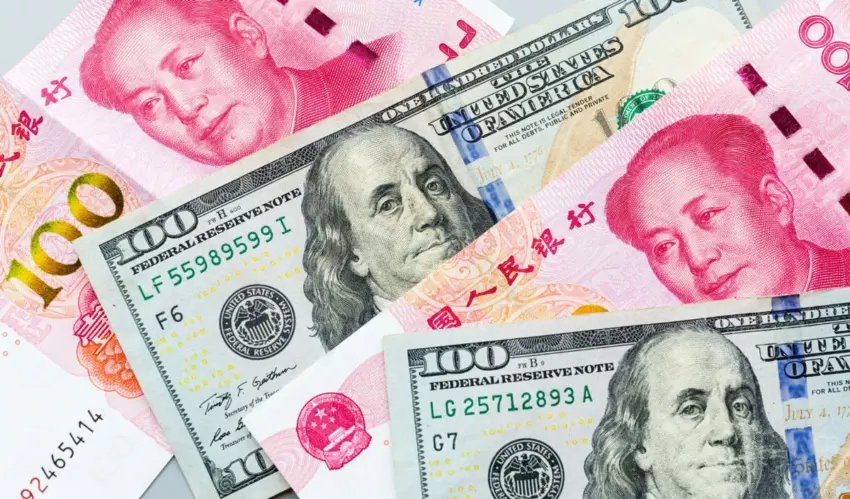
China could strengthen the yuan’s international standing through its influence on the markets for clean energy equipment, critical minerals and electrical infrastructure, according to an article in the American journal Foreign Affairs. The publication argues that Beijing does not necessarily need to displace the dollar as the world’s leading currency in order to reduce its dependence on the US financial system.
The green industry as a tool of currency policy
The article, ‘The China Price: Beijing’s Green Path to Ending Dollar Dominance’, examines the link between China’s industrial advantages and its ambition to expand the international use of the yuan.
China holds a strong position in a number of segments of the green energy supply chains. These include, in particular, critical minerals, clean energy equipment and electrical systems necessary for the development of low-carbon infrastructure.
According to the author, if China can consolidate its advantage in these sectors, it will gain further opportunities to influence the terms of international trade in the relevant products. One potential outcome could be the wider use of the yuan in pricing and settlements for Chinese exports.
Thus, industrial policy and the development of green technologies could serve as an additional tool for Beijing to expand the international role of its national currency.
Why China does not necessarily need to supplant the dollar
A key message of the article is that a full-scale replacement of the dollar by the yuan is not necessarily in China’s interests.
The status of the world’s leading reserve currency requires deep financial markets that are accessible to international investors, as well as the ability to freely place, transfer and reinvest capital. Capital controls in China and persistent barriers for foreign investors make it difficult for the yuan to become a fully-fledged alternative to the dollar.
Rather than striving for unqualified currency leadership, Beijing may seek to establish a sufficiently developed system for international settlements in yuan, which would allow part of its foreign trade transactions to be conducted without relying on the dollar-based infrastructure.
This also has geopolitical significance, the article argues. The broader the network of alternative settlement and financial channels, the less Chinese companies and banks will depend on mechanisms falling under US jurisdiction. In particular, such an infrastructure has the potential to reduce China’s vulnerability to US financial sanctions.
What is holding back the internationalisation of the yuan
Despite the expansion of the Chinese currency’s international use, the dollar retains a significant advantage. To strengthen the yuan’s position, it is not enough simply to facilitate payments: well-developed funding markets, currency risk management tools and opportunities for foreign participants to invest the funds they receive in liquid assets are also required.
A further constraint is the nature of the Chinese financial system, including capital controls and uncertainty regarding the conditions under which foreign investors can access domestic markets.
Therefore, the expansion of yuan-denominated settlements does not in itself signify an imminent change in the global currency hierarchy. A more realistic scenario, notes Foreign Affairs, is the gradual development of alternative trade and financing channels in specific strategically important sectors.
This story was translated with the assistance of artificial intelligence.The translation was also reviewed by the Logos Press editorial team.
Follow our updates
Have information for the newsroom? Share it with Logos-Press





















Comments
0No comments yet. You can start the conversation.
Comments are open to readers with a Logos Press account.
Sign in to comment