


Photo: Reuters
The trigger was Judge Anna Korwin-Piotrowska’s decision to temporarily suspend the Tribunal’s President, Bogdan Swenczkowski, and his deputy, Bartłomiej Sokhanski, reports RBC. She stated that the Tribunal’s leadership was obstructing the work of the new judges elected by parliament and, in doing so, was paralysing the entire institution.
Korwin-Piotrowska announced the suspension of both leaders’ powers for one month and assumed the duties of president. She also convened a general meeting of judges for 3 November to decide on the tribunal’s future operations.
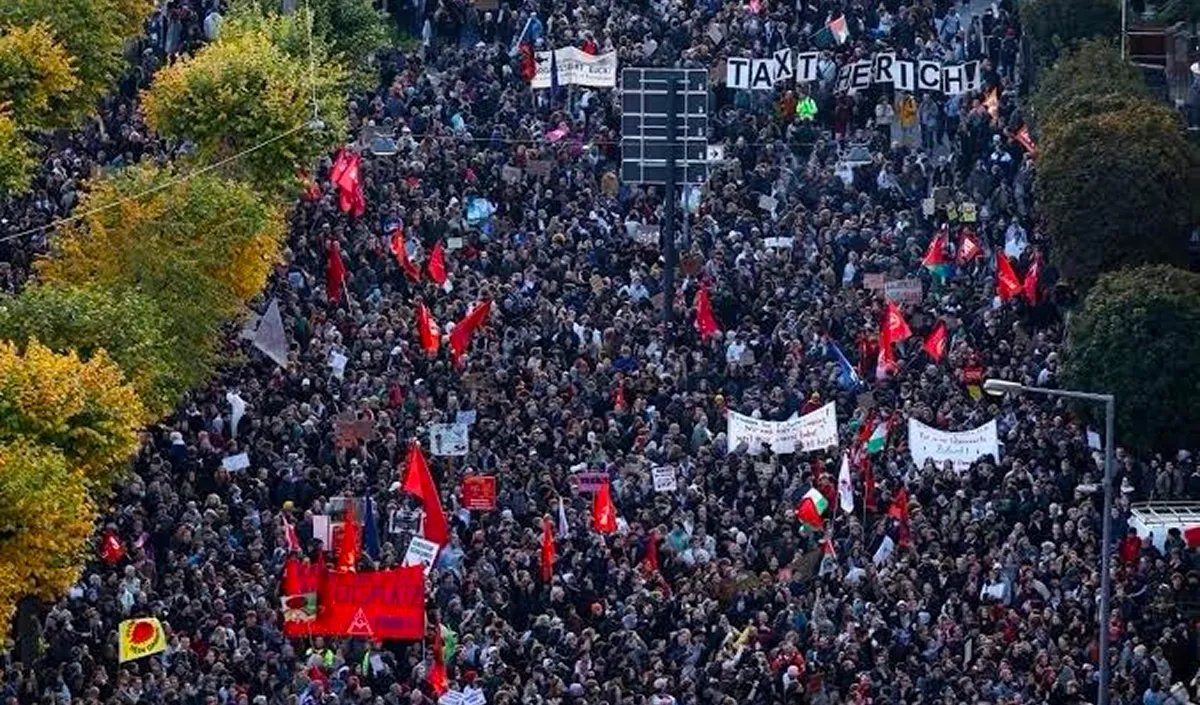
Svenczkowski and Sokhanski did not recognise this decision as lawful. The latter described the events as an attempt at a coup d’état. Shortly after the announcement of the suspension, protesters gathered outside the court building in Warsaw to voice their opposition to the judge’s actions. The police set up a cordon. Three people were detained after attempting to enter the court premises.
Navrotsky, who was flying to Senegal at the time, ordered the plane to turn back. “At a time like this, the President must be in Poland. I am cancelling my flight to Senegal. I am returning,” he wrote on social media platform X.
Upon his return to Warsaw, the president held urgent consultations with the heads of the highest judicial bodies and announced a meeting with representatives of the parliamentary parties. He described the incident as a violent takeover of the Constitutional Tribunal.
The standoff continued into the night. Navrotsky arrived at the court building and attempted to enter. However, a scuffle broke out between the President and the judges present there. The parties gave differing accounts of the incident: the President’s Office stated that the Head of State had been prevented from entering the building, whilst Judge Maciej Berek accused Nawrocki of physically assaulting Korwin-Piotrowska and other judges.
The Minister of Justice and Attorney General, Waldemar Żurek, described the President’s behaviour as unacceptable and announced an investigation into the actions of those involved in the incident.
Prime Minister Donald Tusk, by contrast, supported the removal of the tribunal’s leadership. He stated that restoring the rule of law after several years of rule by the Law and Justice (PiS) party required decisive action.
How the conflict unfolded
The standoff over the Constitutional Tribunal has been ongoing for around ten years. It began in 2015, when the Law and Justice (PiS) party came to power and launched a large-scale overhaul of the judicial system. New appointments to the Constitutional Tribunal sparked controversy over their legality and the court’s independence.
Under the PiS government, the Tribunal found itself at the centre of a conflict with the European Union. European institutions accused the Polish authorities of undermining the independence of the judiciary. In December 2025, the Court of Justice of the European Union ruled that the Constitutional Tribunal did not meet the requirements of an independent and impartial judicial body.
Following the victory of Tusk’s coalition in the 2023 general election, the new government set out to reform the judicial system and change the composition of the Tribunal. However, these attempts met with resistance from the president, who was supported by PiS.
The situation escalated again in 2026, when parliament elected new judges to the Constitutional Tribunal. Navrotsky refused to swear in a number of candidates, whilst Svenchkovsky barred some of the judges elected by parliament from taking up their posts.
As a result, the dispute over appointments escalated into a confrontation over the very leadership of the court. The government and the president’s camp now interpret the judges’ powers and the legality of their decisions differently.
Political rift: Nawrocki versus Tusk
The current crisis reflects a rift between Poland’s two political centres of power. Donald Tusk leads the ruling coalition formed following the 2023 elections, whilst President Navrotsky relies on the support of PiS, which, after eight years in power, has moved into opposition.
In the presidential election in June 2025, Nawrocki won in the second round and became an important political ally of the former ruling party.
For Tusk’s government, the change in the composition of the Constitutional Tribunal is part of restoring the independence of the judiciary. His opponents view the cabinet’s actions as an attempt to bring state institutions under its control.
Consequently, the dispute over who has the right to lead one of the country’s highest judicial bodies has marked a new phase in the struggle between the government and the president. Meanwhile, the Tribunal itself—which is tasked with resolving disputes over the constitutionality of laws—has found itself at the centre of a conflict in which the parties contest the legality of each other’s actions.
It should be noted that the Constitutional Tribunal of Poland is the highest body of constitutional review, which examines laws and other regulatory acts for compliance with the Constitution. It also hears disputes concerning the powers of central state bodies and citizens’ complaints regarding violations of their constitutional rights. The Tribunal’s rulings are considered binding and final. Consequently, control over its composition and leadership is of significant political importance: the court has the power to declare laws passed by parliament and the government unconstitutional.
Today’s key events:
- Polish President Karol Nawrocki, following his emergency return to Warsaw, met with the President of the Constitutional Tribunal and other judges.
- In the early hours of 31 October, he arrived at the Constitutional Tribunal together with the First President of the Supreme Court, Zbigniew Kapiński, and entered the building. Nawrocki remained there until 5.00 am, after which he left the Tribunal.
- Paweł Schefernaker, Head of the President’s Office, read out a statement in which Nawrocki announced the convening of urgent consultations involving the parliamentary parties on 31 October. “There has been a violation of the constitutional order of the Republic of Poland and a violent takeover of a constitutional body; I call for the restoration of the rule of law,” Navrotsky’s statement read.
- The Minister of Justice and Prosecutor General, Waldemar Żurek, stated that Nawrocki had behaved inappropriately at the Constitutional Tribunal, and that an investigation would be carried out into the “scandalous and unacceptable” actions of “people from the President’s Office” and Nawrocki himself.
- The leader of the opposition Law and Justice (PiS) party, Jarosław Kaczyński, called on Navrotsky’s supporters to back him in the conflict with the Cabinet over the Constitutional Tribunal and to “win the battle for Poland”.
This story was translated with the assistance of artificial intelligence.The translation was also reviewed by the Logos Press editorial team.
Follow our updates
Have information for the newsroom? Share it with Logos-Press


















Comments
0No comments yet. You can start the conversation.
Comments are open to readers with a Logos Press account.
Sign in to comment