

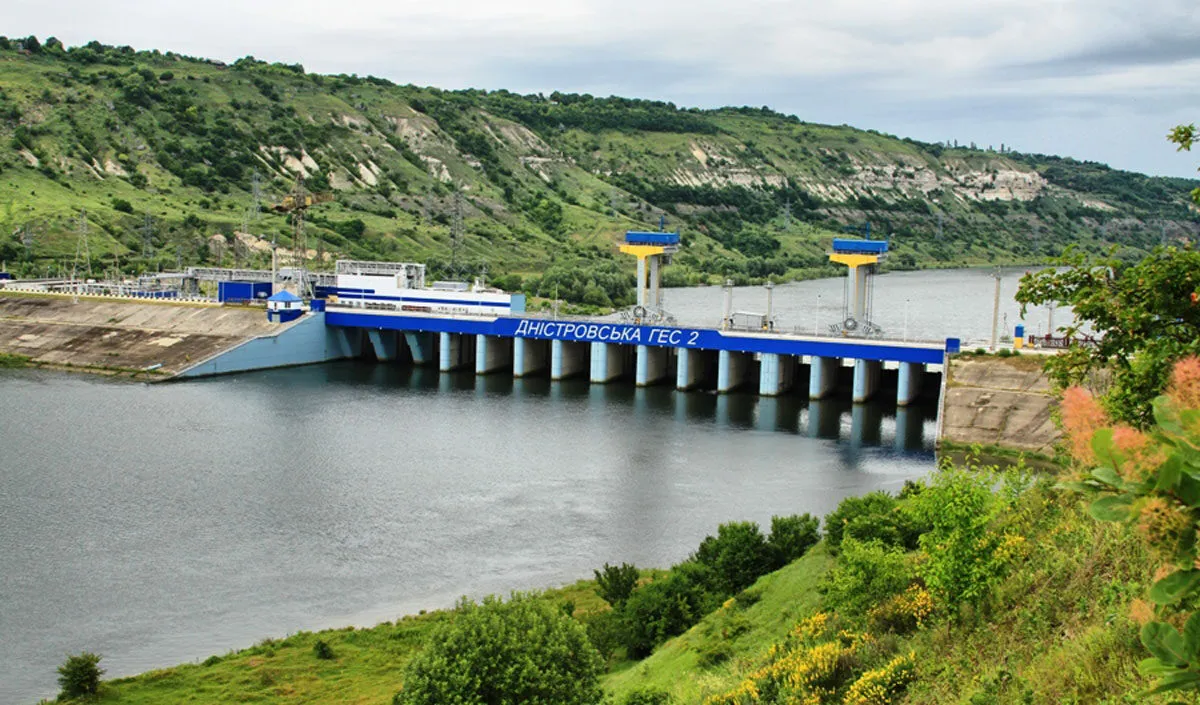
On 28 September, the Ministry of the Environment released a new figure. The water level in the Novodnestrovsk Reservoir stands at approximately 111 metres, whilst the normal level is around 121.5 metres. The water level is ten and a half metres below normal.
Not long ago, we were discussing a drop of 68 cm over the twenty days of September. It is now clear that the 68 cm figure only reflects the change over a few weeks. The ten and a half metres reveal the true scale of the overall shortfall.
To understand what is happening, it is not enough to look out of the window and ask how bad the drought is, even if it has been raining for three days. We need to understand how this river actually functions following the construction of the Dniester Hydropower Complex. And we must start with the source of its water.
The role of the dam
Most of the water that reaches Moldova does not originate here, but in the river’s upper basin, in the Carpathians and in western Ukraine. Rain in Chișinău may flood the streets, but it adds almost nothing to the Novodnestrovsk Reservoir, because it is located further upstream.
And in the upper reaches, 2026 has been a record-breaking year. Ukrainian hydrologists report that low water levels in the Dniester basin began as early as May. In July, river flows in the basin stood at 10–40 per cent of the norm. In early September, the inflow into the reservoir fell to 26–27 cubic metres per second. This is the absolute minimum since the reservoir was established in 1985.
During the first twenty days of September, an average of around 23 cubic metres per second flowed into the reservoir, whilst around 60 cubic metres per second were released downstream. 40.3 million cubic metres flowed in, and 103.7 million cubic metres flowed out. The reservoir released 2.6 times more water than it received. The difference – 63.4 million cubic metres – was drawn from the reserve.
Hence the first conclusion, which many will not like. Today, the dam is not holding back the water. All summer long, it has been releasing its reserves downstream to us. Without it, the Dniester at Naslavchi in September would not have carried 60 cubic metres per second, but around 23. The river would have been even shallower.
The Dniester is not running dry because of the dam.
But that is only half the truth. The dam does not create water, but it does determine when and how much water reaches us. If 23 cubic metres per second are coming from upstream, no operator can keep releasing 100 indefinitely.
But the dam can do other things: it can hold back water, store it, reduce spring floods, shift the flow from one season to another, and vary the discharge throughout the day.
That is why the Dniester downstream of Novodnestrovsk has long been governed by more than just the laws of rain and snow. Its flow regime is regulated. And this is not merely the opinion of politicians. It is the conclusion of a major study into the environmental and social impact of the complex, carried out by independent experts on behalf of the Moldovan government with the support of the UNDP and Sweden. The figures are significant.
What the river is losing
The first thing the river has lost is the floodwater it needs. Since the complex was built, the Dniester’s maximum discharge has fallen by around 30 per cent, and spring flood peaks by around 38 per cent. The average flow downstream of the complex has fallen by more than 10 per cent, amounting to approximately 800 million cubic metres per year. There is less water in spring, and more in summer and autumn.
For humans, flooding is a disaster. For the river, it is normal life. High water washes out the riverbed, floods the floodplain, connects the river with its oxbow lakes, carries sand and gravel, renews spawning grounds and carries away silt.
Previously, the Dniester followed a cycle: spring rise, flood, ebb, and low-water period. Now this cycle has been smoothed out. This is convenient for the energy sector. For the river, it marks a shift in its centuries-old rhythm.
Secondly, the dam holds back not only water but also sediment – sand, gravel and suspended matter, the very stuff from which the river builds its own bed. The water flows through, but the sand remains. Downstream of the hydroelectric complex, the amount of suspended sediment drops sharply and the water becomes clear.
Clear water sounds lovely. For the river, it is bad news. Along with the turbidity, nutrients and building material are washed away. Clear water without sediment begins to erode the riverbed downstream of the dam, whilst further downstream, where there are no flushing floods, the riverbed silt up and becomes overgrown.
In northern Moldova, the area covered by aquatic vegetation has increased in some sections from 1 per cent to 85 per cent. There are fewer species typical of flowing water and more species typical of standing water. The river is gradually turning into a chain of slow-moving water bodies.
Thirdly: the river’s temperature regime has been disrupted. Water for the turbines is drawn from the deep layers of the reservoir. Consequently, in summer, the water downstream of the hydroelectric power station is up to 7.5 degrees colder than its natural temperature, whilst in winter it is up to 5 degrees warmer.
For humans, a couple of degrees is a trifle. For the river, however, it affects spawning times, the development of eggs, insect life cycles, oxygen levels and the food supply. The Dniester has even lost its temperature rhythm.
Fourthly: the river breathes in time with the power system. When the power system needs capacity, more water is passed through the turbines, then less. An artificial wave travels down the river downstream of the dam, after which the water level drops. This effect can be observed over a distance of more than 130 km, with the section around 150 km downstream of Naslavcha considered to be the most affected. Researchers have measured daily water level fluctuations of around 52 cm, whilst the regulations permit less than 50 cm.
Such fluctuations are devastating for fish eggs, juveniles and riparian vegetation. The river rises and falls not because it has rained in the Carpathians, but because the load on the power grid has changed.
The fish have already paid the price for all this. Nineteen species of fish have disappeared from the middle reaches of the Dniester, and 15 from the lower reaches. According to the study’s authors, the populations of valuable species have declined tenfold. There is not just one cause, but a combination of factors: temperature, flow regime, bottom sediments, food supply and water level fluctuations.
The Dniester is dying because of the dam. The hydroelectric complex is destroying the river’s natural environment. The issue here is not so much the slogan ‘the dam is bad’, but rather the rules by which it operates and who determines those rules.
The reserves have now run out. According to the ministry, the reservoir has switched to a transit mode: whatever comes in from upstream flows straight out downstream. According to the capital’s city council, since 25 September, outflows have fallen to around 20 cubic metres per second, compared with the usual 100. On 14 September, the Dniester Commission convened for an extraordinary meeting, but Ukraine and Moldova failed to agree on a further reduction in outflows.
The dispute is no longer about whether there is water in the Dniester. It is about the last few cubic metres. And it is not Chisinau that decides this.
What Moldova can and cannot do
Here we need to go back to the events of 2010 and understand exactly what it was that we gave up back then. But let’s be clear: without any myths about the ‘tap being turned off’.
The Dniester hydrocomplex consists of three parts. The first and most important: the Novodnestrovsk Reservoir, with a capacity of around 3 billion cubic metres, and Hydroelectric Power Station No. 1. It lies entirely within Ukrainian territory. It is here that decisions are made on how much water to store in the spring and how much to release in the summer.
The second part is a buffer reservoir with a capacity of around 40 million cubic metres. The third is the dam near the Moldovan village of Naslavcha, which houses Hydroelectric Power Station No. 2. This is the final point before the water enters Moldova.
The buffer reservoir is seventy-five times smaller than the main one. Control over the dam at Naslavcha would never have given Moldova the right to decide how much water to hold back at Novodnestrovsk. To claim otherwise is to perpetuate a myth.
But something else is at stake at Naslavcha. It is from here that the water flows to us, and it is here that what we see every day takes shape: the daily fluctuations in the water level. The buffer reservoir also serves as the lower basin of the Dniester Pumped-Storage Power Station, which pumps water uphill at night and releases it through the turbines during the day. BIRN journalists who investigated the complex’s operations reported that the water pumped up at night does not always return to the river, but only when required by the Ukrainian power grid.
The dam at Naslavchi was originally built as a joint project. In the 1990s and early 2000s, Ukrhydroenergo installed three generating units on its section of the dam without Moldova’s consent. This is how HPP-2 came into being. At that time, Moldova held a strong bargaining position: it controlled the part of the dam without which the facility could not legally operate.
On 1 October 2010, Prime Ministers Vlad Filat and Yulia Tymoshenko signed a protocol. Moldova relinquished control over its section of the dam. In return, it received recognition of its ownership rights to two stone quarries on the border.
In other words, Moldova did not simply hand over the concrete. It legalised a fait accompli and relinquished the leverage from which it could have demanded regulations governing the plant’s operations near its border: limits on daily fluctuations, minimum discharge levels, access to data, and environmental standards. Everything we are now forced to ask for could have been stipulated as a condition back then.
Eleven years later, Filat himself described this as a disgraceful outcome and explained it simply: we didn’t know. We didn’t know what we were giving away. We didn’t visit the site. We didn’t do the calculations.
Quarries can be assessed. There are stone reserves, extraction volumes and market value. You cannot assess a position on a dam on a transboundary river in the same way. Its value is measured not in lei, but in the right to have a say at the very moment when there is not enough water for everyone. That moment has arrived now.
Clear rules are needed for the management of the Dniester
Moldova has one last lever left: a single physical location. Ukraine needs around 19 hectares of Moldovan land near Naslavchi to expand the complex. In 2021, Filat himself stated that without this land, Ukraine would be unable to commission seven new generating units, and the ball is in our court. At the time, Chisinau did not give Kyiv a response regarding the expansion due to concerns about the river.
The mistake made in 2010 must not be repeated with this land. If it is to be handed over, it should only be in exchange for commitments set out in a treaty, not in a memorandum of understanding.
This means a guaranteed minimum discharge at Naslavchi, even in years of low water, with a clear rule on how to allocate the shortfall when there is no water. It means a limit on daily fluctuations in water level and a penalty for exceeding it. These are spring ecological releases, which at least partially restore the river’s floodplain. These are real-time operational data on inflow, reserves and discharges, freely available to the Moldovan side, rather than via a press release. And this is the coordination of the pumped-storage power station’s operating regime with the interests of water intakes further downstream.
Land in exchange for rules. Not land in exchange for quarries.
Because this is now a matter of national security. The Dniester provides the bulk of the country’s water supply. According to UNDP estimates, this accounts for around 70 per cent of total water consumption in Moldova. Chisinau’s drinking water comes via Vadul-lui-Vode, whilst the north is supplied via Cosăuți. Today, the water intakes are operational, and the ministry keeps them under constant monitoring. But the very need for constant monitoring means that this is no longer a matter of abstract environmental concerns.
Climate change is making such years not less frequent, but more so. And if the current 23 cubic metres per second were one day to fall to 15 or 10, Moldova would need not just declarations, but legally enshrined rights.
Nature determines how much water flows in. The hydroelectric complex determines when and in what condition it reaches us. As for Moldova, it is currently determining only one thing: whether it will once again cede its position without realising what it is giving up.
Today, the main Dniester reservoir is ten and a half metres short of its normal level. The cost of decisions taken fifteen years ago is not measured in terms of the value of two quarries. It is measured in water.
Dumitru Taraburca, expert
This story was translated with the assistance of artificial intelligence.The translation was also reviewed by the Logos Press editorial team.
Follow our updates
Have information for the newsroom? Share it with Logos-Press





















Comments
0No comments yet. You can start the conversation.
Comments are open to readers with a Logos Press account.
Sign in to comment