

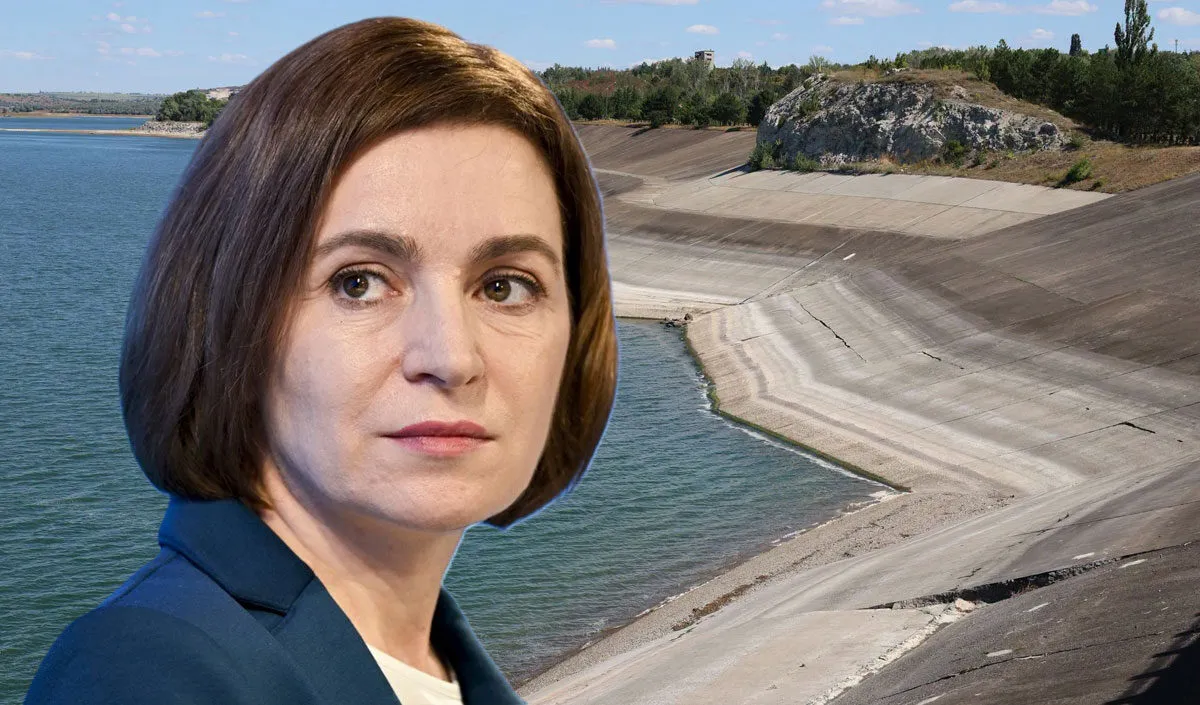
Maia Sandu
“Unfortunately, there is a risk that the problem we are facing this autumn will recur year after year, due to increasingly severe climate change,” said Maia Sandu.
According to the head of state, in several towns in Ukraine water is already being supplied on a rota basis, due to low water levels in the Dniester. The water level in the Novodnistrovsk reservoir has fallen by more than 10 metres and has reached a critical threshold.
The situation on the River Prut is also difficult. A decision has been taken to reduce the discharge rate to 14 m³/s, as there are now only 72 centimetres remaining until the level at which water can no longer be discharged via the hydrotechnical system. Several localities in the districts of Ungheni, Cahul, Cantemir, Glodeni, Fălești and Leova are supplied with water from the Prut.
Sandu has called on the authorities to prevent a water supply crisis
In these circumstances, the president is calling on the authorities to take action to prevent a potential crisis.
“The government, together with local councils and the relevant institutions, must find joint solutions to prevent a crisis. They must carry out all the necessary work on the water intake stations and identify and prepare alternative water sources for use. We now all have a single responsibility: to ensure that people have water on tap,” said Maia Sandu.
The Head of State believes that measures should not be limited to managing the current situation, but should also focus on preparing for the coming decades.
“In the medium and long term, we must prepare for a reality in which periods of drought will be more frequent, and water will become an increasingly scarce resource. This means adapting our water collection infrastructure to these new realities and reusing water wherever possible, investing in reserves, reducing losses from the networks and using every cubic metre of water more efficiently,” the President said.
Maia Sandu also emphasised the importance of protecting forests and ecosystems to maintain water reserves.
“Forests help the soil retain water, reduce erosion and contribute to the replenishment of water reserves. We will continue to reforest the country, protect existing forests, and restore wetlands and ecosystems around rivers. We must take better care of the Dniester and Prut river basins, as well as smaller rivers, because our water supply depends on this,” said Maia Sandu.
The President noted that resolving the issue requires long-term measures.
The Government is examining several scenarios
A working meeting convened by Prime Minister Vasile Tofan took place at the Government, attended by representatives of the Ministry of the Environment, ‘Apele Moldovei’, Chișinău City Council and ‘Apă-Canal Chișinău’. Discussions focused on the hydrological situation and the measures needed to maintain the water supply.
The participants analysed several scenarios regarding water level trends and the options for action in each situation. They examined existing technical capabilities and the possibility of implementing additional measures should the situation worsen. At present, consumers in the area served by ‘Apă-Canal Chișinău’ are being supplied with water, and the operator’s facilities are operating normally. The level of the Dniester and its flow rates are being monitored continuously.
A further meeting will take place in the near future, at which the relevant authorities are due to present specific technical solutions and determine the next steps.
This story was translated with the assistance of artificial intelligence.The translation was also reviewed by the Logos Press editorial team.
Follow our updates
Have information for the newsroom? Share it with Logos-Press



















Comments
0No comments yet. You can start the conversation.
Comments are open to readers with a Logos Press account.
Sign in to comment