

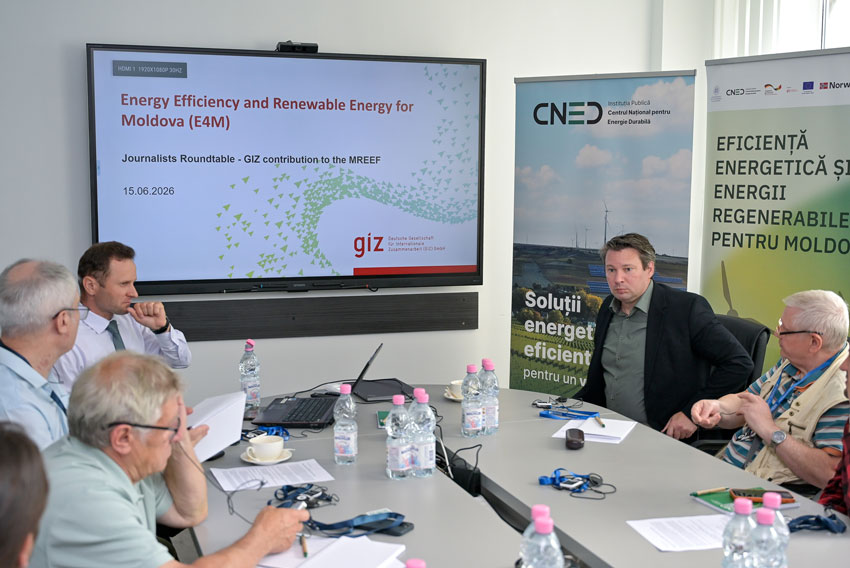
The program’s results were presented were presented during a Press Club event organized by the National Centre for Sustainable Energy (CNED) in partnership with GIZ Moldova. Representatives of development partners and media organizations attended the event.
“Every leu invested in energy efficiency can generate more than four lei in economic and social benefits through lower energy costs, job creation and support for the local economy. This is the principle behind FEERM – not temporary compensation, but structural investments with measurable long-term impact,” said Ion Muntean, Director of CNED, while presenting the results of the FEERM program.
Thorsten Greis, Project Manager of the “Energy Efficiency and Renewable Energies for Moldova” (E4M) project implemented by the German Agency for International Cooperation (GIZ), highlighted the contribution of international partners to the development and implementation of FEERM financing products.
“In 2024, we began working with CNED on the development of financing products under FEERM. Since then, we have seen successful implementations, aimed at aligning the country with European energy efficiency standards. We have supported new financing products and, two years later, we continue to work at the same pace. To ensure the sustainability of the program, we are investing in IT systems and training, and we are also working together with CNED to develop new FEERM products,” said Thorsten Greis.
Energy Efficiency in Apartment Buildings: First Works Launched
Energy renovation of apartment buildings remains the most complex component of FEERM, as it requires collective decision-making by homeowners, preparation of technical documentation and the implementation of comprehensive renovation works.
By the end of 2025:
- 98 energy audits of apartment buildings had been completed across the country;
- 77 Homeowners’ Associations in Condominiums (APCs) had entered the project implementation process;
- 17 projects worth a total of MDL 74.2 million had been approved;
- the first four works contracts had been signed for buildings in Chisinau and Balti;
- three additional projects were in the contracting phase.
Construction works have already started on the projects for which contracts have been signed and are progressing according to schedule.
Under this financial product, APCs receive grants covering 70% of eligible renovation costs. For low-income households, additional support is available through the Energy Vulnerability Reduction Fund (EVRF), which may cover up to 90% of their co-financing contribution.
Eligible measures include:
- thermal insulation of facades and roofs;
- modernization of heating systems;
- installation of energy-efficient LED lighting in common areas;
- elevator modernization;
- installation of photovoltaic systems and heat pumps.
For residents, these investments translate into greater comfort, improved indoor temperature control, lower energy bills, safer common spaces and increased property value.
Energy efficiency of individual houses in rural households: First 42 Households Successfully Renovated
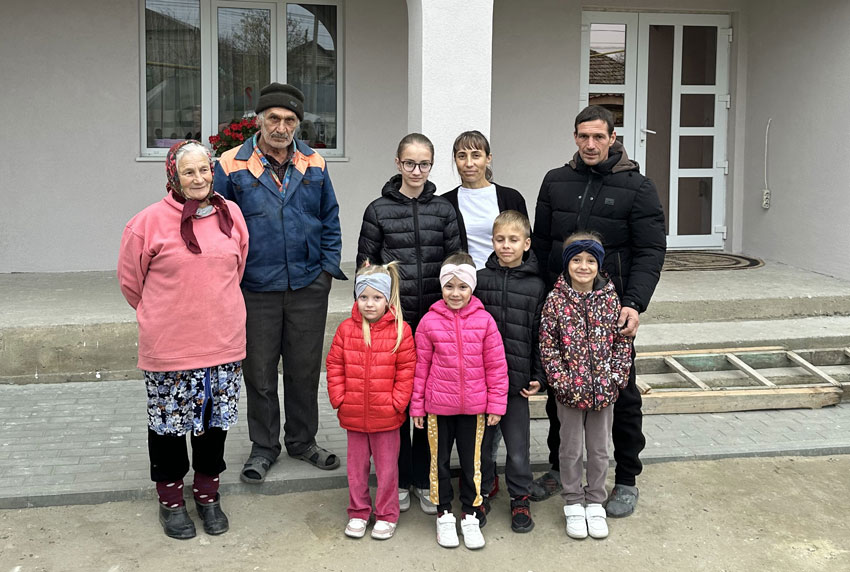
The financial product targeting households with extreme energy vulnerability in rural areas recorded the strongest progress in 2025. The absorption rate of grant funding reached approximately 90% of the annual budget allocated to this component.
Beneficiaries for the pilot phase were selected through the Energy Vulnerability Information System (SIVE), ensuring balanced territorial coverage across the country.
FEERM grants cover up to 95% of eligible renovation costs, while the beneficiary contribution is limited to only 5%, significantly reducing the financial burden on vulnerable households.
Results achieved so far:
- 190 applications submitted;
- 163 applications approved;
- 153 grant agreements signed;
- renovation works completed in 42 houses;
- total value of completed projects: MDL 12.8 million.
As a result of the investments, beneficiaries’ homes have become more energy-efficient, comfortable and affordable to maintain in terms of energy costs.The total value of approved projects amounts to MDL 51.2 million, with an average investment of approximately MDL 350,000 per household. A second financing round for an additional 99 rural houses is currently under consideration.
Casa Verde: More Than 1,700 Applications During the First Year of Implementation
Launched in July 2025, the Casa Verde financing programme targets homeowners interested in investing in energy efficiency improvements and renewable energy solutions. Public interest proved exceptionally strong from the very first application rounds.
During its first year of operation:
- 1,745 applications were submitted through the feerm.md platform;
- 964 applications were approved under Component I – energy audits and technical documentation;
- 528 applications were submitted under Component II – renovation works;
- 295 projects were approved;
- 275 financing agreements were signed, with a total value of MDL 55 million.
Most beneficiaries opted for integrated solutions, including photovoltaic systems with battery storage and heat pumps, increasing household energy independence while reducing long-term energy costs.
The average investment per household is approximately MDL 400,000, of which 50% is covered through a FEERM grant, up to a maximum amount of MDL 200,000.
Energy and Social Impact: Tangible Results and New Challenges
Beyond individual results for beneficiaries, the programme is generating broader impact. Based on the projects approved by the end of 2025, FEERM will deliver annual energy savings of 5.86 million kWh, equivalent to MDL 14.65 million saved by beneficiaries on energy bills and a reduction of 1,438 tonnes of CO₂ emissions. Energy consumption at household level may be reduced by up to 69%.
The effects are also felt in the local economy. FEERM stimulates demand for thermal insulation materials, energy efficiency equipment and renewable energy systems, supports the development of energy audit and design services, and creates skilled jobs – from installers and designers to energy auditors and technical supervisors. In 2025, 35 eligible energy auditors were identified and dozens of construction companies were registered in the programme, laying the foundations for a service ecosystem dedicated to residential energy renovation.
The year 2026 marks the transition from the operationalization phase to intensive investment implementation. CNED has set clear targets: the renovation of at least 8 apartment buildings, completion of works in around 160 vulnerable households, financing of more than 1,000 households through Casa Verde, and the launch of at least two national calls under this product.
In the medium term, the programme aims to renovate at least 500,000 square metres of heated floor area, with estimated annual savings of 66.3 GWh, while ensuring that at least half of the beneficiaries are energy-vulnerable households.
FEERM’s progress has not been without obstacles. The main challenge has been the limited capacity of the local technical market – the insufficient number of specialized designers, certified energy auditors and construction companies experienced in energy renovation has led to repeated procurement procedures and longer implementation timelines than initially planned.
At the level of apartment buildings, the challenges were different. Decisions on building renovation must be taken collectively by all homeowners – a process involving general assemblies and lengthy negotiations. This was compounded by the difficulty faced by some design companies in managing complex and customized technical solutions. Nevertheless, once these challenges were overcome, projects moved forward, and the first works contracts have already been signed and are now under implementation.
Based on the lessons learned, CNED has defined an action plan for 2026 structured around five areas: standardization and development of practical tools, digitalization and automation of workflows, development of the energy efficiency market, acceleration of implementation, and communication better adapted to beneficiaries’ needs.
In addition, to facilitate access to financing for homeowners’ associations, CNED is developing a guarantee and compensation mechanism for bank loans. This will allow APCs to access loans to cover residents’ contribution to the investment. The mechanism is planned to become operational by autumn 2026.


