

But if they pursue such spending in isolation, they will only perpetuate a fragmented, outdated defense system that has made them dependent on the United States for more than 70 years—and may even create new risks.
Europe faces three major challenges in defense: outdated technology, insufficient scale, and ineffective management. The war in Ukraine has starkly highlighted all three. As Ukraine uses innovative and flexible technologies to counter Russia’s much larger arsenal of conventional weapons, the limitations of outdated systems have become apparent.
Nevertheless, Europe has not yet fully seized the opportunity presented by the war to test new weapons systems, scale up production of the most effective ones, and translate these efforts into progress in institutional consolidation.
If the current institutional and market fragmentation persists, increased defense spending may become politically unacceptable. Research shows that public support for rearmament is stronger when citizens view the additional spending as part of a credible European security project. They support increased defense spending, but only if it follows consolidation at the European level, rather than preceding it.
Public support is likely to wane if new resources lead to inefficient and excessive duplication of efforts across countries, thereby increasing the overall cost of addressing capability gaps. This will increase pressure on governments to ensure that domestic industrial projects yield sufficient returns to justify increased defense spending—which may come at the expense of social programs, measures to combat climate change, and more effective public spending that promotes economic growth.
Undoubtedly, increased spending by European countries will lead to the creation of larger arsenals, albeit inefficient ones. But a more heavily armed Europe will not necessarily be safer. As long as states act primarily through their national defense systems, Europe will remain strategically vulnerable. If larger countries are governed by nationalist parties, the risk of reckless maneuvers or catastrophic mistakes increases.
Sovereignty is often used as an excuse for uncoordinated actions by national defense forces. But this is a red herring. Many of the capabilities that are paramount to strategic autonomy are beyond the reach of even the largest European states.
Dependence on the U .S. vs. European Consolidation
Thus, European countries have two options: either they can retain control over procurement while remaining dependent on the U.S. for critical capabilities, or they can cooperate with their European partners to build up these capabilities.
Pooling demand, coordinating procurement, and consolidating production may reduce national freedom of action with regard to individual contracts, but it will enhance the EU’s ability to defend itself and, consequently, its collective sovereignty.
As we have noted previously, only a genuine European Defense Union can ensure overall security in the long term. However, in the medium term, much can be achieved through political agreements and commitments that do not require treaty-level intervention.
The first step is to integrate military investments into a European framework that limits duplication and promotes interoperability and joint procurement involving more partners than is currently required under the “Security Actions for Europe” (SAFE). (Under SAFE, only two countries may participate in “joint procurement.”)
Within this framework, a distinction should be made between investments that merely support existing national production lines and those that create shared European assets. While it may be easier to secure political support for the former, the latter are more likely to create valuable capabilities and reduce unit costs, making them vital to European security.
Without an EU-level framework agreement capable of scaling up resources, Europe’s defense capabilities will remain limited, regardless of how much it spends. Nevertheless, Germany currently appears inclined to act alone.
Germany’s Temptation
Thanks to the permanent exemption of defense-related borrowing from constitutional limits on public debt and a favorable interpretation of EU fiscal rules, Germany’s potential for defense spending is impressive. According to our calculations, when the country reaches its target of €200 billion ($229 billion) in annual defense spending—likely around 2030—it will account for about half of the EU’s total defense spending.
Given this asymmetry in purchasing power, Germany faces a strong temptation to bypass the slow-moving European coordination mechanism. The country has already pulled out of landmark joint projects, such as the next-generation combat aircraft program with France, and has rushed to procure off-the-shelf, non-European defense solutions. This approach risks fracturing joint defense efforts from within.
Germany, the EU’s largest economy, now faces a familiar choice: either to act independently or to assume the role of a benevolent hegemon. If it chooses a unilateral approach—and, worse still, inspires others to follow its example— — the EU may well remain entirely dependent on the United States for key assets such as low-Earth-orbit satellite communications, intelligence and targeting systems, air defense, nuclear weapons, and strategic airlift capabilities. These are genuine European public goods that must be funded and provided at the EU level.
Like Europe’s long-term security, a lasting solution to this new “German question” may well lie in a European Defense Union. When the Berlin Wall fell, German Chancellor Helmut Kohl, French President François Mitterrand, and European Commission President Jacques Delors succeeded in anchoring Germany’s reunification within Europe by introducing a single currency. Today, however, such an anchor must take the form of a full-fledged defense union.
It remains unclear whether Chancellor Friedrich Merz, President Emmanuel Macron, and European Commission President Ursula von der Leyen will demonstrate the same vision and political will as their predecessors. But time is of the essence. Next year, elections in several EU countries will raise the “political discount rate”—political leaders’ preference for policies that deliver tangible results quickly—and make it harder to take bold decisions, especially in the defense sector.
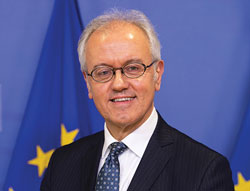
Marco Buti,
Head of Department at the Robert Schuman Center of the European University Institute and a visiting scholar at the Bruegel Institute.

Francesco Nicoli,
associate professor in the Department of Political Science at the Polytechnic University of Turin, is a professor of political economy at Ghent University and an associate researcher at the Faculty of Economics at the University of Amsterdam.
© Project Syndicate 1995–2026
www.project-syndicate.org


