

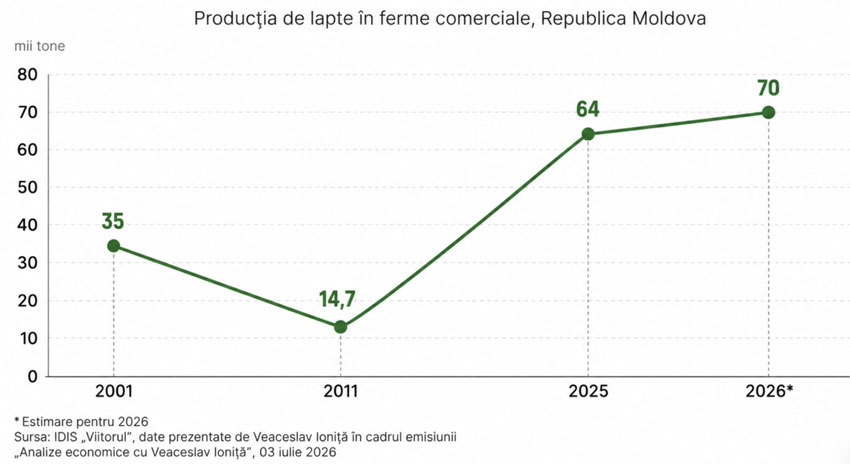
As a result, within the raw material base of dairy processing plants, the share of large-scale (corporate) farms is increasing, while that of small-scale (individual) farms is decreasing.
However, this positive trend has not yet translated into systematic growth in the production of milk and dairy products. At present, the country meets less than half (about 40%) of its own demand for products in this category. The remainder, estimated at approximately $200 million, is covered by imports. Moreover, dependence on imports is increasing.
These conclusions are drawn from an analysis of Moldova’s dairy market presented by economist Veaceslav Ionita, an economic policy expert at IDIS “Viitorul.”
Production is growing, but not keeping pace with consumption
As Vyacheslav Ionita notes, over the past 15 years, industrial farms have increased production nearly fivefold. While they produced about 14,700 metric tons of milk in 2011, that figure is projected to reach 64,000 metric tons by 2025, with forecasts for 2026 predicting 70,000 metric tons.
According to the expert, this growth is supported by investments and government support measures provided to the sector after 2022 (this refers to subsidies “per head of livestock” and “per kilogram of milk” delivered for processing by farms authorized by the ANSAagency — ed. LP).
However, this growth is driven exclusively by industrial farms, while in the individual sector (micro-farms and households), milk production is declining—due to the migration of the rural population and a decrease in livestock numbers on rural farms.
(To complete the picture, it is worth noting in parentheses that, according to statistical data, milk production on farms of all categories totaled 560,000 metric tons in 2011 and 282,500 metric tons in 2025, — ed. LP).
The balance doesn’t add up: consumption exceeds local production
According to Vyacheslav Ionita, domestic demand significantly exceeds the capacity of local dairy producers. Expert estimates put annual consumption at:
– 85,3 thousand metric tons of milk;
– 40,200 metric tons of yogurt and kefir;
– 14,000 metric tons of cottage cheese and other cheeses;
– 6,900 metric tons of butter;
– 2,300 metric tons of condensed milk.
Most of the processed products come from abroad. “Since 2023, Moldova has been producing less than half of the required volume of milk. Basic dairy products are produced domestically, while butter, cottage cheese, and cheese are imported,” noted Văceslav Ioniță.
At the same time, the market for cheese and cottage cheese is growing particularly rapidly: per capita consumption has increased from 400 grams in the early 2000s to 6.9 kg in 2025 and is expected to reach 8.3 kg in 2026. However, more than 85% of this volume is covered by imports.
Local dairy producers note that the dominance of imported milk-intensive products—such as cheese, butter, and the like—on the Moldovan market — is due to lower purchase prices for raw milk in neighboring countries than in Moldova. As a result, certain Moldovan dairy products are more expensive than their imported counterparts.
It is also important to note that the powerful dairy industry in neighboring Ukraine specializes in the production of butter—nearly half of all Ukrainian milk is processed into this product.
Expert Summary: Investment and Incentive Tax Policies Are Needed
Viecheslav Ionita asserts that the development of commercial farms is an important step, but insufficient to offset the decline in production in private households.
According to the expert, expanding milk collection and processing capacity could help reduce the local dairy market’s dependence on imports. “Without resuming milk collection (presumably by local collection points — LPnote ) and investments in processing, dependence on imports will only grow,” concluded Vyacheslav Ionita.
The expert also warned that potential changes in tax legislation, including a possible increase in the VAT rate for this sector, could put additional pressure on an industry that is already undergoing a difficult restructuring process.


