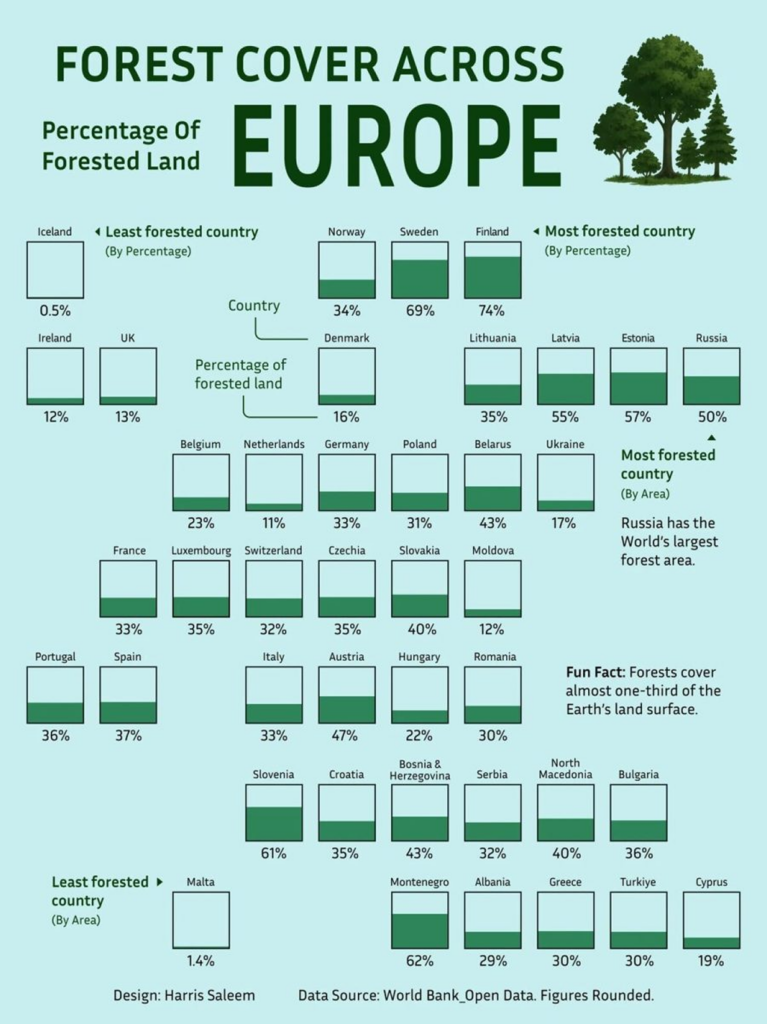

An analysis of World Bank data shows how geographical features, climate, and centuries of land use have shaped Europe’s extremely diverse forest landscapes. Europe’s forest landscapes range from the vast northern boreal forests to the mixed and broadleaf forests of the southern regions, reflecting the diversity of climatic zones and topography. Forest cover is determined by a combination of geographic conditions, climate, land use patterns, and government policy.
Finland (74%) and Sweden (69%) lead the list of Europe’s most forested countries by a wide margin: forests cover approximately seven out of every ten hectares of land here. Montenegro (62%) and Slovenia (61%) also stand out among the countries with the highest forest cover. In contrast, in a number of countries with a high degree of urbanization or developed agriculture, the proportion of forests is significantly lower.
Northern Europe’s dominance is closely linked to the boreal forest belt, which stretches across Finland, Sweden, and Russia (50%). A harsher climate and low population density have historically limited the development of agriculture, allowing large forest ecosystems to remain virtually intact. Mountainous regions also often have higher forest cover, as steep slopes are less suitable for intensive farming. This largely explains the significant proportion of forests in Slovenia, Austria (47%), and some countries on the Balkan Peninsula (Bosnia and Herzegovina – 43%, North Macedonia – 40%, Bulgaria – 36%, Serbia – 32%, Greece – 30%).
Which countries are lagging behind?
The situation is different in the fertile plains of countries such as Denmark (16%), the United Kingdom (13%), Ireland (12%), the Republic of Moldova (12%), and the Netherlands (11%), where the land has been actively used for agriculture and settlement for centuries. As a result, countries with both similar and different climatic conditions can vary significantly in forest cover depending on how their land resources have been managed over time.
Unlike many other regions of the world, Europe as a whole has increased its forest area over the past thirty years. Reforestation, natural forest regeneration, and sustainable forest management policies have contributed to the growth of total forest area, despite increasingly frequent forest fires, droughts, storms, and pest outbreaks.
Government policy matters
Forest cover is influenced not only by the natural environment but also by government decisions. Sustainable forest management practices, conservation programs, and reforestation initiatives have helped many European countries maintain or even increase their forest area. In some cases, forest areas have expanded over the past decades because low-productivity agricultural lands were abandoned and given the opportunity to recover naturally.
According to the recently published report State of Europe’s Forests 2025, the total forest area in Europe continues to grow, although forest ecosystems themselves face increasingly serious challenges related to natural disasters and pests. Indicators of forest cover and biodiversity as a whole show a positive trend, although growth rates in some regions are beginning to slow.
However, the increase in forest area does not mean there are no problems. Research by the World Resources Institute shows that deforestation in Europe is increasingly influenced by logging, natural disturbances, and the effects of climate change. In turn, the European Environment Agency notes that the resilience of forest ecosystems is becoming a key focus of environmental policy as temperatures rise and extreme weather events become more frequent.
Thus, Europe remains a region where the total forest area continues to increase. However, the task of preserving healthy, resilient, and regenerative forest ecosystems is becoming increasingly complex and requires a comprehensive approach.