


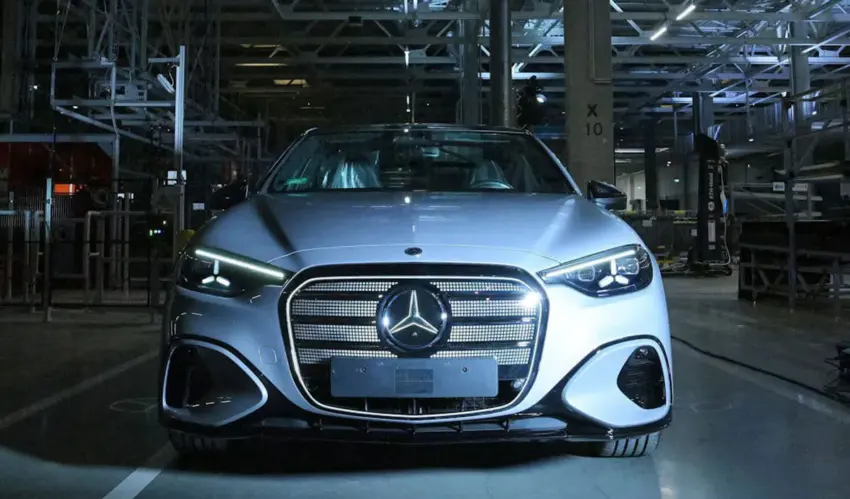
© Zsolt Szigetvary/MTI via AP/dpa
The industry’s prospects will depend on whether Germany can restore its price competitiveness and accelerate its technological restructuring against the backdrop of the growing strength of Chinese manufacturers, the Berliner Zeitung believes.
Mercedes and Volkswagen are reviewing their production strategies
Mercedes-Benz has suspended further investment in its German production sites. According to the company’s production director, Michael Schiebe, the decision was taken due to a lack of progress in negotiations with employee representatives regarding cost-cutting measures. At the same time, management is considering the possibility of closing certain plants.
According to the Berliner Zeitung, the company is seeking to extend the working week from 35 to 38 hours whilst maintaining current pay levels, as well as to reduce bonus payments. If an agreement cannot be reached with the IG Metall trade union and the works councils, new models may be produced exclusively outside Germany.
However, the publication notes that, for the time being, the discussion centres on reviewing investment policy and considering possible scenarios, rather than a confirmed decision to close specific plants.
Mercedes-Benz’s problems reflect a wider crisis in the industry. According to the Berliner Zeitung, the combined scale of Volkswagen’s current and planned job-cutting programmes could reach 100,000 jobs worldwide.
Against the backdrop of business restructuring, German car manufacturers and component suppliers are also reviewing their production locations, investment plans and workforce numbers.
Production is moving to where it is more profitable to manufacture cars
One of the most noticeable manifestations of the crisis is the redistribution of investment between Germany, other European countries and the US.
According to the Berliner Zeitung, Audi intends to invest $4.2 billion in setting up its first car factory in the US, where it is expected to create around 4,500 jobs. Mercedes-Benz plans to allocate $7 billion to the development of its business in North America by 2030 and is expanding production in Kecskemét, Hungary. BMW, for its part, is developing the production of its new-generation Neue Klasse cars in Munich and at its plant in Debrecen, Hungary.
These decisions are based on different economic factors. Hungary attracts manufacturers with lower labour costs. The US offers a large sales market, comparatively cheap energy resources and incentives for localising production. Additional pressure is created by US trade restrictions, which increase the appeal of manufacturing cars directly in the target market.
The publication therefore argues that the problems facing the German car industry cannot be attributed solely to high wages. For investors, the total cost of production, access to customers, tax conditions, energy costs, infrastructure and the speed of decision-making are all important factors.
Germany retains the advantages of an industrial nation with a developed engineering base, a skilled workforce and an established network of suppliers. However, these advantages become less significant if they do not offset the costs and lack of flexibility in the production system.
China is changing the rules of competition
The second key challenge relates to changes in the global automotive market. Chinese manufacturers are strengthening their position in the electric vehicle segment by offering new models at competitive prices and shortening development times.
German companies are facing dual pressure. In the domestic and European markets, they have to compete with manufacturers capable of updating their model ranges more quickly. At the same time, the previous growth model in China is losing momentum, where Volkswagen, BMW and Mercedes-Benz have long held strong positions in the mid-range and premium segments.
The situation is compounded by the German manufacturers’ own strategic errors. In particular, the *Berliner Zeitung* highlights Volkswagen’s software issues and the manufacturers’ delayed response to shifts in demand and the rise of electric vehicles. According to the publication, Mercedes-Benz also relied on expensive models for too long.
As a result, technological lag, high production costs and competitive pressure are reinforcing one another. Falling sales and profitability are limiting investment opportunities, whilst a lack of investment is hampering the modernisation of products and production processes.
For the German car industry, this means it must tackle three challenges simultaneously: reducing production costs, accelerating the development of new vehicles and maintaining the appeal of its brands in international markets.
Job cuts could become a long-term trend
The industry’s outlook is also reflected in employment forecasts. According to an assessment by the consultancy firm Roland Berger, published in October 2026, the number of jobs in the German automotive industry could fall by at least 200,000 by 2030 – from approximately 692,000 in 2025 to fewer than 500,000.
This forecast covers not only car manufacturers but also suppliers and other related functions. It reflects the expected structural reorganisation of the industry and is not a list of redundancies that have already been confirmed.
Among the reasons are underutilisation of production capacity, high costs and the need to adapt to new technologies. According to Roland Berger’s estimates, German car factories utilise on average around 60 per cent of their capacity, whereas a utilisation rate of around 75–80 per cent is usually required for profitable operation.
If this situation persists, manufacturers will be forced to cut excess capacity, consolidate functions and review the allocation of models across plants.
Moldova is also feeling the effects
The repercussions could extend far beyond the automotive groups themselves. A decline in orders and the relocation of production could affect component suppliers, engineering centres and logistics.
The problems faced by German car manufacturers also pose risks for Moldovan automotive component producers integrated into European supply chains. According to UN Comtrade data published by the World Bank on the WITS platform, exports from Moldova of wiring harnesses for ignition systems and other automotive wiring harnesses (HS code 854430) from Moldova in 2025 amounted to $304.2 million, an increase of approximately 9.8 per cent compared with $277 million in 2024.
However, in January–August 2026, supplies of automotive components to overseas customers fell significantly, as reported by Logos Press based on data from the National Bureau of Statistics. As a result, the share of exports for this product group fell from 16 per cent in 202 to 13.8 per cent in 2026.
Admittedly, this group includes not only automotive components, and the geography of exports is not limited to Germany. However, supplies to the same plants in Romania, Poland and elsewhere are also intended for the plants of German conglomerates in those countries. Moreover, numerous factors and signals from Moldovan enterprises integrated into global automotive supply chains confirm the trend towards a decline in orders.
Therefore, if German conglomerates continue to cut production and relocate new projects abroad, Moldovan enterprises may face a review of their orders, increased price pressure and the need to seek new customers.
At the same time, relocating production not to the US or distant countries, but to Central and Eastern Europe, could create opportunities for Moldovan suppliers – provided they remain competitive and meet the requirements of car manufacturers.
Thus, the future of the German automotive industry is determined not so much by the number of announced job cuts as by the country’s ability to retain new investment, technological expertise and a competitive manufacturing base. If these conditions are not restored, job cuts and the relocation of production abroad may become established as a long-term trend.
Follow our updates
Have information for the newsroom? Share it with Logos-Press





















Comments
0No comments yet. You can start the conversation.
Comments are open to readers with a Logos Press account.
Sign in to comment