


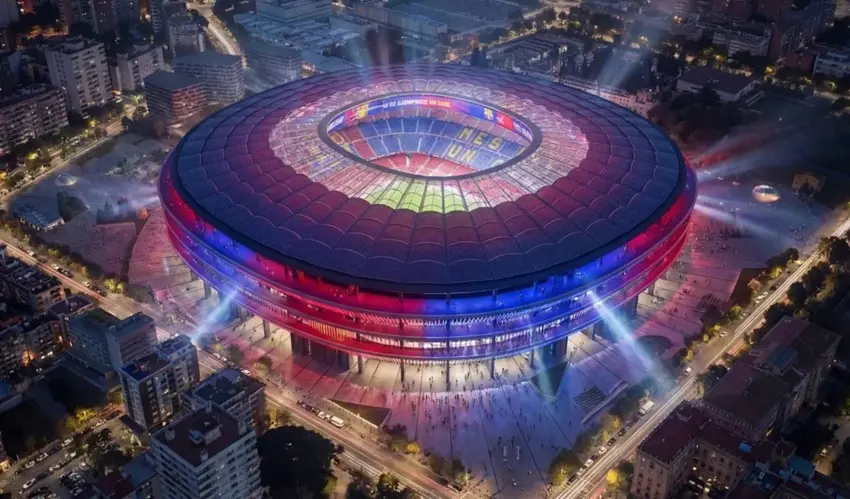
The bond issue forms part of the financial programme approved by members at the club’s general assembly in September 2026. At that time, club officials supported raising an additional €510 million to complete the works and cover costs associated with the delay in the redevelopment.
According to the club’s website, €300 million of this sum is earmarked directly for construction, with a further €210 million set aside to address financial issues arising from the postponement of the project.
Once the refurbishment is complete, Spotify Camp Nou will have a capacity of around 105,000 spectators. This will make the stadium the largest football stadium in Europe in terms of seating capacity.
The project involves not only the refurbishment of the stands but also a large-scale modernisation of the entire infrastructure. In particular, the stadium will feature:
- a full-scale roof over the stands;
- modern VIP areas and spaces for corporate clients;
- an expanded museum area;
- upgraded communications systems and digital services;
- state-of-the-art building management technologies.
Barcelona is placing particular emphasis on premium services. The club expects the new VIP areas, restaurants and spaces for corporate events to become a significant source of additional revenue.
Around €1.8 billion will be allocated to the redevelopment
The large-scale Espai Barça project was launched in 2023. Initially, its funding was estimated at approximately €1.45 billion. However, during construction, the scope of work increased, and with it, so did the costs.
Among the reasons for the additional costs are the need to reinforce the structure of the second stand, expand the VIP facilities, increase the museum spaces and implement modern technological solutions. As a result, the project budget has risen to approximately €1.8 billion.
The financing is structured for the long term. Barcelona plans to repay the funds raised specifically for the stadium’s refurbishment using future revenue from Spotify Camp Nou. The relevant portion of the loan has a 30-year repayment term. The club raised a further 210 million secured against future revenue from television rights.
Due to the large-scale refurbishment, Barcelona was forced to temporarily relocate to the Estadi Olímpic Lluís Companys. The team later began returning to the partially open Spotify Camp Nou, although the stadium is not yet operating at full capacity.
According to the club’s plans, the final return to the refurbished stadium is due to take place in January or February 2028. However, the completion of all construction work, including the installation of the roof, is expected later – during the 2028/29 season.
The new Camp Nou is set to boost the club’s revenue
The refurbishment is important not only in terms of fan comfort. The refurbished stadium is set to become one of Barcelona’s key sources of revenue.
With a capacity of around 105,000 spectators, it will be able to accommodate more fans at home matches. As reported by Arab News, additional revenue will be generated by VIP seats, restaurants, a museum, corporate events and other commercial spaces.
The club’s management expects Barcelona’s revenue to exceed €1.45 billion in the 2030/31 season, with EBITDA reaching over €370 million. By way of comparison, the forecast for the 2025/26 season was around €1.06 billion in revenue and €184 million in EBITDA.
Follow our updates
Have information for the newsroom? Share it with Logos-Press




















Comments
0No comments yet. You can start the conversation.
Comments are open to readers with a Logos Press account.
Sign in to comment