

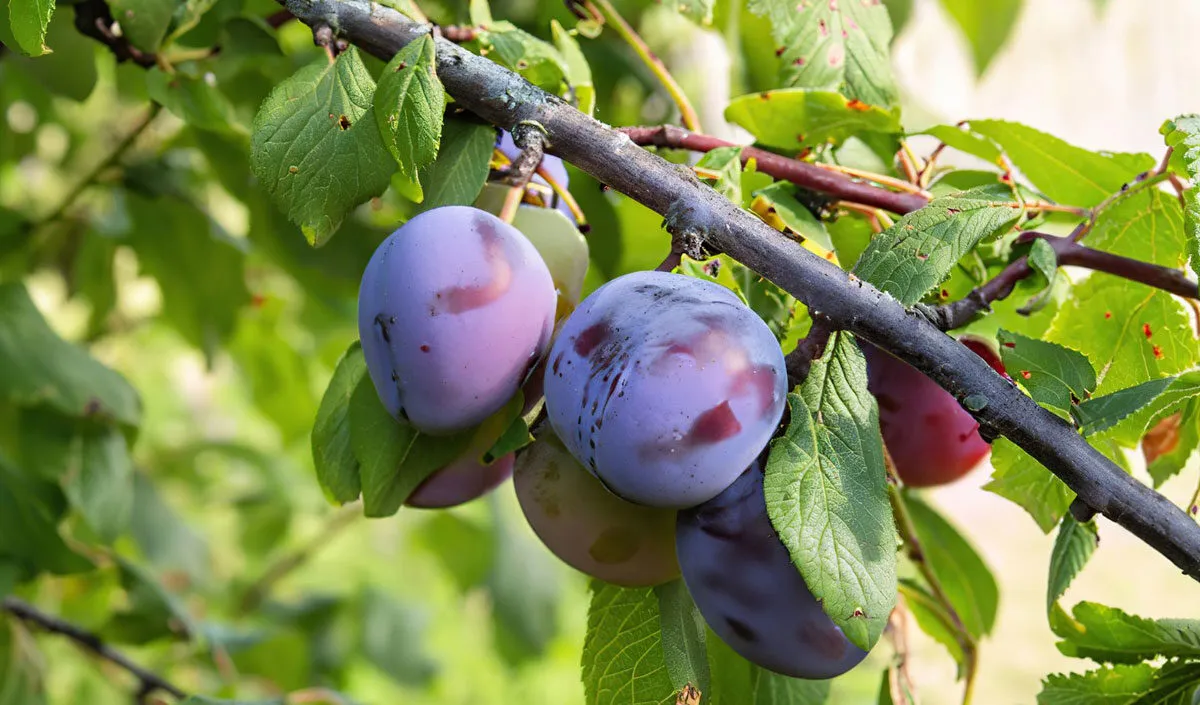
Harvest: from good to mediocre
Estimates for the 2026 plum harvest in Moldova vary widely, ranging from 100,000 to 130,000 tonnes (last year’s harvest was around 100,000 tonnes). The wide variation in forecasts is due to the very different yields in plum orchards this season – depending on the region of the country, the level of agricultural technology, the availability of resources for organising production processes (in particular, harvesting) and the marketing channels for the produce.
In areas where weather conditions were normal – that is, there were no spring frosts and pollination went well – yields in plum orchards are 10–20 per cent higher than last year.
At the same time, many fruit growers note that, due to the summer drought, the average fruit size is small – this reduces the proportion of dessert plums (intended for sale on the ‘fresh market’) within the 2026 harvest.
By and large, high yields and consistently good quality plums will only be found on farms that irrigate their plum orchards and which were situated in areas with favourable weather conditions throughout the current agricultural season. Clearly, there are not too many such very fortunate horticultural farms in Moldova.
Furthermore, a significant number of fruit-growing enterprises have faced the now-familiar problem of a labour shortage during the fruit harvest this year. The problem is being addressed by increasing the wages of seasonal workers. According to some orchard owners, they have had to raise the daily wage for fruit pickers to 400–450 lei.
As a result, according to expert estimates, the cost per kilogramme of marketable plums has risen to an average of 2–2.5 lei/kg, with half of this amount accounted for by wages.
According to Andrei Zbankă, an expert in fruit marketing, at least half of the 2026 plum harvest will consist of ‘technical’ produce – sold for processing. He also notes that even within the export flow, around a third consists of ‘technical’ plums, supplied in large-capacity sacks.
Taking all this into account, it can be assumed that this year not the entire biological plum harvest will be gathered (and become a commodity) due to low profit margins.
Prices: on average, not high
According to EastFruit’s price monitoring data, in September this year plums in Moldova are being sold at a wholesale price of 6–8 lei/kg, averaging 7 lei/kg. That is, significantly cheaper than the average for the same period last year (9 lei/kg). The current price of Moldovan plums on the domestic market is one of the lowest since the start of this decade.
At the same time, the average wholesale price for plums in Moldova ($0.41 per kg) is lower than in Ukraine ($0.45 per kg), Russia ($0.53 per kg) and Poland ($0.73 per kg).
Interestingly, according to farmers, the actual range of wholesale prices for dessert plums is even wider. It is not uncommon for plums destined for the ‘fresh market’ to be sold for less than 6 lei/kg. However, there are also numerous instances of high-quality plums being sold for storage in industrial cold stores (for export in October–November) at a price of 10–12 lei/kg.
As expected, prices for industrial plums fell slightly in September (by 5–7 per cent on average), with the typical range in the middle of the month standing at 2.50–4.50 lei per kg.
At the same time, as market operators note, the volume of plums supplied for drying has fallen – due to rising energy costs for dried fruit producers. However, the volume of plums supplied for processing into plum paste has increased. Although, of course, in the latter case, the purchase price for the raw material is significantly lower.
Export nuances
According to fruit industry operators, in September, exports of dessert plums from Moldova ‘have not yet reached the average planned level’. In the markets of neighbouring EU countries, there is currently an ample supply of locally grown plums; traders hope that demand for high-quality Moldovan plums for the ‘fresh market’ will begin to rise towards the end of this month and in October.
For the time being, however, a significant proportion of shipments consists of lower-quality plums destined for processing in Romania, the Czech Republic and certain other Central European countries. Suppliers of Moldovan plums have also stepped up their activities for deliveries to Serbia, where the fruit is repackaged and re-exported to European Union countries under previously concluded contracts between major European and Serbian traders.
What are the prospects for Moldovan plums intended for storage over a more or less extended period? Opinions on this matter differ.
Theoretically, if circumstances align favourably, plum exports in the second half of autumn could increase, in which case the costs – including those associated with the expensive storage of the produce – might pay for themselves. In this case, the optimistic forecast by the leadership of the fruit growers’ associations – that the 2026 EU quota for plum exports (61,000 tonnes) will be utilised in full or for the most part – may prove accurate. In an unfavourable scenario, a significant proportion of the ‘plums from cold stores’ will be sent for drying.
This story was translated with the assistance of artificial intelligence.
Follow our updates
Have information for the newsroom? Share it with Logos-Press




















Comments
0No comments yet. You can start the conversation.
Comments are open to readers with a Logos Press account.
Sign in to comment