


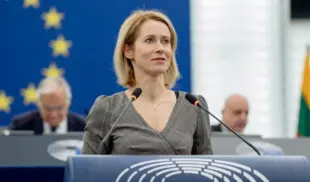
Marta Kos
The Republic of Moldova is one of the four candidate countries making the most significant progress in the process of accession to the European Union, alongside Montenegro, Albania and Ukraine, said EU Commissioner for Enlargement Marta Kos in an interview with France 24. The European official particularly commended the pace of reforms in the Republic of Moldova.
2026 promises to be one of the busiest years in the European Union’s enlargement process following a long period during which the bloc did not admit any new members. The last country to join the EU was Croatia in 2013, noted Marta Kos.
“Montenegro, which is indeed the frontrunner, could complete technical negotiations by the end of the year and become an EU member in 2028,” she said.
The European Commissioner also mentioned Moldova, Albania and Ukraine in this context, stating that these four countries are currently leading the way in the accession process.
“Albania is on the right track. Moldova is making increasing progress, and, of course, so is Ukraine. So these are the four frontrunners. But when I say that this is the year of enlargement, I mean that in the first nine months of this year we have opened and closed more chapters than in any other year over the past 25 years,” said Marta Kos.
As for the Republic of Moldova, the European official drew a distinction between countries that began the EU accession process at different times, emphasising that Chisinau has rapidly caught up with the candidate countries in the Western Balkans.
“Moldova is the best performer in my class,” said Kos, referring to the progress made by the Republic of Moldova, given that it began the EU accession process later than some candidate countries in the Western Balkans.
In July 2026, the Republic of Moldova began negotiations on Cluster 6, dedicated to external relations, which includes sections on external relations and foreign policy, security and defence. On the same day, the European Union organised accession conferences with the Republic of Moldova, Ukraine, Montenegro and Albania.
EU financial support may be reallocated
The European Commissioner also spoke about the link between progress in the accession process and the implementation of reforms. In her view, European financial support for candidate countries is conditional upon the implementation of reforms.
Marta Kos cited the example of the Growth Plan for the Western Balkans, where the level of reform implementation varies from country to country. She mentioned that, in the case of countries with poor results, part of the EU funds may be reallocated.
“The European Union is not a charity. Therefore, to help their economies and societies develop, they must carry out reforms, and we provide funding only if they do so,” said the European Commissioner.
In the same interview, Marta Kos also touched upon relations between the European Union and Serbia, criticising certain recent events and emphasising that candidate countries must respect the principles of reconciliation and the condemnation of war crimes.
“We may have different views on how quickly a country should carry out reforms. But there is no place for glorifying a war criminal or denying the genocide in Srebrenica. We expect all EU candidate countries, especially those in the Western Balkans, to follow the path of reconciliation,” said Kos.
The European Commissioner stated that the EU enlargement process had gained new momentum in 2026. Official data from the Council of the EU showed that on 14 July, negotiations with the Republic of Moldova and Ukraine had moved forward, opening a new cluster, whilst Montenegro and Albania had made progress by provisionally closing certain chapters of the negotiations.
The European Commission has repeatedly emphasised the pace of the Republic of Moldova’s EU accession process. In June, during her visit to Chișinău, Marta Kos discussed with the authorities the progress made on reforms, particularly in the justice sector, as well as investment and the implementation of the Republic of Moldova’s Economic Growth Plan.
This story was translated with the assistance of artificial intelligence.The translation was also reviewed by the Logos Press editorial team.
Follow our updates
Have information for the newsroom? Share it with Logos-Press
















Comments
0No comments yet. You can start the conversation.
Comments are open to readers with a Logos Press account.
Sign in to comment