


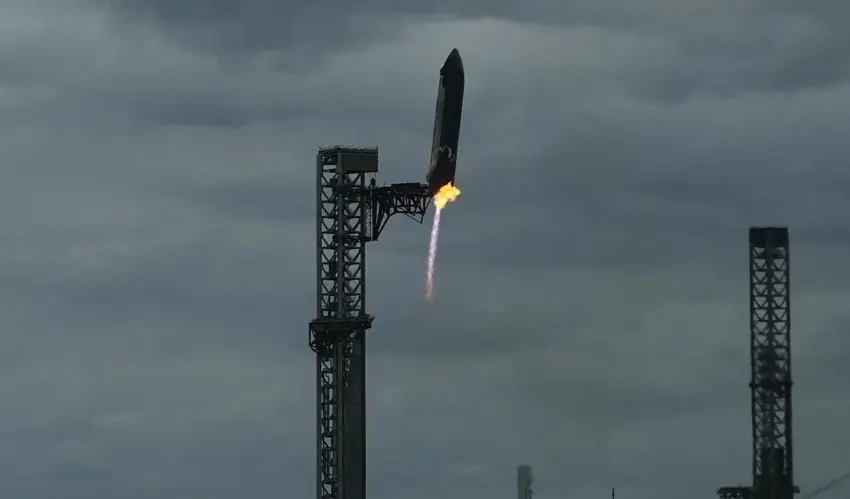
“Congratulations to the incredible SpaceX team!!!” wrote Musk on the social media platform X after the operation was completed.
The Starship Flight 15 test flight began on 13 November. The upper stage of Ship 42 entered low Earth orbit, completed 14 orbits around the Earth and spent around 22 hours in flight.
During this time, the spacecraft deployed 26 next-generation Starlink V3 satellites. After completing its orbital programme, Starship began its re-entry into the atmosphere, passed through the aerodynamic deceleration phase and performed a controlled descent to the SpaceX launch complex in South Texas.
The final manoeuvre took place on 14 November. The spacecraft slowed down, moved into a vertical position and was caught by two large mechanical grippers on the Mechazilla tower, which the company refers to as ‘chopsticks’.
This is the first time that a Starship upper stage returning from orbit has been directly caught by the launch tower. SpaceX had previously demonstrated the successful recovery of Super Heavy boosters, but the return of the spacecraft itself presented a distinct engineering challenge.
The economic significance of SpaceX’s success
Starship is being developed as a transport system capable of delivering large cargo, satellites and, in the future, people into orbit. Its design envisages the reusability of both stages: the Super Heavy booster and the Ship upper stage.
This is of fundamental importance to the space industry. If expensive rocket components can be regularly recovered, maintained and reused, operators can spread the costs of their manufacture across multiple flights. This has the potential to reduce the cost of launches and allow for more frequent launches.
However, a successful recovery in itself does not yet prove that Starship will achieve its stated economic targets. To do so, SpaceX must confirm the reliability of the return, the technical condition of the spacecraft after flight, the extent of necessary repairs, and the feasibility of repeated launches at short intervals, according to users commenting on the company’s announcement.
SpaceX’s immediate challenge remains transforming a one-off technological achievement into a sustainable operational model. The company needs to demonstrate that Starship can return regularly, undergo maintenance and launch again without excessive costs or lengthy downtime.
Follow our updates
Have information for the newsroom? Share it with Logos-Press























Comments
0No comments yet. You can start the conversation.
Comments are open to readers with a Logos Press account.
Sign in to comment