


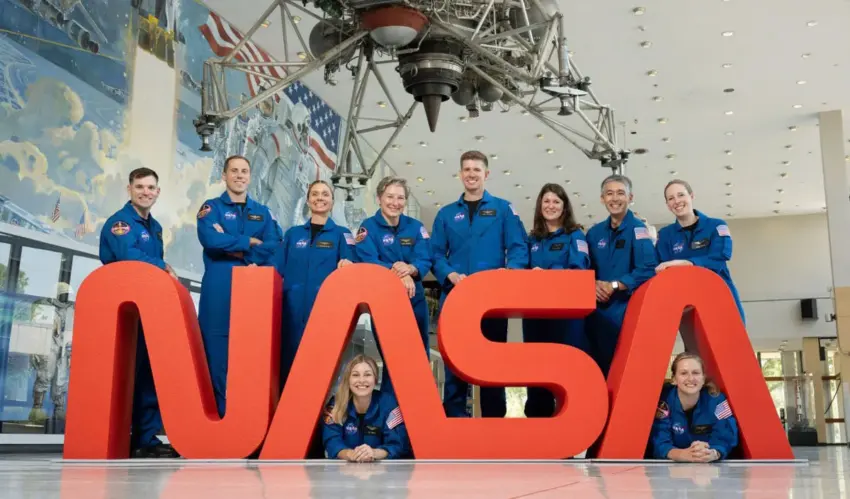
NASA astronauts recruited in 2025. Photo: Josh Valcarsel/NASA-JSC
The launch of the campaign was announced on 7 November at an air show at the Kennedy Space Centre in Florida, dedicated to lunar exploration, aviation and new technologies. Applications to take part in the selection process can be submitted until 3 December.
NASA’s previous recruitment drive took place in 2024. At that time, more than 8,000 people applied to become future astronauts, but by September 2025, only ten candidates had been selected.
The current recruitment drive is linked to the expansion of the ‘Artemis’ lunar programme. The agency currently has only 32 active astronauts at its disposal, which is insufficient for the growing volume of tasks. Following the Artemis II expedition in April, during which the crew carried out a manned fly-by of the Moon, NASA is preparing for its next missions.
“We have far more work than we have astronauts,” Artemis III mission commander Randy Bresnik told the Associated Press.
Selection process with a view to a lunar base
The agency expects to complete the new selection process by the end of 2027. Training for the candidates is set to begin in the winter of 2027/2028 — a period when NASA plans to send people back to the Moon’s surface after a hiatus of more than half a century.
The upcoming missions will involve testing lunar equipment and practising the docking of the Orion spacecraft with test versions of the lunar landers being developed by Elon Musk’s SpaceX and Jeff Bezos’s Blue Origin. The Artemis III mission will take place in Earth orbit and will serve as a preparatory stage ahead of Artemis IV, during which NASA hopes to land two astronauts near the Moon’s south pole in 2028.
Going forward, the agency intends to begin establishing the infrastructure for a long-term human presence on the Moon: launching lunar rovers and robots, constructing facilities and developing energy systems.
However, being selected for the astronaut corps is only the first step – and by no means a guarantee of an imminent space journey. Candidates must be US citizens, hold a master’s degree in one of the fields of science, technology, engineering or mathematics (STEM) or possess an equivalent alternative qualification, as well as at least three years’ relevant professional experience.
Once selected, they face two years of intensive training, and it may be several more years before their first flight.
Frank Rubio, who set the American record for the longest continuous stay in space – 371 days – advises applicants to be patient. According to him, spaceflights make up only a small part of an astronaut’s work.
“It’s important to understand that most of this work isn’t about flying to the Moon. That’s only about 1 per cent of your experience. You’re contributing to the mission to explore the Moon,” he explained to the AP.
The upcoming recruitment drive will be the 25th in NASA’s history. The first took place in 1959, when the agency selected seven astronauts for the Mercury programme.
This story was translated with the assistance of artificial intelligence.The translation was also reviewed by the Logos Press editorial team.
Follow our updates
Have information for the newsroom? Share it with Logos-Press


























Comments
0No comments yet. You can start the conversation.
Comments are open to readers with a Logos Press account.
Sign in to comment