


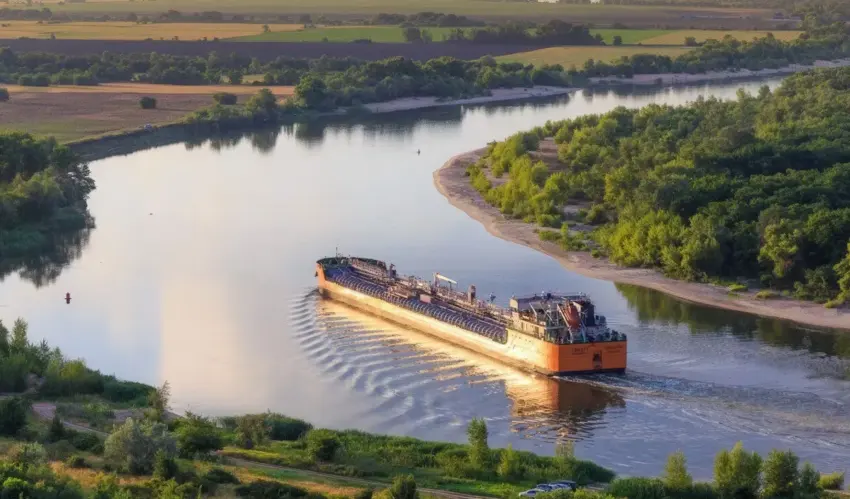
This is reported by the Romanian publication SFIN. The initiative could expand the region’s transport capabilities, in particular by creating an alternative route for freight transport and contributing to Ukraine’s reconstruction.
How the waterway between the Black Sea and the Baltic Sea will run
The project, costing several billion euros, involves turning the River Prut into a navigable waterway and creating a waterway corridor between the Black Sea and the Baltic Sea. It is set to link the Romanian county of Galați with the Polish port of Gdańsk via the territories of Romania, Moldova, Ukraine and Poland. There are also plans to connect the city of Iași to the future transport network.
The initiative, known as the ‘Blue Highway’ or the ‘Eastern Gate’, is supported by Paul Butnariu, President of the Iași Chamber of Commerce and Industry. He believes the project could become a strategic investment for Eastern Europe and hold significant geo-economic importance.
The route will run along the Prut, Dniester, San and Vistula rivers. To ensure uninterrupted connectivity between them, two artificial canals will need to be built: one approximately 30 km long between the Prut and the Dniester, and another approximately 51 km long between the Dniester and the San. The latter flows into the Vistula, which carries its waters to the Baltic Sea near Gdańsk.
Advantages of the project
According to Butnariu’s estimates, the length of the future waterway will be less than 2,000 km. The actual economic viability of the project will depend on the construction costs, the waterway’s capacity, journey times and the development of the necessary infrastructure.
However, the project’s author does not even provide a rough estimate of its cost or possible sources of funding.
One of the key stages of the initiative will be the development of approximately 500 km of the Prut riverbed for navigation. The initial plan is to develop the section between Galaț and the Stynka-Costești reservoir. According to Butnariu’s forecast, this could take seven to eight years, provided the project receives political support, funding and the necessary technical documentation. However, this timeframe is not official, as the initiative must be analysed, designed and approved before work can begin.
There are also plans to connect Iași to the waterway via the Bahlui and Jijia rivers. According to Butnariu, a canal between them has already been constructed in the past.
Barges with a load capacity of between 500 and 1,000 tonnes will be able to operate on the developed sections. The plan is to use them to transport agricultural produce and other bulk cargo, which could provide an alternative to road and rail transport. Furthermore, the project has the potential to contribute to the development of irrigation infrastructure and reduce the risk of flooding.
This project is over 100 years old
The idea of creating a waterway linking the Black Sea and the Baltic Sea has been under discussion since the 1920s. The first proposal was submitted to the Polish mission in December 1921, and by 1927 the Polish side had prepared an initial technical design. However, the initiative is attributed to the Romanian engineer Ion Popovici, who worked on it between 1922 and 1924.
In 1926, Romania and Poland held negotiations on implementing the plan. However, due to the economic crisis of 1929–1933 and the outbreak of the Second World War, the project was ultimately abandoned.
“The relaunch of the project will involve cooperation between Romania, the Republic of Moldova, Ukraine and Poland. According to Paul Butnariu, Iași could become a key hub for European transport and a base for the reconstruction of Ukraine and the integration of the Republic of Moldova,” the article notes.
This story was translated with the assistance of artificial intelligence.The translation was also reviewed by the Logos Press editorial team.
Follow our updates
Have information for the newsroom? Share it with Logos-Press



















Comments
0No comments yet. You can start the conversation.
Comments are open to readers with a Logos Press account.
Sign in to comment