
The Moldova Fruct association presented this forecast at Prognosfruit-2026, the most important forum for global apple market operators. Will Moldovan fruit growers and traders be able to turn the expected increase in the apple harvest into a competitive advantage and, as a result, into higher sales figures?
According to Yurie Fale, executive director of Moldova Fruct, not only the increase in production but also the expected improvement in apple quality points to an affirmative answer. According to the association’s representative, thanks to rainfall in the first half of the summer, a significant portion of the 2026 harvest will consist of large fruits (70 mm+ in caliber), and temperature fluctuations will contribute to their good coloration.
Association members point out the important fact that (given the reduction in the total area of apple orchards in Moldova due to the accelerated process of clearing old plantations over the past few years) the 2026 apple harvest in Moldova will be close to its potential maximum. As for fruit quality, in their opinion, many risks remain.
For example, just one week in August with daytime temperatures ranging from +37 to +39 degrees in some regions of Moldova has already had a somewhat negative impact on the situation in apple orchards—even intensive ones —those equipped with shade nets and irrigation systems. And summer is far from over; new weather anomalies are entirely possible.
For example, just a few days ago, hail fell in some apple-growing regions of Poland and Ukraine that had previously been spared from spring frosts and were counting on a good harvest. Given climate change, it is unlikely that such an event could be ruled out in Moldova.
WAPA’s forecast for the European Union is negative; for Europe as a whole, it is positive
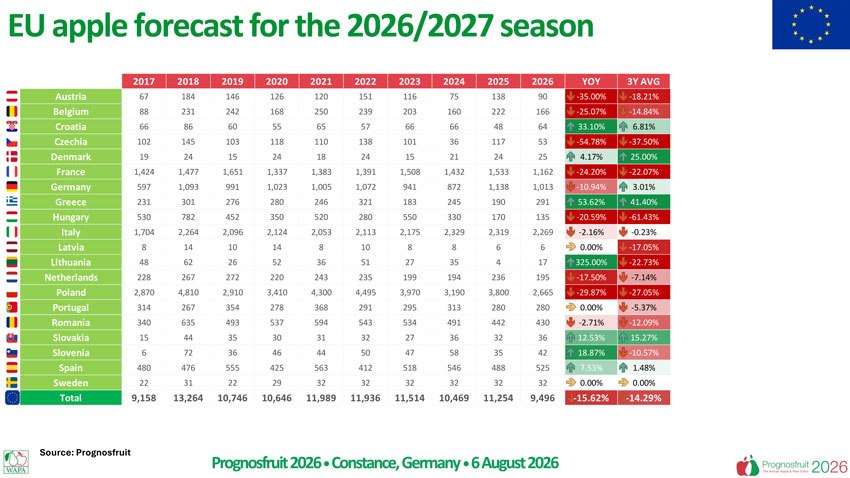
Another positive (without any political correctness) factor in the future configuration of the apple market for Moldovan fruit business operators is that, according to the forecast by the World Apple and Pear Association (WAPA), the European Union will harvest only about 9.5 million metric tons of apples in 2026. That is, approximately 15% less than last year (11.25 million metric tons). The only time the European Union produced fewer apples was back in 2017 (9.16 million metric tons).
The overall forecast for the 2026 apple harvest in the EU is being dragged down by production figures in Poland—the bloc’s leading apple-producing country. According to the WAPA forecast, Poland’s new apple harvest will total just 2.67 million metric tons—nearly 30% less than the previous year (3.8 million metric tons).
However, as one participant from Moldova at Prognosfruit-2026 noted, “Three presentations at the conference were dedicated to Poland’s apple industry, and in each case, the expert speakers offered different forecasts.” Among these, one forecast is moderately positive: this year’s Polish apple harvest is unlikely to fall below 3 million metric tons.
To support his conclusions, this Logos Press source pointed out that last year, the initially pessimistic forecast for Poland’s apple harvest was repeatedly revised upward, and as a result, the country produced slightly more of this fruit than the average for the previous ten years.
The overall projected 2026 apple harvest in the EU was influenced by a very modest production forecast for France—1.16 million metric tons (-24% compared to last year’s level). This is significant because France, along with Poland and Italy, makes up the “European triad” of countries, each of which is guaranteed to produce more than 1 million metric tons of apples.
It is also important to note that WAPA’s forecast for Italy’s apple production this year has declined only slightly—by 2.16%—to 2.27 million metric tons compared to last year.
Neighbors Expect a Good Harvest
For traders from the Republic of Moldova, it can be assumed that, aside from the “not particularly reliable” forecast for the 2026 apple harvest in Poland, the relatively stable forecast for apple production in Romania—430,000 metric tons (442,000 metric tons in 2025)—is of great importance. On the European market, the bulk of Moldovan apples is sold to Romania.
According to major operators in Moldova’s apple market, their main challenge will be that, according to WAPA estimates, two countries bordering the EU will see a fairly sharp increase in apple production this season: Ukraine (+15%, to 1.15 million metric tons) and Turkey (+104.2%, to 4.67 million metric tons).
In typical marketing years, Ukraine traditionally sells most of its apple harvest on the domestic market and in the Middle East. But this season promises to be, to put it mildly, very unusual for the country in terms of production and transportation logistics. And Turkey will certainly significantly increase its apple exports to the European Union.
As a result, the total European apple market capacity will likely exceed 10 million metric tons, meaning there will be no market shortage to “drive up” prices.