This article was prompted by two pieces published in recent days. The first is an interview with Marina Solovieva in Logos Press titled “More Than 88,000 Apartments and Houses Stand Empty in Chisinau.” The second is architect Anatoly Gordeev’s response, “Vacant Apartments or New Construction? Don’t Confuse Tactics with Strategy.”
The debate of recent days has taken the form of a clash between two “truths.” One side cites a statistic: nearly one in four apartments in Chisinau stands vacant. This means there is no supply shortage, and rising prices are not due to a lack of housing. The other side counters: construction is grinding to a halt, the industry is crumbling, and the stock of vacant apartments is finite and unreliable—so there’s no reason to panic about construction; rather, it needs to be supported.
Both sides cite real figures. Both describe the system from the perspective of the individual apartment, rather than from the perspective of the market as a whole. And that is why both miss the diagnosis that these very same figures confirm when viewed systematically.
Market Distortion
The diagnosis is simple: Moldova has a well-established construction contracting market but virtually no real estate development market.
A contractor knows how to build a building—secure a contract, go to the site, construct square meters, and sell it.
A developer must tackle a different task: not just creating a building, but a functioning area—with land, infrastructure, transportation, and social and economic functions—and with long-term responsibility for what happens to the neighborhood after the project is completed.
In Chisinau, these two functions have merged into one: a construction company calls itself a developer while remaining, in economic terms, a contractor, and everything that isn’t square meters—roads, utilities, schools, and the quality of the environment—is either dumped on the municipality or left unaddressed altogether.
It is precisely this distortion that simultaneously produces the two phenomena that are discussed as if they were separate: a record-high proportion of vacant housing and continued demand for new construction.
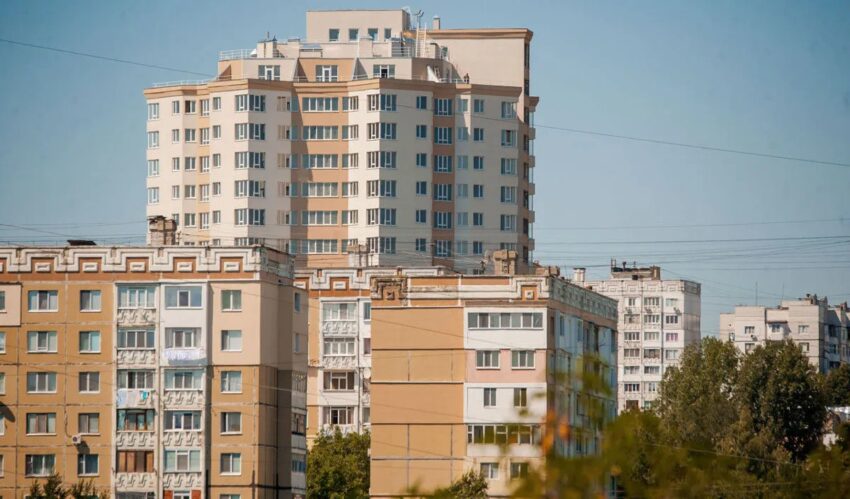
We view the figure of 88,000 not as a fact, but as a symptom. The key point here is not the proportion, but the structure: the highest concentration of vacant units is found not in the Soviet-era housing stock—with its outflow of residents—but specifically in new construction.
These data directly confirm the diagnosis of “contracting without development”; they neither refute the thesis of a housing shortage nor confirm the thesis of sufficient supply—they point to a third possibility: the market produces not housing, but units for storing capital, which only incidentally serve as living space.
The mechanism is clear and has been described quite precisely:
– banking liquidity and remittances from the diaspora drive demand, which is directed not at the territory itself, but at the square meter as an asset;
– the developer responds rationally by maximizing the density of development on a plot to which infrastructure has already been connected—because developing a new area from scratch is expensive and does not fit into the developer’s business model;
– the municipality receives permit fees and housing completion statistics without bearing responsibility for the condition of the neighborhood ten years down the line;
– The buyer receives not a home, but a surrogate for a financial instrument in a country where bank deposits fail to keep pace with inflation and the secondary market for government bonds does not function.
An empty new building in this chain is neither an anomaly nor a reserve, but a normal, expected product of the system. Just as normal a product of this system is the continuing demand for new construction: until an alternative savings instrument emerges, local and diaspora capital will continue to flow into concrete, regardless of how many thousands of apartments already stand empty.
An apartment, like a deposit, has no impact on the market
This explains why the “reserve” argument does not work as intended.
A reserve is something that can enter the market when prices or conditions change. An asset purchased as a substitute for a deposit, by definition, does not interact with the market: it is not required to generate income through rental or sale; it is only required not to lose its nominal value.
These apartments will not enter the market under any reasonable price adjustment, because the decision to purchase them was not originally based on housing needs. Formally, the argument about the reserve is correct; in practice, it is meaningless.
And for precisely this reason, the argument that we must maintain the pace of new construction at any cost to save the industry does not hold water.
The argument that halting construction leads to the collapse of supply chains, an exodus of skilled workers, and a crash in the building materials market is valid and deserves serious consideration as an industry risk.
But this is an argument for industrial policy, not housing policy. An industry that has spent twenty years learning to build investment properties by densifying existing developments will indeed collapse if construction is halted—but mechanically propping it up in its current form will not add a single meter to the city that would alleviate the shortage of decent, infrastructure-supported housing for those who live and work in Chisinau, rather than those who are merely hoarding capital.
The fallacy in this argument is the same as that of the opponent: private, industry-specific interests are passed off as urban, strategic ones.
Identifying the symptoms does not cure the disease
It thus becomes clear that both articles are not arguing over the diagnosis, but over tactics within the same distorted model, accepting its structure as a given.
One proposes to release the existing stock of capital storage units. The other proposes to continue producing new ones.
Neither option changes the fact that both represent not housing in the functional sense, but rather the result of the country’s lack of an institutional entity responsible for the territory and capital’s lack of an alternative to concrete.
The practical implication is this: any policy that operates at the level of an individual apartment—whether a tax on vacant housing, incentives for renting, subsidies for new mortgages, anti-crisis support for developers—will treat the symptom while leaving the cause untouched.
A tax on vacant housing may force some owners to sell or rent out their properties, but it will not create an alternative savings vehicle—the freed-up capital will simply be used to purchase another identical apartment.
Support for new construction will preserve contracting capacity, but, since it is not tied to the emergence of institutional development or to real—rather than speculative—housing demand, it will result in a new layer of new buildings in a few years, with the same structure of vacant housing stock within them.
A genuine discussion of Chisinau’s housing policy does not begin with the question of whether to sell off vacant properties or build new ones, but with a question that neither of these articles asks: why, in over thirty years, the country has still not developed either a real estate development institution—as the entity responsible for the territory—or a capital market capable of competing with the square meter as a means of saving.
Until these two shortcomings are addressed, the city will simultaneously build, sell, stand vacant, and become more expensive—and the statistics cited by both sides of the debate will support each side with equal conviction.
This is because both describe different projections of the same flawed system.
Dmitri Taraburca,
an expert in real estate appraisal and development
Follow our updates
Have information for the newsroom? Share it with Logos-Press