

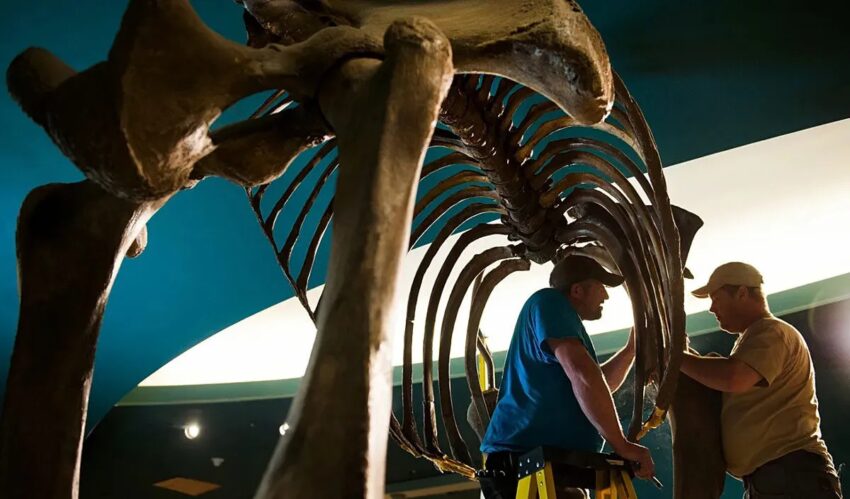
So far, researchers have discovered and identified the lower jaw, tusks, a shoulder blade, several ribs, and other bone fragments; however, a significant portion of the skeleton likely remains buried.
Museum curator Krasimir Kirov, as quoted by Euronews, stated that the animal was nearly five meters tall, weighed more than 7–8 metric tons, and may have been carried to this location by the current of the Danube, in whose riverbed the remains of prehistoric animals had accumulated over millennia.
This species existed from approximately 500,000–800,000 years ago until 7,000–10,000 years ago. Thus, the bones found date back thousands of years, and because of their prolonged exposure to water, they are being retrieved from the riverbed with the utmost care, as they are extremely vulnerable to deterioration upon contact with air.
The remains are scheduled to be exhibited at the Ruse City Museum, located approximately thirty kilometers from the discovery site.
What the Shallow Danube Reveals
The Danube, which flows through ten countries from southwestern Germany to the Black Sea, has dropped to record-low levels along most of its course, exposing rocks, sandy shoals, and ancient sunken ships that were previously almost never visible.
Shipwrecks have surfaced both in Hungary, near Mohács, and in Serbia, near the town of Prahovo, where German warships from World War II have reappeared.
However, these discoveries are not the only consequence of the low water levels on the Danube. In Hungary, the situation remains tense due to the forced shutdown of the Paks Nuclear Power Plant, precisely because the river’s water level was too low to ensure adequate cooling.
Follow our updates
Have information for the newsroom? Share it with Logos-Press


























Comments
0No comments yet. You can start the conversation.
Comments are open to readers with a Logos Press account.
Sign in to comment