


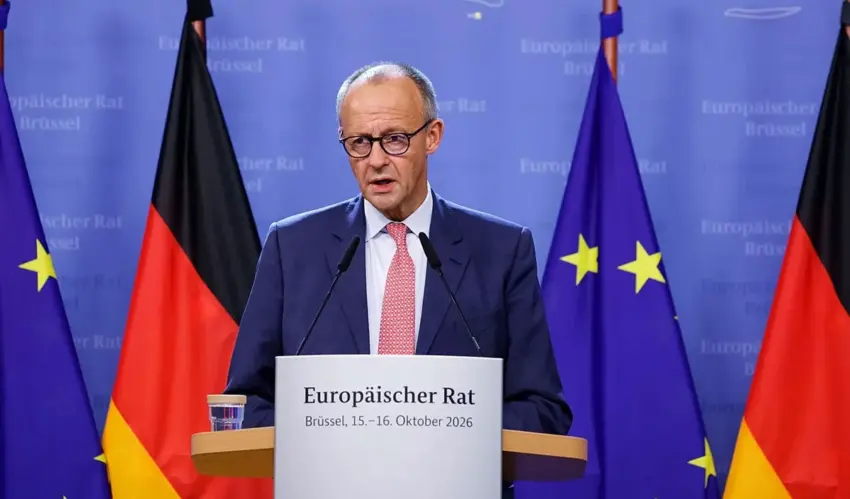
Friedrich Merz
A new source of friction and a cause for heated debate has been a demand made by German Chancellor Friedrich Merz. As reported by Logos Press, he demanded that the approval of the EU budget for 2028–2034 be made conditional on all member states contributing to the financing of Ukraine.
This initiative met with resistance from Slovakia, the Czech Republic, Hungary and Bulgaria. Slovak Prime Minister Robert Fico accused Berlin of blackmail, whilst other leaders pointed to financial constraints and risks to negotiations on the EU’s next seven-year budget.
Slovak Prime Minister Robert Fico displayed the strongest reaction. According to Reuters, he described the German Chancellor’s demand as a ‘classic case of blackmail’ and stated that Slovakia had the same right of veto as Germany.
Fico opposes military aid to Ukraine and supports maintaining contacts with Russia. Bratislava also has no intention of joining the new loan facility for Kyiv.
Czech Prime Minister Andrej Babiš, speaking alongside Fico, drew attention to the possible consequences of blocking the budget negotiations. According to him, in such a scenario, the funds earmarked for Ukraine could also be at risk.
At the same time, Babiš noted that the draft of the next EU budget already allocates around €100 billion for Ukraine. However, these funds relate to the period from 2028 onwards and do not resolve the issue of funding for Kyiv in 2027.
Linking budget negotiations to Ukraine is ill-advised
Hungarian Prime Minister Péter Magyar, following a meeting with Merz in Berlin, stated that he did not regard the German Chancellor’s actions as blackmail, but questioned the wisdom of linking the two issues.
In his view, such an approach “does not necessarily send the right signal”. Magyar also noted that Hungary cannot commit to new pan-European debt, as it is itself facing the problem of a high budget deficit.
At the same time, the Hungarian Prime Minister expressed confidence that the parties would manage to find a solution regarding the EU budget.
Bulgarian Prime Minister Rumen Radev also stated that his country was unwilling to participate in an additional financial package for Ukraine. According to Bulgarian National Radio, Radev explained Sofia’s position by citing limited financial resources and the need to reduce the budget deficit.
He emphasised, however, that Bulgaria would continue to support Ukraine in other ways, notably through electricity supplies, the restoration of energy and rail infrastructure, and aid to Ukrainian families.
Sofia is thus separating its continued support for Ukraine from its participation in the new financial assistance mechanism.
Brussels and Ireland are insisting on a joint decision
At the same time, the idea of taking Ukraine’s funding into account when agreeing the multiannual budget is finding support among a number of European representatives.
Ireland’s Finance Minister Simon Harris stated that discussing the EU budget for the coming years without resolving the issue of funding for Kyiv would be incomplete. According to him, aid to Ukraine is linked to European security.
European Commissioner for Economic Affairs Valdis Dombrovskis, for his part, emphasised that proposals to cover Ukraine’s financial deficit must receive the support of all 27 EU member states, and not just 24 or fewer. This indicates Brussels’ desire to secure broader participation from member states, despite resistance from some countries.
However, Poland has warned that linking the issues of Ukraine’s financing and the long-term budget could backfire and complicate the reaching of a final agreement.
Kyiv may face a shortfall of €70 billion in 2027
According to estimates cited in Euronews reports, Ukraine’s external financing needs in 2027 amount to around €70 billion. The European Union is considering covering approximately €45 billion of this sum, but the mechanism for raising the funds has not yet been agreed.
Merz insists that all Member States should contribute fairly to covering these costs, and that long-term financial support for Ukraine should be provided from 2028 onwards.
The dispute is complicating the preparation of the EU’s next seven-year budget. Germany is using its position as the largest net contributor to the general budget to push for a broader sharing of the financial burden. Opponents of the initiative, for their part, warn that linking these issues could lead to a deadlock in the negotiations.
This story was translated with the assistance of artificial intelligence.The translation was also reviewed by the Logos Press editorial team.
Follow our updates
Have information for the newsroom? Share it with Logos-Press
















Comments
0No comments yet. You can start the conversation.
Comments are open to readers with a Logos Press account.
Sign in to comment