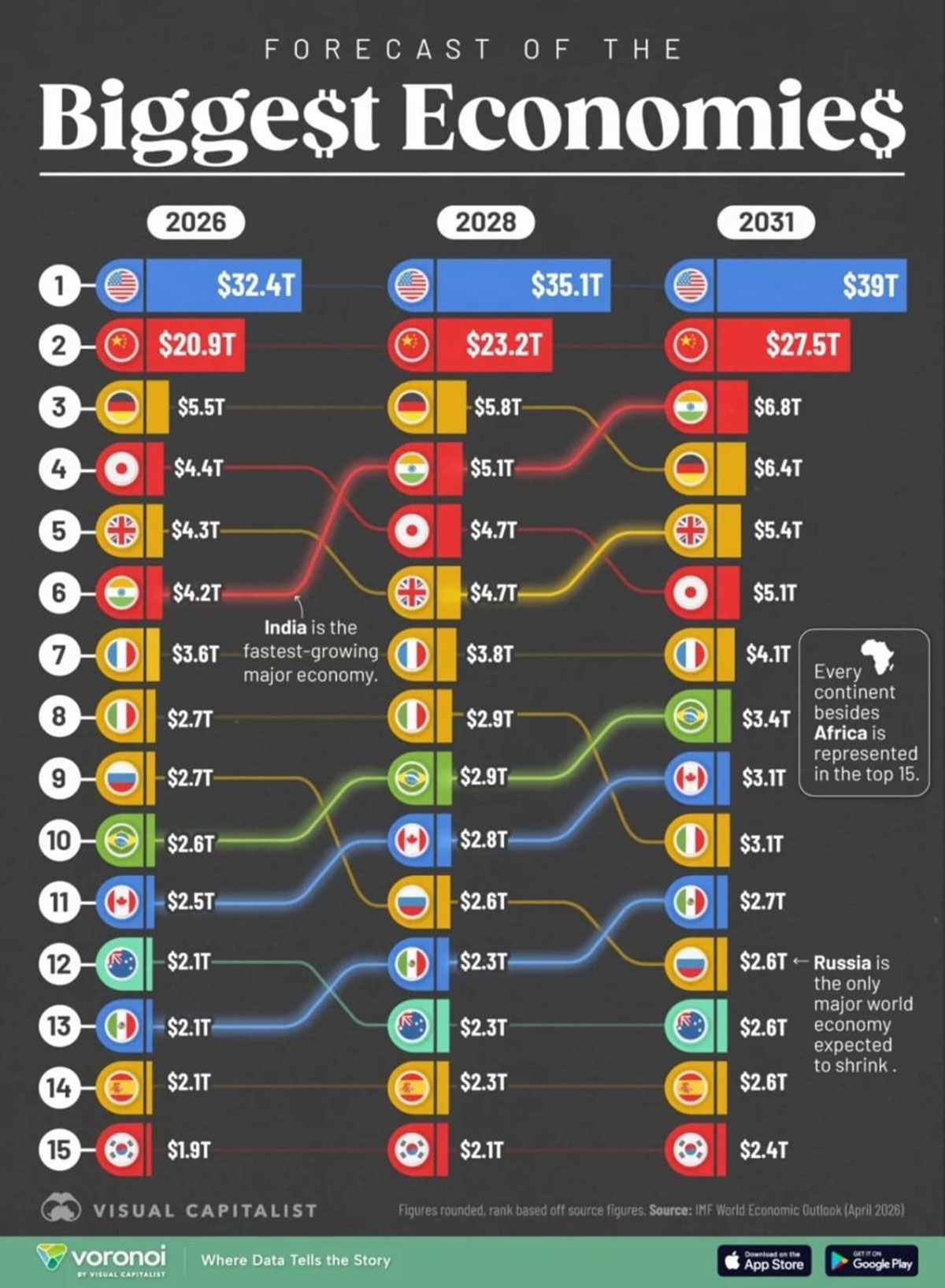

This one involves forecasting the performance of the world’s 15 largest economies in terms of nominal gross domestic product (GDP) in 2026, 2028 and 2031. The data are based on the April update report International Monetary Fund (IMF) World Economic Outlook for 2026.
While the U.S. and China are projected to maintain a huge lead over the rest of the world, emerging markets – such as India, Brazil and Mexico – will strengthen their position in the global rankings.
By 2031, the U.S. and China are expected to remain in their own “big leagues”: the size of their economies will be far larger than any other nations. Each of the two powers is expected to increase the size of its economy by about $6.6 trillion. This corresponds to growth of about 20% for the US and 32% for China.
Even with China’s projected GDP of $27.5 trillion by 2031, China’s economy will still be about $11.5 trillion smaller than the U.S. economy. At the same time, China will remain about four times larger than the world’s next largest economy.
Despite strong growth, both the U.S. and China will face serious challenges in the coming years that could stall further development.
The United States is struggling with increasing political polarization and skyrocketing public debt, with debt service costs taking up a growing share of the federal budget. China, for its part, faces a shrinking population, making its export-oriented economy vulnerable to a slowdown in long-term growth.
If the US and China maintain a strong lead, India is projected to emerge as the next superpower of the global economy. The country with the largest population on the planet is set to increase its GDP by 63.5% by 2031, making it the world’s fastest-growing major economy.
The IMF estimates that by 2028, India will overtake Japan and the UK, surpassing the $5trillion GDP mark for the first time. Then, by 2031, it is expected to overtake Germany, reaching a projected $6.8 trillion economy.