

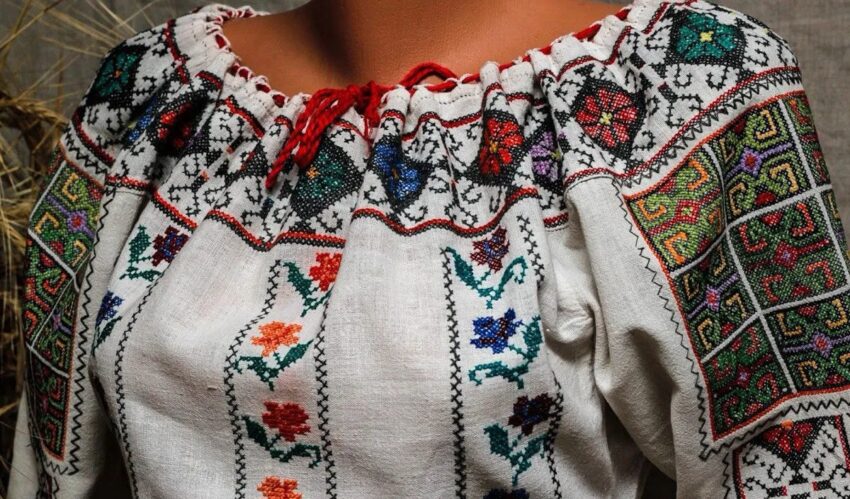
On Ie Day, which is celebrated annually at the end of June, the traditional Moldovan shirt has once again taken center stage. However, behind the beautiful patterns and discussions about preserving the heritage of folk costumes lies a very real economy. Some items are handmade and cost thousands of lei, while others are produced in a matter of days using machines. An entire market has emerged between these two approaches.
Handmade vs. Machine-Made: What Determines the Price
In Moldova, the national clothing segment has long since expanded beyond the classic ie. Several trends coexist within it: traditional handmade shirts, ateliers specializing in a combination of hand and machine embroidery, and designer collections inspired by folk heritage.
Handmade items remain the most expensive. The cost of such items can reach several thousand lei.
According to representatives of Casa Cristea, the main factor affecting price is the time required to make the item. While a complex shirt with machine embroidery can be made in two days, creating a hand-embroidered one takes anywhere from one month to one year. As a result, the cost of a hand-embroidered item is four to five times higher than that of its machine-embroidered counterpart.
The situation is similar in the designer segment. Oxana Kasandruță, the founder of the Kasandruță brand, explains that all of her brand’s items are one-of-a-kind and require a significant amount of handwork. The brand works with vintage lace, which is restored and incorporated into contemporary collections.
“If you work on the lace every day, creating a piece can take up to two months—depending on the complexity of the design. But sometimes the work takes just a few days. The most labor-intensive stages are crocheting or restoring antique lace. We rescue lace that has been discarded and is no longer used. These are our roots, which we must preserve and pass on,” notes the designer.
According to Oxana Kasandruță, customers often focus only on the final price of an item, without realizing the amount of labor that went into it.
“Those who appreciate art, tradition, and their roots understand very well what they’re paying for. Consumers need to be educated and made to understand how much labor goes into a single item or another piece of national costume,” she believes.
The family-run Mirabela store operates in a more affordable price range. Here, prices for handmade women’s blouses start at 850 lei, men’s shirts at 950 lei, and children’s items at 600 lei. The price depends on the complexity of the design: a blouse with dense embroidery can cost up to 2,500 lei. Mirabela’s main customers are artists, dancers, and participants in national competitions.
Different Scales—Different Business Models
Casa Cristea remains the country’s largest producer of traditional clothing, having operated in the market for over 30 years. The company combines an industrial approach with the use of manual labor. According to the atelier, about 15 employees work full-time in the workshop today, while another 25–35 craftswomen fulfill orders from home on a contract basis.
Each year, it produces about 5,000 items for artists, orchestras, educational institutions, and local government agencies.
“When it comes to the hand-embroidered items featured on our website—which we promote the most—we produce about 500 pieces a year. Machine embroidery accounts for about 4,000 items, and this includes not only embroidered items but all elements of the traditional costume,” says Galina, the administrator of Casa Cristea.
Smaller brands operate differently. Kasandruța focuses on exclusivity and operates with a team of seven people. Mirabela employs six people: three tailors, an embroidery specialist, and two salespeople. The company also sources some of its products from abroad—machine production allows them to offer more affordable prices.
The main customer is the Moldovan diaspora
Logos Press’s interviewees agree that interest in traditional clothing has remained steady in recent years.
The summer months are traditionally the busiest season for manufacturers. The increase in sales is linked both to World Day and to the wedding season, christenings, festivals, and other cultural events. The Moldovan diaspora remains the main source of demand.
“We see a rise in sales during periods when the diaspora returns home. This usually happens during the Christmas holidays, at Easter, as well as in the summer and in September, when many come to Moldova for vacation,” noted Galina, administrator of Casa Cristea.
In the domestic market, the main customers remain urban residents over the age of 30. It is this demographic that has sufficient purchasing power to buy designer items and high-quality handmade goods.
Demand is driven not only by commercial producers. In recent years, educational initiatives aimed at popularizing traditional embroidery techniques have been actively developing in Moldova. One of the largest such projects is MăiestrIA, which brings together 31,000 participants on a popular social network. The project offers courses on making ie and other elements of traditional costumes.
Embroidery is fading along with its masters
Despite steady demand, most market participants cite a shortage of skilled workers—not a lack of buyers—as the main constraint.
According to producers, the number of specialists skilled in traditional embroidery techniques is gradually declining. Many craftswomen are of retirement age, and young people rarely consider this craft as a primary profession.
At Casa Cristea, they explain that among their craftswomen are women over 70 who continue to work from home.
“Of course, their productivity is lower now; they don’t work as quickly as they used to. But they are very skilled and responsible people,” the company notes.
Today, the Casa Cristea team consists of roughly equal numbers of young and experienced craftswomen. However, many young employees view embroidery more as a source of supplemental income, combining it with other work.
To maintain production and increase output, the company is increasingly turning to technology. Casa Cristea uses modern German equipment that allows them to reproduce traditional patterns based on hand-drawn sketches.
“We’re doing this partly because we’re concerned that young people will lose interest in the craft. It takes a great deal of time to create these designs, and the pay is incomparable to what one can earn in IT, the banking sector, or other modern professions,” says Galina.
Nevertheless, the market for Moldovan national clothing is growing. It is supported by cultural initiatives and a growing interest in national identity. At the same time, technology is not a replacement for tradition, but rather a way to preserve it as the number of artisans declines.
It is worth noting that in 2022, the art of making a shirt with a lace collar—“cămașa cu altiță”—was included on UNESCO’s list of intangible cultural heritage.
Follow our updates
Have information for the newsroom? Share it with Logos-Press
















Comments
0No comments yet. You can start the conversation.
Comments are open to readers with a Logos Press account.
Sign in to comment