

The festival took place in late July and brought together designers, students, specialized universities, and industry representatives. The program included fashion shows, graduation projects by young designers, presentations, and special events. A distinctive feature of Feeric Fashion Week was the format of the fashion shows: instead of a traditional runway, the organizers used urban spaces, transforming the architecture and surroundings into part of the visual concept.
Moldova was represented at the festival by a collective project from the TUM Design Department, which brought together the works of 11 graduates—Valeria Cuchuc, Vitalia Bita, Lyubov Krasovskaya, Alena Trikolici, Juliana Mokan, Laura Lavrik, Daria Katser, Aykhan Betul, Valeria Litovka, Victoria Certan, and Laura Balan. Six of the designers personally took part in the presentation of the collection.
According to Alena Tricolici, a graduate of the faculty, preparation for the project began while the students were still in school. Faculty members selected student works that could represent the faculty on an international stage. Each designer proposed several looks, after which the final composition of the collection was agreed upon with the festival organizers.
The main challenge was to combine different graduation projects into a single artistic statement. Each designer had their own theme, style, and approach to their work; however, at the international show, the collection had to be perceived as a cohesive project.
“The most difficult part was combining pieces from completely different collections and finding a common thread between them,” notes Alena.
This challenge was addressed by the “Transformation in Motion” concept. It allowed for a seamless transition from classic silhouettes to more experimental forms, showcasing the development of the young designers’ ideas as a unified process.
Preparations for the event took place within a tight timeframe. The team had to finalize the collection, select accessories and footwear, check the technical condition of the garments, and prepare them for transport. The university provided organizational and technical support, and the faculty helped structure the fashion show.
The overall collection included two looks by Alena Tricolici from her graduation project, “Genesis”, which had previously been presented at Students Fashion Day. The project was based on the contrast between a woman’s softness and inner strength: fluid shapes and a warm color palette were combined with stiffer constructions and geometric volumes.
In her work, the designer used natural motifs as a source of inspiration for exploring textures and shapes, rather than as a direct reproduction of elements of nature. To create three-dimensional surfaces, the fabric was stitched multiple times, and voluminous elements were achieved through draping and structural techniques. One of the most technically challenging elements was a cape featuring geometric triangular details. To maintain the structure’s shape and ensure the necessary rigidity, the designer developed her own method for joining the outer fabric to the felt.
The festival’s international format provided a unique professional experience for the participants. Unlike traditional fashion shows, Feeric Fashion Week utilizes unconventional spaces, where the venue itself becomes part of the collection’s presentation. According to Alena, it is precisely the international environment, the diversity of participants, and a different approach to fashion shows that have become one of the festival’s main distinguishing features.
For Moldova, the participation of young designers in international projects is significant not only in terms of the career development of individual professionals. Such initiatives raise the profile of the national design school and create opportunities for collaboration between educational institutions, international partners, and the industry.
It is particularly important that Feeric Fashion Week featured not an individual designer but a collective project by the faculty. This format allows for the promotion abroad not only of graduates’ work but also of the training system itself.
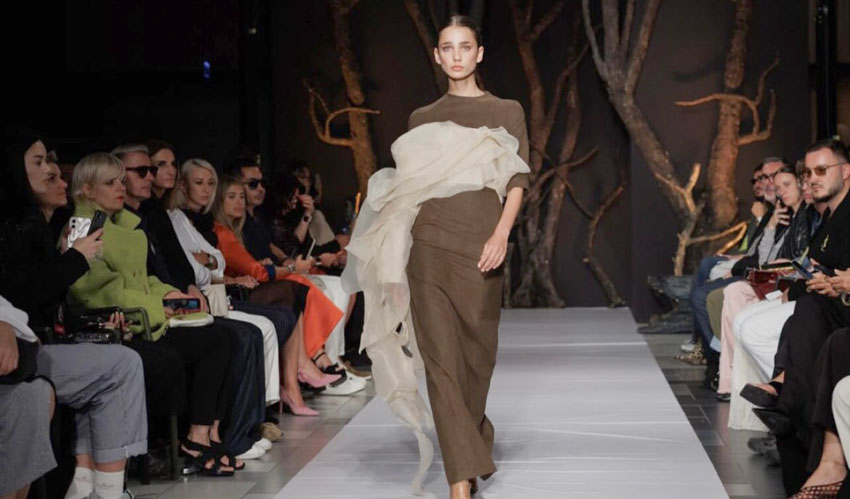
Aliona Tricolici


