

Donald Trump
Trump’s Republicans have not merely ceased to be defenders of capitalism and free enterprise; they no longer support either.
American-style capitalism is characterized by strictly private ownership of firms. In the Chinese and Russian models of capitalism, the state can own clearly mediocre companies through corrupt schemes that benefit political leaders and their “friends.” This system has little in common with the economy taught in introductory economics courses.
But now America has embarked on the same path as Russia and China.
I have long argued that there is ample room in the U.S. economy for government intervention in the form of industrial policy, and that regulation is needed in many areas to reconcile private interests with the public good. But I have always insisted that such intervention must be institutionalized, and its procedures must be impartial and transparent, to rule out even a hint of political favoritism.
The Republican Party, by contrast, tacitly endorses Trump’s “gangster capitalism,” even though this model has nothing in common with the rules-based market economy that conservatives once championed.
It is therefore not surprising (but extremely alarming) that, according to press reports, the Trump administration is engaged in discussions that could lead to artificial intelligence (AI) development companies—including Anthropic and OpenAI—“voluntarily” ceding “shares to the state.” In much the same way, Putin “voluntarily” receives support from Russian oligarchs.
From Russia and China to Saudi Arabia (where, in 2017–2018, wealthy members of the elite were locked up for three months at the Ritz-Carlton hotel in Riyadh until they handed over a sufficient share of their assets), businesspeople are learning not to challenge the authorities. Examples include the stories of Alibaba founder Jack Ma and former Russian oligarchs Mikhail Khodorkovsky and Boris Berezovsky.
Trump’s “Discussions” Border on Extortion
Trump may not go to the same extremes as Putin or Xi Jinping, but his basic approach is the same. His administration’s relationship with Anthropic resembles the Chinese authorities’ treatment of Ma when he dared to criticize the regulator.
After suddenly imposing an export ban on Anthropic’s most advanced tools in early June, the Trump administration began new “discussions,” presumably to secure additional concessions from this AI lab, which is demonstrating the fastest growth rate in the country.
Last August, the administration had already taken decisive steps in the same direction, demanding that Nvidia and AMD hand over 15% of their revenue from sales in China to the U.S. government in exchange for lifting the export bans. In this case, Trump openly traded national security (which supposedly justified the bans) for several billion dollars in revenue through extortion.
Less than two weeks later, Intel “voluntarily” handed over a 10% stake to the government in exchange for financial support that it was already entitled to receive under the “Chips and Science Act,” passed in 2022.
Meanwhile, in response to growing public demands for some form of AI regulation, Trump recently signed an executive order calling on AI developers to subject themselves to limited regulation. The text of this document reflects the clear influence of tech oligarchs such as Mark Zuckerberg and Elon Musk.
For example, it explicitly states that “nothing in this section shall be construed as authorizing the imposition of mandatory government licensing, require prior approval, or impose conditions for granting permits for the development, publication, release, or distribution of new AI models, including advanced models.”
Administration officials claim that these steps toward state capitalism will help ensure that everyone benefits from AI.
If that were truly the goal, they would support the corporate income tax, which exists to collectivize the benefits of economic activity, as it recognizes the fact that corporations themselves benefit from public goods.
Instead, the current administration is cutting corporate taxes. In the 1970s, the corporate income tax generated revenue equal to 2.6% of GDP, whereas today it generates only half that amount, even though the share of corporate profits in GDP has nearly doubled.
The U.S. Is Heading Toward Oligarchy
In any case, anyone who thinks that Trump and his “friends” are acting out of concern for the average American is so gullible that I could sell them the Brooklyn Bridge.
We are facing the most corrupt administration in U.S. history—and by several orders of magnitude. This government does nothing openly, without deception. Every stake it takes in the private sector is tied to favoritism or personal investments by high-ranking officials. The economic distortions resulting from this will only intensify.
The Republican Party’s choice of this type of capitalism will have serious consequences.
First (and most importantly), it weakens democracy, bringing us closer to an oligarchy where policy is dictated by an elite close to power.
Second, it undermines America’s prosperity. One of the key lessons of modern economics and economic history is that achieving sustainable growth in living standards requires strong institutions, including the rule of law.
Trump’s gangsterism is the exact opposite of the institutional foundation upon which the U.S. economy was built. The winners in this new oligarchic competition are not those who produce the best products or are the most innovative (in the field of AI, that title currently seems to belong to Anthropic).
No, the winners are those with the fewest principles and who are best at flattering the mad king. Is anyone surprised that Sam Altman, CEO of OpenAI (Anthropic’s lagging competitor), was the first to propose the idea of government stakes to the Trump administration?
The government has legitimate reasons to support new industries and regulate those where private-sector profits may not align with the public interest (which is precisely the case with AI). But such market interventions must be grounded in the rule of law and subject to oversight by independent institutions, rather than taking the form of opaque, ad-hoc deals driven by self-interest.
With Trump at the helm, America is doomed to join the ranks of countries suffering from “crony capitalism” rather than those demonstrating what a successful industrial strategy looks like.
The U.S. economy, democracy, and national security are being sacrificed to satisfy the bottomless greed of Trump and his sycophants.
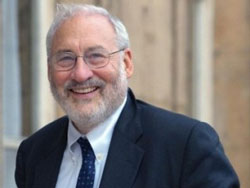
Joseph Stiglitz
Joseph Stiglitz—Nobel laureate in economics, former chief economist of the World Bank, former chair of the U.S. President’s Council of Economic Advisers, currently a professor at Columbia University, and author of *The Path to Freedom: Economics and a Good Society” (published by W. W. Norton & Company and Allen Lane, 2024).
© Project Syndicate, 2026.
www.project-syndicate.org


