That is precisely why I presented the concept of “compassionate AI” to more than 12,000 delegates from 170 countries who attended the “AI for Good” Global Summit in Geneva earlier this month (Logos Press reported on the summit’s outcomes).
If we truly want AI to contribute to the common good—and not just to profit and power—we must take AI engineers and developers out of their labs for a month. Let them meet children working in mines and factories, families forced to flee their homes due to conflict, and vulnerable communities suffering from poverty, discrimination, and social isolation. Let them walk side by side with people whose lives are defined far more by uncertainty, fear, and injustice than by any technological achievements.
Even a single month can change a person’s way of thinking, and this will influence how developers create this technology and shape the future.
AI is already transforming education, healthcare, business, government, and scientific discovery. It promises remarkable achievements: from accelerating medical research and improving the quality of education to exposing human trafficking networks, predicting famine before it strikes, and strengthening humanitarian efforts.
But every technological revolution presents us with a moral challenge, and AI is no exception. As this technology has become the front line of fierce global competition for economic and geopolitical power, speed is rewarded, scale is glorified, and market dominance is valued above all else.
The Foundation of Responsible Innovation
In such an environment, we risk losing sight of the most important question: whom, ultimately, should this intelligence serve? The biggest challenge facing AI today lies not in technical aspects, but in leadership.
Of course, much of the discussion at global forums is already focused on concepts such as “ethical AI” and “responsible AI,” and they are indeed indispensable. We need stricter governance, genuine accountability, and effective regulation.
But such safeguards are not enough. Ethics can guide us toward what is right, and laws can set boundaries; however, neither one nor the other, on its own, will change the worldview of those who conceive and develop technologies that will affect the lives of billions of people. This requires something deeper: compassion.
Compassion is often confused with empathy, kindness, or charity. But it is not synonymous with any of these concepts, nor is it merely an emotion or an abstract moral ideal. Compassion begins with recognizing another’s suffering as our own, which compels us to take action to alleviate that suffering. It involves the courage to act before further harm is done. It leads us not merely to optimize systems, but also to protect human dignity.
Compassion is by no means an obstacle to technological progress; rather, it is the foundation of responsible innovation. AI based on compassion differs from all other approaches in that it stems not from technology, but from humanity.
Before asking what a system is capable of, compassion-based AI asks: whom does this system serve? Before striving for greater efficiency, it considers the consequences for people. Before celebrating innovation, it asks: Who might be left behind?
This single shift changes everything. Many of today’s AI failures—bias, discrimination, isolation, misinformation, environmental damage, and threats to children’s well-being—are often described as unfortunate side effects of progress.
But these are not merely side effects. They are proof that, in the development of these systems, someone was left out, overlooked, or ignored.
Human rights must be the cornerstone of AI design
Technology is not neutral, nor are algorithms. Every system embodies the assumptions, priorities, and values of the people who created it. Since AI has been trained on the knowledge accumulated by humanity, it has absorbed the prejudices, inequalities, and historical injustices accumulated by humanity.
Human rights cannot simply be a coat of paint applied after construction is complete. They must be the supporting pillars of the entire structure. We are confident that a bridge was safe before anyone crossed it because safety is critical to its purpose.
Clearly, the same standards must apply to AI. Compassion cannot be added retroactively after implementation. It must be at the core of the system’s design.
Changing the trajectory of this technology’s development is an urgent task. Children growing up today may spend more time interacting with intelligent machines than with their parents, teachers, or neighbors. We already understand some of the negative psychological consequences of social media, which operates on the basis of relatively simple forms of AI. The impact of far more capable systems on children’s emotional development, relationships, imagination, and mental well-being remains largely unknown, but it could prove to be profound.
Instead of focusing primarily on how AI can transform the economy, we should ask ourselves: What will happen if algorithms replace the unique human ability to empathize with another’s pain? Will they be able to uphold justice if they were never designed to recognize suffering? Will they be able to foster peace if their sole purpose is to optimize engagement, efficiency, and profit?
These moral questions must take precedence over technical ones, for they are what will determine the future of humanity.
Undoubtedly, AI has the potential to become one of humanity’s greatest allies. It can help eradicate modern slavery and human trafficking, identify cases of child sexual abuse, expand access to high-quality education in every child’s native language, improve healthcare in underserved communities, predict humanitarian crises, and accelerate progress toward the Sustainable Development Goals.
But AI will not choose this future. We will. The principles we establish today will form the foundation for the increasingly powerful systems we are building. Once this foundation is established in the form of standards, institutions, and business models, it will shape humanity’s relationship with intelligent machines for generations to come.
We cannot afford to wait until the damage is irreversible. Legislation has often been enacted only after suffering has already become a reality; but in the case of AI, we can no longer afford to take a wait-and-see approach.
The age of intelligence demands wisdom. History will not judge us by how intelligent our machines have become. It will judge us by whether we had the foresight and courage to ensure that this intelligence remains in the service of humanity.
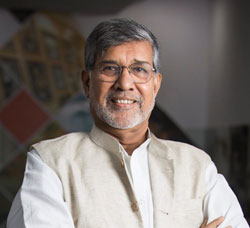
Kailash Satyarthi,
Nobel Peace Prize laureate, is the founder of“Laureates and Leaders for Children.”
© Project Syndicate, 2026.
www.project-syndicate.org
Follow our updates