
According to the Ministry of Labor and Social Protection, the increase is part of a reform aimed at strengthening the social services system and making the profession more attractive.
The size of the increase will depend on the employee’s category and will range from 12.4% to 28.7%.
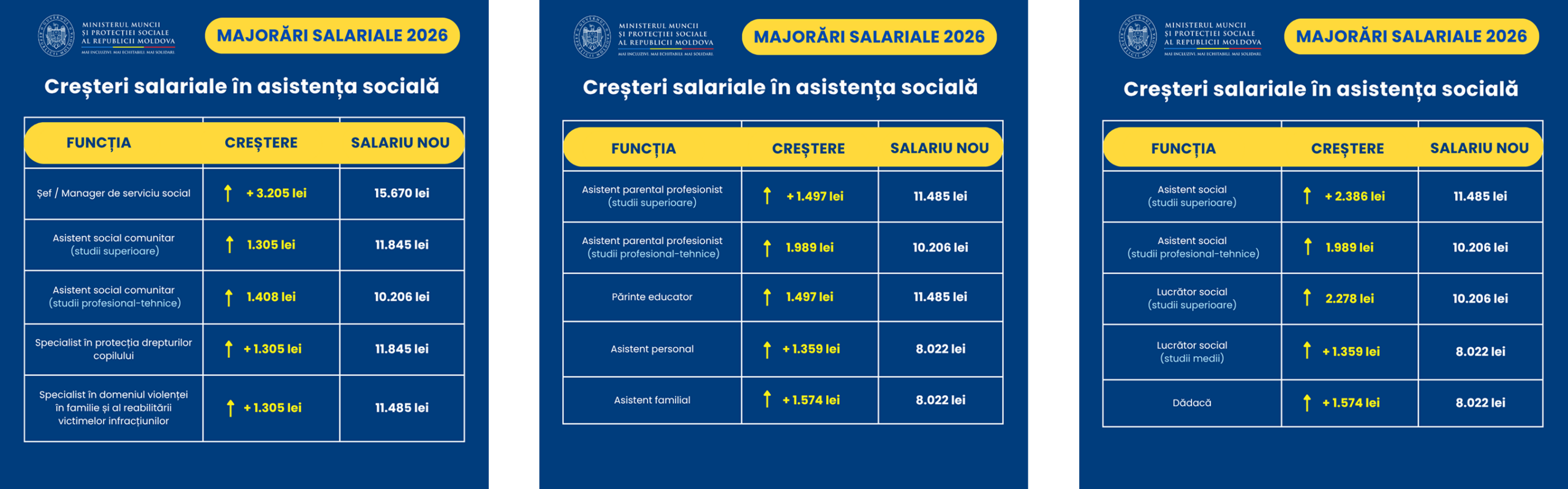
The largest increase is intended for employees who previously had lower pay levels. For example, the salary of a social worker with a college degree will increase by 2,278 lei—from 7,928 to 10,206 lei, which corresponds to a 28.7% increase.
Social service managers will receive a raise of 3,205 lei—from 12,465 to 15,670 lei (+25.7%).
The salary of a social assistant with a college degree will increase by 1,305 lei—from 10,540 to 11,845 lei (+12.4%). Child protection specialists will also receive 1,305 lei more—11,845 lei instead of 10,540 lei.
Personal assistants will receive 1,359 lei more—their salary will rise from 6,663 to 8,022 lei (+20.4%). Professional foster parents with vocational education will receive 1,989 lei more—10,206 lei instead of 8,217 lei (+24%).
Additional Payments and New Qualification Levels
In addition to the increase in base pay, social workers will be eligible for a performance-based bonus. The bonus will range from 6% to 15%, depending on performance metrics achieved.
For example, a social worker with a college degree could earn up to 13,622 lei per month with the maximum bonus.
At the same time, the salary calculation system itself is changing. According to the new formula, the base amount used to determine wages will be increased from 2,400–2,500 lei to 4,200 lei.
The Ministry of Labor and Social Protection also announced that starting in 2028, professional qualification levels are planned to be introduced in the social sector. These levels are intended to take into account employees’ experience, professional development, and the quality of their work. Each level will be accompanied by a monthly bonus ranging from 750 to 2,000 lei.
The Ministry of Labor and Social Protection links the reform to the need to strengthen the human resources capacity of the social welfare system.
“These professionals work daily with children in difficult situations, the elderly, people with disabilities, and vulnerable families,” said Minister of Labor and Social Protection Natalia Plugaru.
According to her, raising salaries and introducing qualification levels should make the profession more attractive and contribute to the further development of the social services system.
For the government, the reform means increased spending on social infrastructure, but it is also aimed at addressing the challenge of retaining professionals in a sector where the quality of services depends directly on the qualifications and stability of the workforce.