


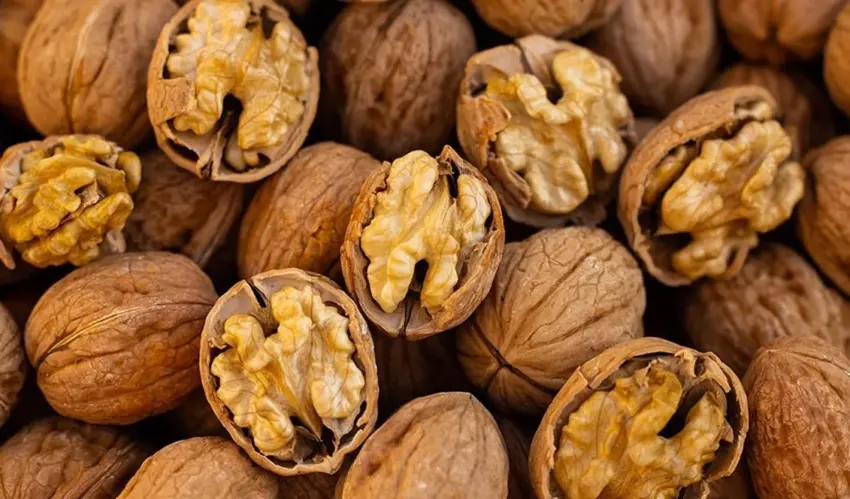
As ANRM Director Oleg Tîrsînă noted to Logos Press, the best-quality nuts came from those farmers who managed to harvest early and mid-season walnut varieties before the first wave of rainfall in mid-October.
According to the association’s director, Moldovan walnut growers traditionally begin the mass harvest from the end of the first ten days of October – at the moment when the green husk (pericarp) of the walnuts in the orchards begins to crack. Until now, this has been a sign that the nuts have reached the stage of biological ripeness, at which the husk separates easily from the nut, the kernel is well-formed and completely fills the shell.
The problem is that, against the backdrop of climate change, for several years now a more or less prolonged period of rain has been setting in across Moldova in mid-October. This rainfall makes harvesting the nuts difficult and, most importantly, impairs their quality – the kernels darken. This year, this undesirable process has occurred once again – walnut kernels, particularly those gathered from the ground, have taken on a darker, golden hue. Overall, the produce still looks presentable in this instance. However, this represents a deviation from the most desirable standard on the global market: the lighter the kernel, the better.
In this regard, Oleg Tîrsînă believes that, given the climate trend, it would probably make sense for Moldovan walnut growers to consider bringing the harvest forward to an earlier date. Of course, until they reach optimal ripeness, walnuts are more difficult to shake from the trees, even with mechanised harvesting. However, leaving 5–10 per cent of the nuts on the trees, or harvesting in two stages, is preferable (from a pricing perspective) to a decline in product quality.
Prices and sales channels
According to EastFruit’s price monitoring data, this year wholesale prices for walnuts in shell on the Moldovan market have stabilised at around 50 lei/kg, whereas in previous years of this decade the price for this commodity ranged between 27 and 35 lei/kg. Walnut kernels have also risen significantly in price during the current marketing season – to 140 lei/kg, albeit to a lesser extent (during the same period last year, the price was 130 lei/kg; the lowest price recorded in November this decade was 70 lei/kg, in 2022).
However, as Oleg Tîrsînă points out, the price levels mentioned are primarily for the domestic market. For exports, the price of ‘extra-premium’ grade walnuts in shell can reach 60–70 lei/kg – depending on the size of the consignment, the destination and the nature of the relationship between the seller and the buyer. The wholesale price for the finest walnut kernels (light-coloured halves – ‘butterflies’) reaches 180–200 lei per kilogram. However, in both cases, this often involves the supply of small consignments directly to the end buyer – a European trader or retailer – bypassing the chain of intermediaries.
As noted by the ANRM administrator, an interesting situation has now developed on the Moldovan market – a significant proportion of the produce is sold to foreign buyers who have themselves entered the Moldovan market in search of suppliers. At the same time, the vast majority of these buyers sell Moldovan walnuts in fairly distant markets – France, Germany, Italy, Switzerland, the Western Balkans and Turkey.
Meanwhile, neighbouring markets – Romania and Central Europe – have, in a sense, fallen out of the Moldovan walnut growers’ field of vision. Meanwhile, these markets, like other European ones, have been actively developed in recent years by walnut suppliers from China. In terms of quality, these products are still slightly inferior to European and American walnuts, but they are already only marginally cheaper.
According to Oleg Tîrsînă, in the near future, an important part of the next stage in the evolution of Moldova’s walnut industry is likely to be the independent search by its operators for new export channels for their produce. It is not out of the question that these might be neighbouring markets which have not yet been fully explored.
Follow our updates
Have information for the newsroom? Share it with Logos-Press

























Comments
0No comments yet. You can start the conversation.
Comments are open to readers with a Logos Press account.
Sign in to comment