


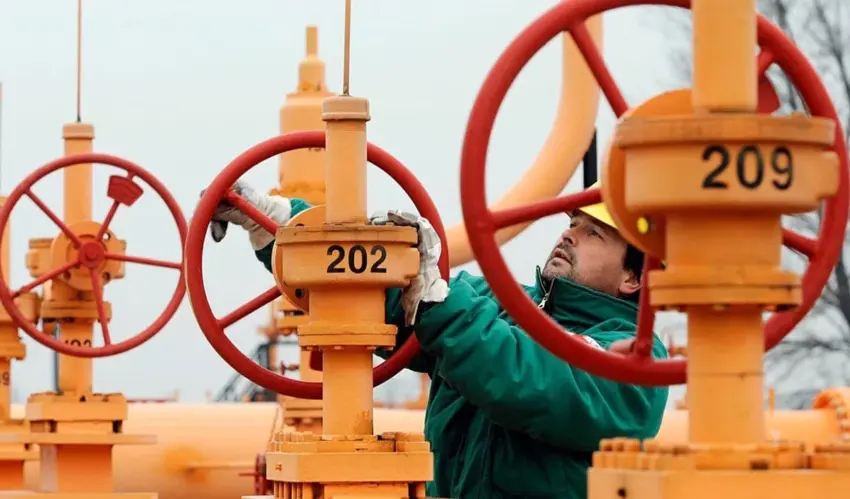
Photo: AP Photo / Bela Szandelszky
According to Gas Infrastructure Europe, there were around 76.6 billion cubic metres of gas in the EU’s underground storage facilities. This is 13.5 billion cubic metres less than a year ago, when storage facilities were 81.6 per cent full.
The current stock level is 18 percentage points below the five-year average for this date. According to Investing.com, since the start of the heating season, European countries have withdrawn 5.6 billion cubic metres of gas from storage facilities over three weeks. This is 1.8 times more than the average volume for the same periods over the last five years. Consequently, during the first weeks of the heating season, Europe has consumed around 11 per cent of the gas injected during the summer.
At the same time, storage facilities were filled to a maximum of 74.96 per cent in the autumn. Europe failed to reach the 90 per cent target set by the European Commission by the start of December. This year, Brussels had allowed for a reduction in the target to 80 per cent, but even this level proved unattainable.
The situation is particularly challenging in Germany. As at 1 November, its storage facilities were 61 per cent full, against a target of around 70 per cent. The Association of German Gas Storage Operators (INES) has warned that the country could face supply problems in the event of very low temperatures.
“In the event of extremely low temperatures, supplies cannot be guaranteed,” the association stated. According to its estimates, if the winter turns out to be as cold as in 2010, the monthly gas shortfall in Germany could amount to 6.6 TWh.
Liquefied natural gas (LNG) prices remain an additional risk factor. In November, the Asian JKM spot index has remained above $31 per million British thermal units — 180 per cent higher than last year’s level. In October, prices on the European TTF gas hub rose to 90 euros per MWh.
The situation is further complicated by the forthcoming ban on imports of Russian LNG into the European Union, which will come into force on 1 January. Between January and September, Russia remained the second-largest supplier of liquefied natural gas to the EU after the US. Russian supplies accounted for 17.3 per cent of LNG imports by value — €6.7 billion — according to Eurostat data.
Meanwhile, the global natural gas market continues to show moderately positive trends, reports Investing.com. According to WarrenAI 2.0, on 19 November, US gas futures were trading at $3.374 per million British thermal units. The price has once again approached the resistance level of $3.38–3.44, but has not yet managed to break above it.
Follow our updates
Have information for the newsroom? Share it with Logos-Press






















Comments
0No comments yet. You can start the conversation.
Comments are open to readers with a Logos Press account.
Sign in to comment